Neither Fated Nor Guaranteed | Stowe Boyd
body
Thomas Zimmer | The Wheels Are Coming Off | First, The Bankers?

Photo by fandilla dp on Unsplash — Can the last to leave turn off the lights?
There is nothing inevitable about either doom or progress. We are neither fated nor guaranteed to experience the status quo for all eternity.
| Thomas Zimmer, [No Right Is Ever Safe - but Progress Is Possible](2026-04-08 No Right Is Ever Safe – but Progress Is Possible - Thomas Zimmer)
…
Zimmer is on to something here. We have no guarantee that the future will be a continuation of the past, that the road we find ourselves walking will be gently graded and smoothly paved.
However, the world conspires to tell us different. We assume thirty-year mortgages — and the financial system is geared to them — under the premise we will be able to pay the note each month. The tax systems our governments impose, and through which they enable the highways to be fixed, school children to be educated, and public health to be ensured. These wheels all turn because people have jobs, are paid for their labor, and pay their taxes.
I’d really like readers to sign up for a paid annual subscription, so for the rest of April, I have dropped the annual subscription to $30. Note that I’ve also raised the monthly subscription to $10 per month from $6 per month. Give annual a try. The biggest value is years of posts behind the paywall, and of course, seeing new posts in their entirety.
The Wheels Are Coming Off
Late last month, Rishad Tobaccowala posted Jobs are a phase work is going through, an attempt to make the collapse of stable jobs across the economy seem like a reasonable response to technological and sociological trends.
He starts with a chart, The Evolution Of Work, which lacks agency.
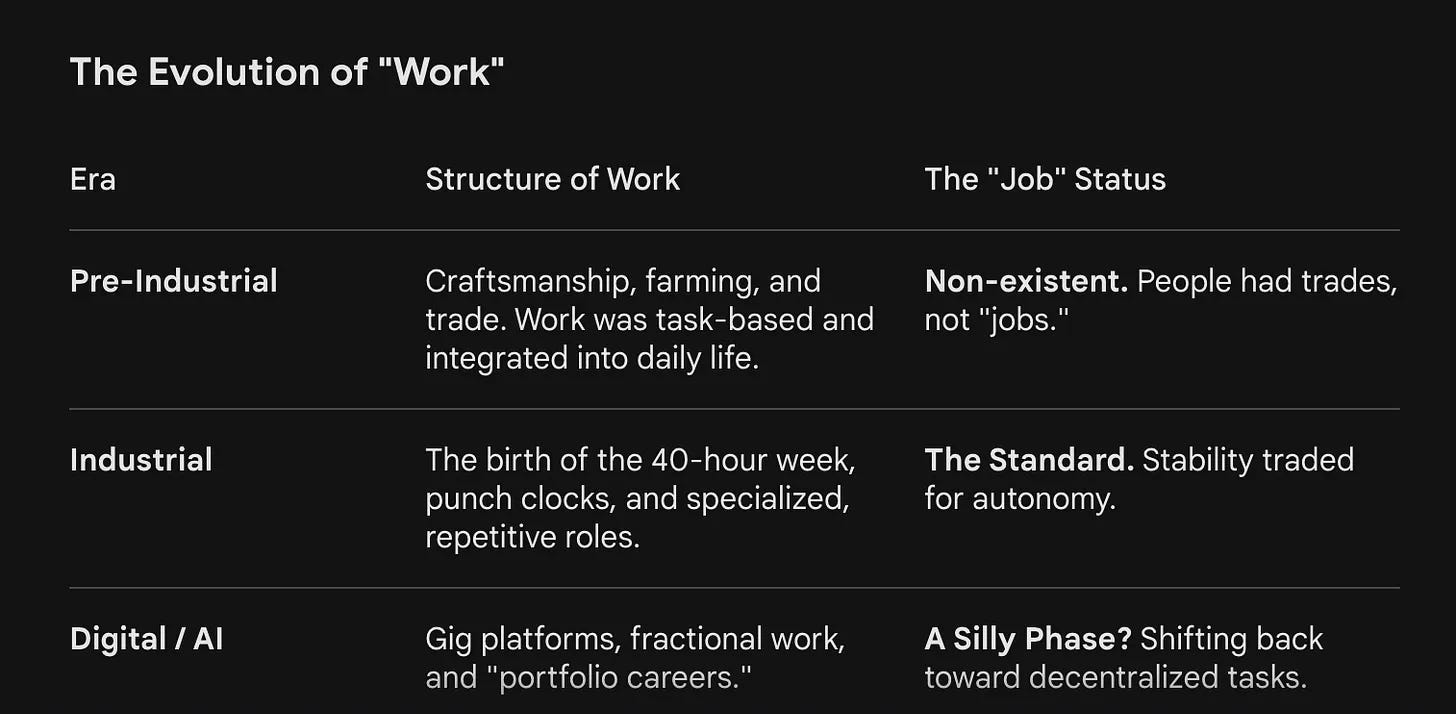
I’ll touch on what I think is missing in this chart, including the drivers of the transitions he lays out. Most especially, who benefits from these transitions, and who is harmed? (Also, I think he left out the post-industrial era, starting in the 70s up to the present, which saw the adoption of information technology across the world, and the dramatic decrease in industrial labor in the developed world. He is condensing more than half a century of the post-industrial economy with the only now emerging AI lottery.)
He writes:
Work and Jobs are uncoupling..
As the chart above shows until the Industrial revolution people had work without jobs and even today 70 million people in the US are free-lancing while 60 percent of people globally work and have an income without holding a job.
In many parts of the world, 2025 will have marked the peak of full-time human jobs.
He doesn’t discuss how many of those freelancing or working part-time jobs would like full-time work, or how these folks pay for their benefits. For example, freelancers have to cover 100% of their social security taxes.
And the impersonal tone of ‘work and jobs are uncoupling’, like it is just happening, like the changing of the seasons.
But then, he addresses the elephant in the room: who is uncoupling who from what jobs? He starts by detailing the layoffs at Meta:
Meta CFO Susan Li said since the start of 2025, “output per engineer has risen 30%, driven largely by adopting AI coding agents, and “power users” have increased output 80% year over year.”
And he makes this claim:
The implications of this shift are significant both for society but also for companies which have tended to be organized around filling and managing jobs versus getting work done. As work can get done with fewer full time humans we will see today’s full time jobs being replaced by a mix of a smaller number of full time jobs and an explosion of freelance and fractionalized jobs plus agentic workers.
Just like how people compile playlists to customize music for mood and occasion rather than buying full compact discs or vinyl records, companies are going to compile and access skills and expertise to get work done. Hiring human workers for specific skills to use on term-fixed projects, instead of full-time employment.
This model is widely prevalent in fields such as entertainment where talent gets together around a project whether it be a play, a movie or a tv show and then move on to the next opportunity.
We will all feel the societal impact of the loss of so many full time jobs. In the US, the linkage between full-time employment and health care access will become a key election issue by 2028, if not earlier.
He takes it as a given that this is not limited to tech companies, and implicitly that all companies will — if unchecked — will cut as many full-time workers as AI will support. He imagines a future where the fabric of job-based work is picked apart, and all that will be left are a few leavings [emphasis mine]:
At the start of this decade most companies’ employees were a mix of full-time employees, contract employees and free-lance employees. Well before the end of this decade the majority of most companies’ employees will be agentic employees and fractionalized employees (individuals with the equity and health benefits of full-time employees, but work for, and are compensated for, 50 to 80 percent of a full-time employee as AI requires less of them and aging populations causes people to work fewer hours).
Let’s unpack that. ‘Fractionalized employees’ will be paid 50% to 80% of what full-time employees make, he says. So, let’s imagine someone who is a full-time employee now, making $100,000/year, and they wake up in 2028 making $60,000/year. How do they pay their mortgage, their car loan, save for retirement, or their kid’s education? And this tectonic change will take place before the end of this decade?
And this notion that they would still be getting full benefits? Why would companies do that? That’s the opposite of what happens when a company transitions employees into consultants, for example. Is he anticipating some new government regulation compelling companies to do that? Aside from a minority of progressives, I haven’t heard any groundswell of support for policies like that. And during a Trump administration? A fantasy.
The rest of his proposition can be boiled down to a dystopic fever dream, where everyone becomes a ‘company of one’, having to ‘constantly honing skills and keeping them up to tomorrow so people will call us for our expertise’ and ‘building a reputation and network long before one needs it’, while seeing their pay cut in half.
He tries to make blowing up the world of jobs sound liberating, but I am reminded that the disruptions of the early industrial age, when highly skilled weavers were displaced by mechanical looms, and it took many decades before wages returned to anything like their earlier levels. Tobaccowala’s vision is terrifying, partly because the tech overlords are trying so hard to make it happen, and partly because those that are in a position to slow it don’t seem to be doing much about it.
First, The Bankers?
A month ago, I wrote in Talking Around The AI Apocalypse, people will tolerate a great deal, even with the ‘inexorable march of AI… and will do what they do, so long as ordinary people can live their lives, save for retirement, and set their kids up for success’.
I was responding to an opinion piece by Michael Steinberger in which he quotes Martin Wolf, of the Financial Times:
‘If lots of “skilled, trained thinking activities” are displaced by machines, it could provoke a furious backlash. “We could have a social and political crisis that makes deindustrialization look trivial,” [Wolf] said. “Deindustrialization, though one of the biggest forces shaping our world, shook the working class, particularly the male working class, from top to bottom. Shaking the prospects of the educated middle class is socially far more dangerous and explosive because it affects them and their parents, who are the people who run our societies in almost every possible way.”’
The remainder of Talking Around The AI Apocalypse is oriented toward the political, financial, industrial, and social institutions — and their leaders — that seem relatively fine with the wheels coming off, and how they need to be stopped. It won’t be easy. Here’s an example.
In less than four months, Brian Moynihan, CEO of Bank of America, has flip-flopped on whether AI will replace human workers, from ‘not a threat to jobs’ at the bank to AI ‘eliminating work and applying technology’, leading to $8.6B in profits in the first quarter and 1,000 jobs gone.
As Rob Copeland reports,
The veneer of Wall Street’s longstanding assertion — that A.I. will enhance human work, not replace it — is rapidly peeling away, as evidenced by the current quarterly earnings season. JPMorgan Chase, Citi, Bank of America, Goldman Sachs, Morgan Stanley and Wells Fargo racked up $47 billion in collective profits, up 18 percent, while shedding 15,000 employees.
All of them credited A.I. to some degree with helping cut jobs and automate work in areas ranging from the so-called back office, where tens of thousands of employees fill out paperwork to comply with various laws and regulations, to the front office, where seven-figure salaried professionals put together complicated financial transactions for corporate clients.
Wells Fargo is in on it:
At Wells Fargo, artificial intelligence software is generating instant memos on the creditworthiness of potential borrowers, creating the “pitchbooks” that banks use to persuade companies to consider merger deals, and rerouting or automatically answering all types of phone calls from credit card customers, its executives say.
Wells Fargo has cut employees each quarter of the past year. Although the bank has not specified how many of those cuts have come because of A.I., its chief executive, Charlie Scharf, has been clear that the technology will reduce the number of people working in banking.
“These are all opportunities to do things much, much more efficiently with A.I. than humans have been doing,” Mr. Scharf said in December. Most other bank chieftains, he said, “are afraid to say it because no one wants to stand up and say that we are going to have lower head count in the future.”
“It’s a difficult thing to say,” he added.
He just saying out loud what they have hoped would happen: increasing profits while cutting labor costs.
What is going to happen when 50 million Americans are productivitied out of their jobs, and stop paying their mortgages, their car loans, their taxes, their insurance bills?
It’s clear the bankers and Wall Street will not put the brakes on this, and we can’t imagine a Trump White House or a Republican-dominated Congress taking steps to derail this impending crash, or at the very least slow it way, way down.
The Polycrisis has three major threads: economic inequality, climate change, and AI. It’s a Gordian knot, and all three must be resolved if we are to avert a collapse. Widespread adoption of AI and the resulting economic impacts of millions pushed out of work will only accelerate the polycrisis as a whole, so we, as a polity, should enact policies to slow this train before we hit a curve in the tracks too tight to turn.