Against Homeownership Populism | Ned Resnikoff
Trying to turn everyone into homeowners means solving for the wrong problem
body
If you’re a housing policy sicko like me, you might already know about the fracas in Congress regarding build-to-rent single-family housing production. But for those who aren’t conversant with the details: the Senate’s 21st Century ROAD to Housing Act—which is overall a pretty good bill, and represents Congress’s first real attempt to deal with the modern American housing shortage—includes a provision that, by one estimate[1], could kill production of up to 100,000 rental units per year, potentially offsetting everything else the legislation does to encourage housing production.
Build-to-Rent Restrictions Undermine Benefits of Federal Housing Legislation | Pew
Pew urges Senate to reconsider Section 901 of the 21st Century ROAD to Housing Act, because it will decrease needed rental housing.
body
Artistic Operations
On March 10, 2026, The Pew Charitable Trusts sent a letter to Chairman Tim Scott and Ranking Member Elizabeth Warren of the Senate Committee on Banking, Housing, and Urban Affairs regarding the 21st Century ROAD to Housing Act (see), which is currently being considered in the Senate. This legislation aims to expand housing supply, modernize federal housing programs, and encourage communities to build more homes. In this letter, Pew applauded the committee’s efforts to advance a bipartisan legislative package aimed at improving housing availability and affordability in the United States. But Pew urged the Senate to revisit Section 901 because it would undermine the legislation’s purpose.
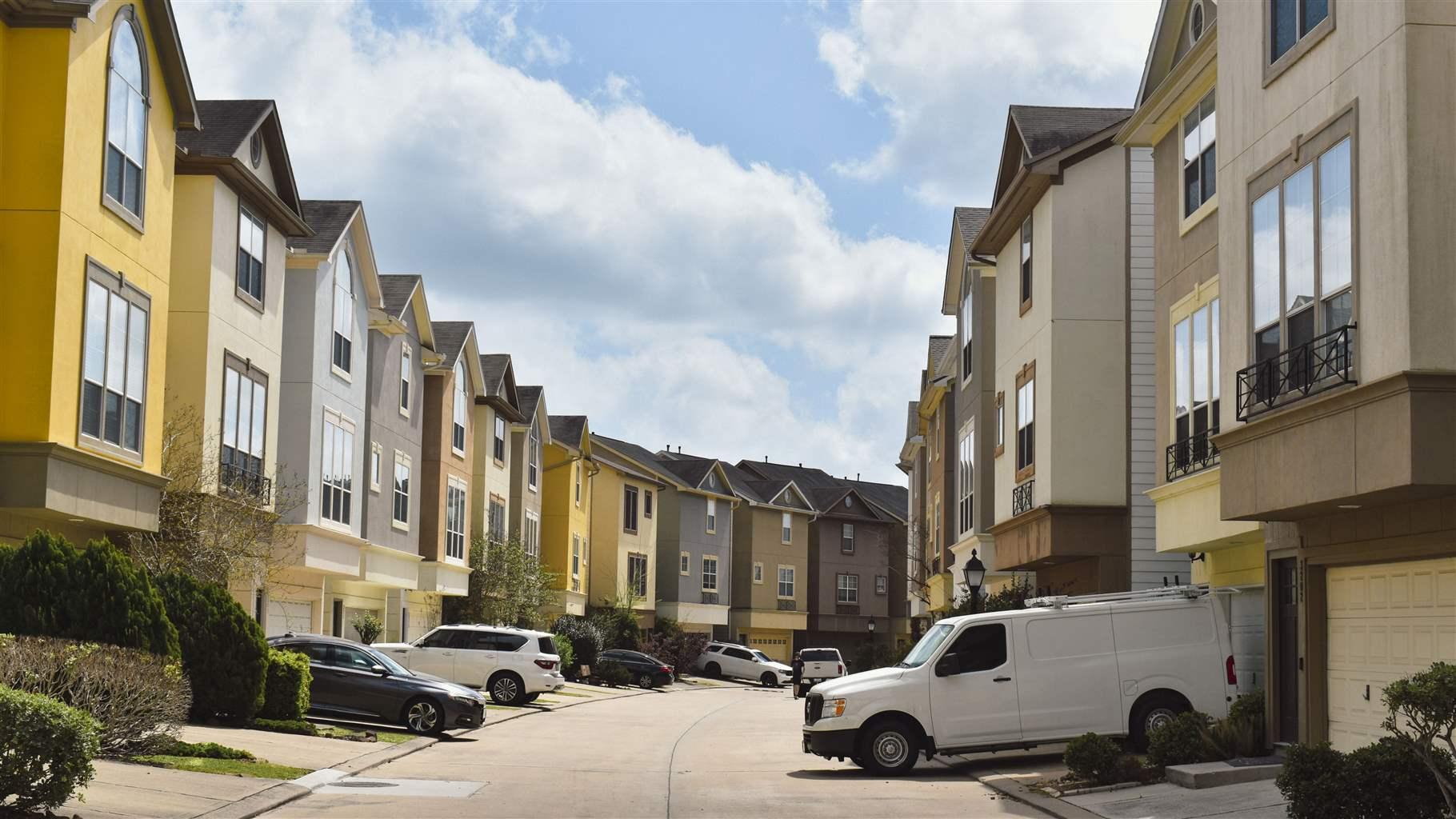
Section 901, which is intended to address concerns about institutional ownership of single-family rental homes, would limit build-to-rent (BTR) housing, which has added between 70,000 and 130,000 homes annually to the U.S. housing market in recent years. Builders in this sector construct single-family homes, including townhouses, specifically for renters, who often do not qualify for a mortgage under current lending standards. While Section 901 does not ban BTR housing, it would require companies to sell these homes after a period of time. This provision could financially undermine the case for building those homes and lead to renter displacement.
Pew’s letter explains how the current language of Section 901 risks sharply reducing the construction of much-needed rental housing and could lead to a decline in new single-family housing construction starts of 100,000 or more homes annually. That large of a reduction in new housing leads to higher rents, according to Pew’s research. Pew’s letter urges the Senate to revisit Section 901 so it does not raise rents for American families by curtailing BTR housing.
Media Contact
Omar Martinez
Officer, Communications
The provision relates to single-family homes that are built specifically for the rental market. If the bill passes in its present form, large investors in this housing type would be required to put them up for sale to individual homeowners within seven years of their construction. While ostensibly intended to increase access to homeownership, this requirement is more likely to simply throttle built-to-rent production. And then there’s the question of what would happen to the people already living in those units when the seven-year countdown runs out: for them, this is a federally mandated eviction notice.
The New York Times put out an article about the fight over this provision yesterday. I was struck by this quote the authors included from one of its supporters:
"Build to rent is essentially home builders switching their construction from building homes for people to building homes for large institutional investors,” said Jim Baker, the executive director of the Private Equity Stakeholder Project, a watchdog organization focused on the impact of institutional investors. “It puts homeownership further out of reach for individuals,” denying them an opportunity “for building wealth for themselves, their families and their children.”
“Building homes for people” versus “building homes for large institutional investors” is a revealing way to frame the conflict. Rental housing is, after all, for people too. I’m both a renter and a person. In fact, my wife and I are currently raising a child in a rental unit. (I can confirm that both wife and child are also, in fact, people. To my knowledge, none of us are large institutional investors.) But to Mr. Baker and others who support the build-to-rent crackdown, people like us simply don’t exist. Either that or we are “ temporarily embarrassed homeowners,” as Jerusalem Demsas recently put it. Assuming Baker and others think of us at all, they evidently see us as unfortunate souls who need to be divested of our lease and awarded a mortgage as soon as possible.
To the extent that Baker — and the legislative champions of the seven-year rule, namely Senators Elizabeth Warren and Raphael Warnock — want to expand access to homeownership for people who want it, I’m fully with them. But for people who want it is the operative phrase. When policymakers operate on the assumption that homeownership is intrinsically superior to renting, and that every American household needs to be put on track toward owning a home whether or not it fits in with their other priorities, they usually end up hurting the very people they mean to help. If the seven-year rule becomes law, it will probably end up reinforcing geographic segregation by locking more working-class renter families out of exclusive residential areas. They still won’t have the means to buy homes in those areas, and now they won’t have any rental options, either.
It isn’t just the Senate proposal that could produce severe unintended consequences. Earlier this week, New York Times contributor Rotimi Adeoye argued that Democrats should adopt another strategy for turning young renters into homeowners:
The “House by 30” program would begin to correct this imbalance and restore faith in government among younger Americans who have grown cynical. The federal government would cover part of a first-time buyer’s down payment based on years of full-time work: The longer you have contributed, the more help you receive. That structure would advantage blue-collar workers, who often enter the work force earlier, rather than disproportionately rewarding those who spend more years in school.
Any first-time buyer, regardless of age or region, would be eligible. The benefit could accrue at roughly $5,000 a year, capped at $50,000, enough to cover a substantial share of a typical down payment on a median-priced home.
Full disclosure: Adeoye reached out to discuss this proposal a few weeks ago, and I told him about all of my concerns then. He was very courteous on our call, but clearly did not think there was a lot of merit to my objections. I’ll rehash some of them here and let the reader decide.
First off: This is effectively a tax on people who choose not to become homeowners for whatever reason. As I understand this proposal, people who did not use the $50,000 they accrued to cover a down payment, that money would simply evaporate.[2] I’m all for helping working-class households build up some assets, but I don’t see why the government should insist that they invest in a particular asset class at the expense of limiting their freedom of movement. Especially because those who can’t supplement the $50,000 with savings of their own will still face some hard limits on where they can choose to live.
Second: Adeoye notes that the structure of his proposal “would advantage blue-collar workers, who often enter the work force earlier, rather than disproportionately rewarding those who spend more years in school.” That’s true, but it would also effectively penalize blue-collar workers who decided to go back to school. And it would also impose a harsh financial penalty on people who drop out of the labor market for whatever reason. Full-time caretakers of children or elderly relatives would probably be particularly impacted.
Third: This would be a massive demand subsidy, and Adeoye does not tie it to any particular pro-supply measures. He does note that “America needs to build more housing, and movements such as the YIMBY and abundance movement are right about the housing supply problem.” But unless “House by 30” is paired with some borderline revolutionary reforms in American land use, I don’t see how it could be anything but inflationary. Most of the benefit of this program would probably go to homesellers, not the homebuyers themselves.
Fourth: Adeoye argues that a particular goal of this proposal would be to improve community stability. He writes: “If workers cannot afford to buy homes and put down roots, the social fabric weakens.” The flipside of this argument is something I alluded to above: it would further limit young people’s freedom of movement by tying them to a particular patch of land. At the same time, I reject the notion that someone who lives in a community for a long time cannot “put down roots” if they reside in rental housing. While I doubt this is Adeoye’s intent, this sort of language implies that renters are effectively less than full members of the communities in which they reside. This echoes a frequent NIMBY talking point used to argue against new rental housing and belittle the concerns of their non-homeowning neighbors.^[Note the evidence that rental housing -- at any price -- increases housing availability and lowers costs. See [[
One could imagine a version of this policy that operates more like a baby bond, allowing all young people to build up a little wealth without dictating that they eschew higher education or acquire a particular type of investment in order to access the whole benefit. Similarly, one could easily imagine a version of the 21st Century ROAD to Housing Act that aims to provide more homeownership opportunities without undermining rental housing production. For example, the authors could do more to spur the construction of condominiums — a great, comparatively affordable homeownership option for people who value living in a dense, walkable neighborhood over having a big backyard.
Ultimately, the goal of American housing policy should be greater freedom: the freedom to live where you want to live, move when you want to move, and make use of whichever housing arrangement makes the most sense for your household, whether that involves renting your home or owning it. That means that people who consider themselves progressive need to abandon the myopic, socially conservative view that single-family homeownership for a nuclear family is normatively superior to all other lifestyles and living arrangements. That view has already done enough damage over the course of nearly a century; it’s well past time to try something else.