21 July 2022. Climate | Strategy | Andrew Curry
body
Thinking about strategy
I’ve been doing some strategy work this week, which sent me back to Richard Rumelt’s book Good Strategy Bad Strategy, which is one of a handful of strategy books worth reading.
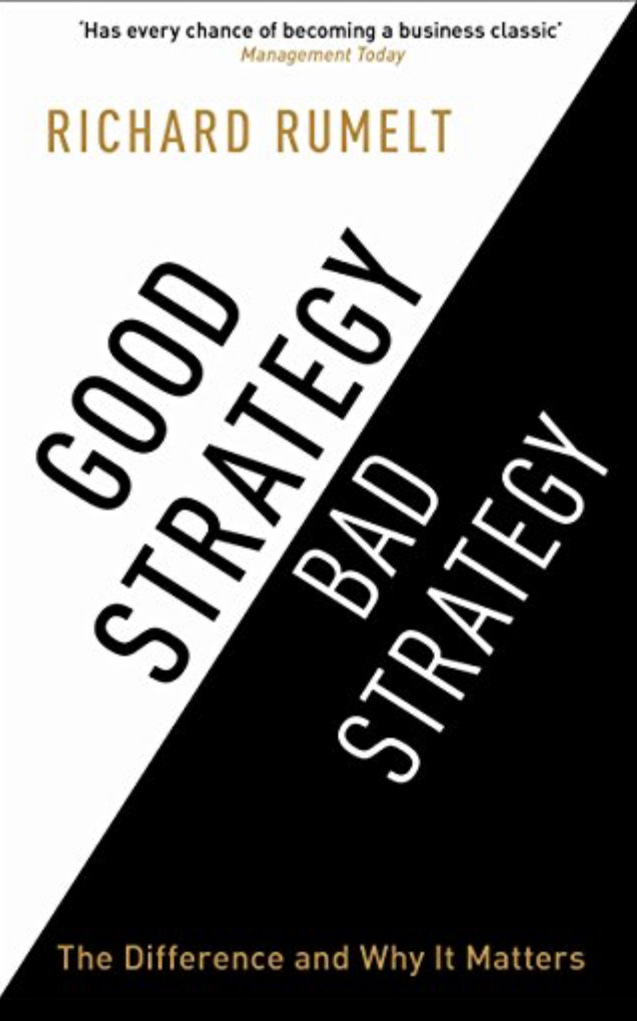
It’s a decade old now, but one of the reasons I like it is that he has a clear model of what strategy is, which I’m summarising here.
Good strategy, he says, is composed of a “kernel” of three elements (p77):
- A diagnosis that defines or explains the nature of the challenge. A good diagnosis simplifies the complexity by identifying the critical aspects of the situation.
- A guiding policy for dealing with the challenge.
- A set of coherent actions that are designed to carry out the guiding policy.
So, in effect, a strategic diagnosis is a model of the situation that allows you to act, and so of course, it comes in the general heading of ‘all models are wrong but some are useful’.
Specifically: a good diagnosis of a situation
should replace the overwhelming complexity of reality with a simpler story, a story that calls attention to its crucial aspects. This simplified model of reality allows one to make sense of the situation and engage in further problem solving.[1]
So it’s doing two things. It is defining “a domain of action”, through a process of sense-making, and it’s also creating alignment around the nature of the problem. Because, for Rumelt, the difference between strategy and analysis is action.
But it’s also worth saying that when you’re operating in a messy or complex environment, and trying to make sense of signs of change around you, the diagnosis is likely to be unclear and also contested. Especially in large organisations, everyone will tend to think that the bit of the situation that they’re closest to is the reason why things are working less well than they used to. It can take time to create a shared understanding of the situation.
That’s all a bit abstract, but one of the examples he uses is of a local shop that is trying to compete with a 24/7 convenience store nearby. And the diagnosis becomes: what can I do well that they can’t do well?
Part of the catchment is ‘busy professionals’ who don’t have time to cook but want to eat well—and can afford to buy decent quality food. So in Rumelt’s example, that becomes the guiding policy: servicing people who are willing to trade money for time and quality.
And this then has some consequences for action. The range needs to change, and they can probably stop selling some of the range at the discount end of the market. These sorts of customers don’t want to hang around at the checkout, and might expect price to turn into decent service, so it is probably worth hiring someone to help on a second till in the busy period when the professional crowd is heading home.
He makes a distinction between a diagnosis that describes outcomes and one that creates the possibility of leverage over outcomes:
For instance, we know from research that K-12 student performance is better explained by social class and culture than by expenditures per student or class size, but that knowledge does not lead to many useful policy prescriptions.
He contrasts this with a diagnosis that he suggests creates an opening for action:
(Bill Ouchi’s) book Making Schools Work diagnoses the challenge of school performance as one of organization rather than as one of class, culture, funding, or curriculum design. Decentralized schools, he argues, perform better... What is critical, and what makes his diagnosis useful to policy makers, is that organization explains some part of school performance and that, unlike culture or social class, organization is something that can be addressed with policy.
Of course, we can argue about this, and it’s a good example of why framing the diagnosis is important. It matters whether we we are looking at student performance or school performance, for example. If you stick with a diagnosis about social class, for example, you might also conclude that actions that reduce the effects of inequality (such as a SureStart early years programme or an educational maintenance allowance that helps poorer children afford to stay in school) are also going to have an effect, although that then also depends on how patient you are going to be about your policy intervention. This makes it a decision for a politician or political party rather than — say— a head teacher or a school district supervisor.
Rumelt has a number of techniques that help to improve the changes of good strategy.
The first is using leverage. Leverage is identified through a mix of anticipation, insight into what is most pivotal, and the concentrated application of effort. It’s about where you need to address your effort. Anticipation brings foresight or futures into play, and may also involve a choice about which emerging trends you’re going to ally your business and business model to. (He uses the example of Toyota developing a hybrid vehicle strategy while American car companies doubled down on SUVs.)
A pivot point is an element that allows you to transform your insight value; it “magnifies the effect of effort.” And concentration is about choosing to focus resources on the points that make a difference. How do you know what makes a difference? Through the guiding principles.
The second element is the proximate objective, which is a short-to-medium term outcome that tells you you’re heading in the right direction. A good proximate objective also helps to resolve ambiguity by requiring the organisation to assess what it knows, and doesn’t know. It’s also a useful test of the strategy, because it’s hard to define a proximate objective for something that’s a slogan rather than a strategy (“the war on drugs”, say.)
A third element is about using design—meant here in the same sense in which John Kay uses “organisational architecture.” Design involves making plans, anticipating responses, and co-ordinating action: “Performance “is the joint outcome of capability and clever design.”
Rumelt has a new book out in hardback, although it’s hard to tell from the reviews if it’s a retread of Good Strategy Bad Strategy but with a spin that it’s for ‘leaders’. But I’ll definitely read it when it is out in paperback.
in Brander's terms, the model makes concrete what is unchanging. ↩︎