Meet the four Democratic tribes | The Economist
What 19,000 survey respondents reveal about rival factions on the left
body
An unpopular war started by an unpopular president: these ought to be favourable circumstances for an opposition party. As yet, though, the Democratic Party has no clear standard-bearer or set of ideas. The primaries for the 2026 midterms, which began in early March and run until September, will offer the sharpest signal yet, from millions of voters across every state, about which faction within the Democratic coalition is ascendant.
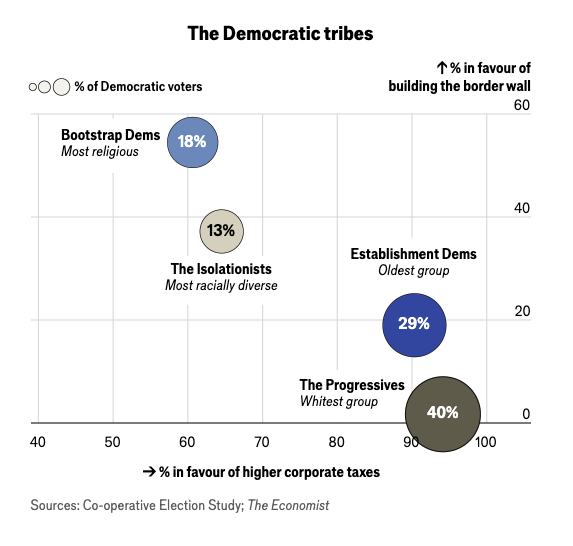
To understand how these groups differ, The Economist analysed responses from the 19,000 Democrats who took part in the Co-operative Election Study, which is administered by YouGov, during the 2024 elections. The study puts a plethora of questions on policy, from zoning laws to banning TikTok, to its patient respondents. Individual voters are idiosyncratic. But put them together, apply some fancy maths, and four distinct clusters emerge.
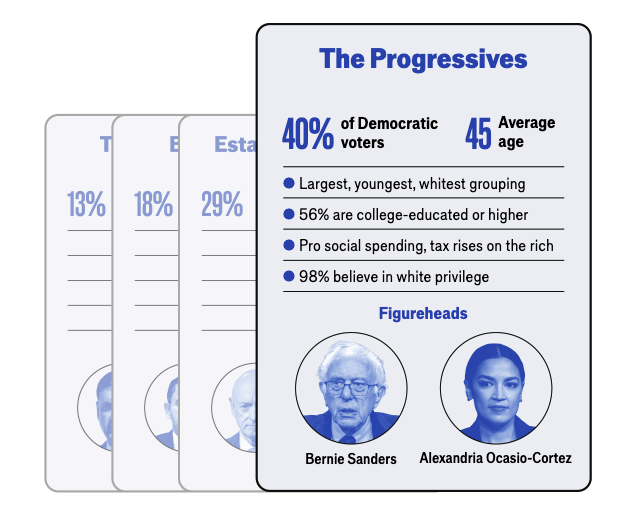
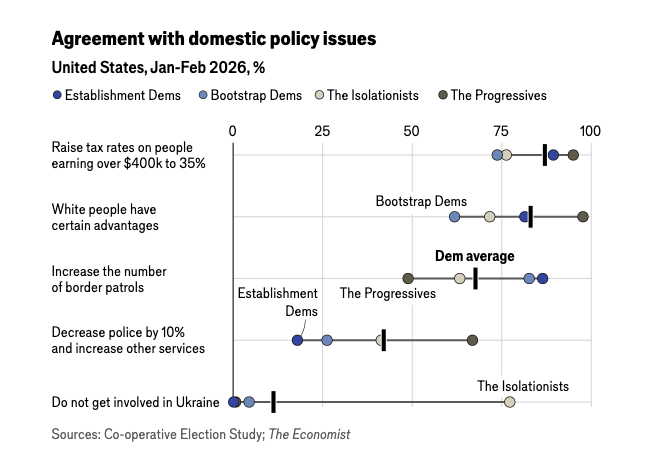
Progressives are the largest bloc of Democratic voters, making up 40% of the total. They are also the youngest, the most highly educated and the whitest. They strongly favour redistribution of wealth. Fully 98% agree with the sentiment that white Americans enjoy “white privilege”. The vast majority also believe that the government should play a larger role in addressing inequality. Roughly 70% believe the government should increase spending on welfare; that is at least 25 points higher than any other faction in the party. They are also much more likely to support an increase in government spending on health care and education. The tribe’s most prominent figures are Bernie Sanders, an independent senator from Vermont who caucuses with the Democrats, and Alexandria Ocasio-Cortez, a Democratic-Socialist congresswoman from New York City.
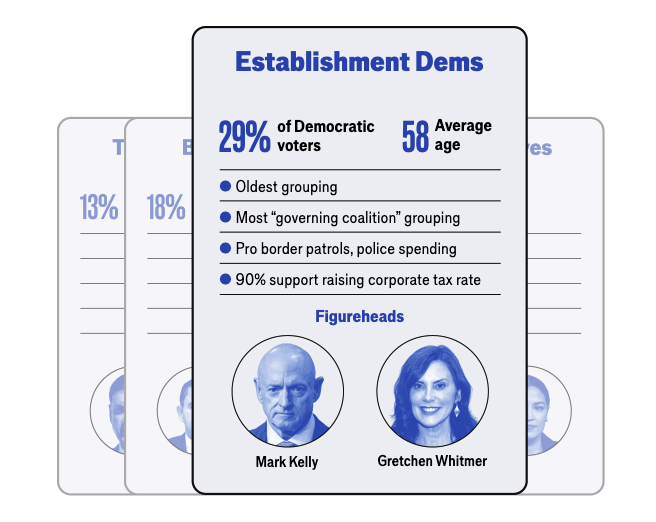
Establishment Democrats are the second-largest tribe (at 29%) and have the highest average age. They share many of the progressives’ views on economics, but are more hesitant when it comes to public safety. Nearly nine-in-ten say they want more patrols at the border and about three-quarters of them oppose reductions to police funding. This faction is most strongly represented by the party’s governing wing. Mark Kelly, a senator from Arizona, and Gretchen Whitmer, the governor of Michigan, are a close match.
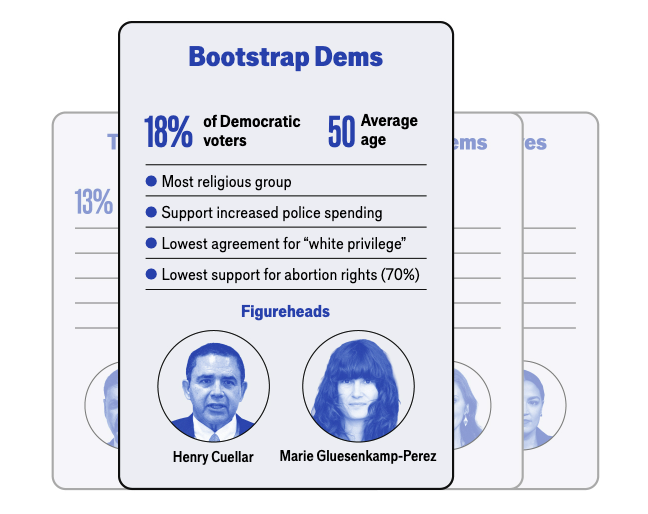
The Bootstrap Democrats (18% of the total) are the most religious of the four tribes. Some of their views more closely resemble those of Republicans.[1] They are least likely to believe in the idea of white privilege, for example (though 60% do). They are more optimistic on race relations than other groups: a majority believe that other minorities overcame prejudice to work their way up in society, so black Americans should follow the same path.[2] Though a majority support the right to an abortion, the share—68%—is far lower than in any other faction. However, on taxation and spending on health care and education, they remain aligned with the rest of the Democratic Party. Elected examples of the tribe include Henry Cuellar, a congressman representing a district in south Texas and the only anti-abortion Democrat in Congress; and Marie Gluesenkamp Perez, a congresswoman from Washington state and the co-chair of the Blue Dog Coalition, a group of moderate and conservative Democrats.[3]
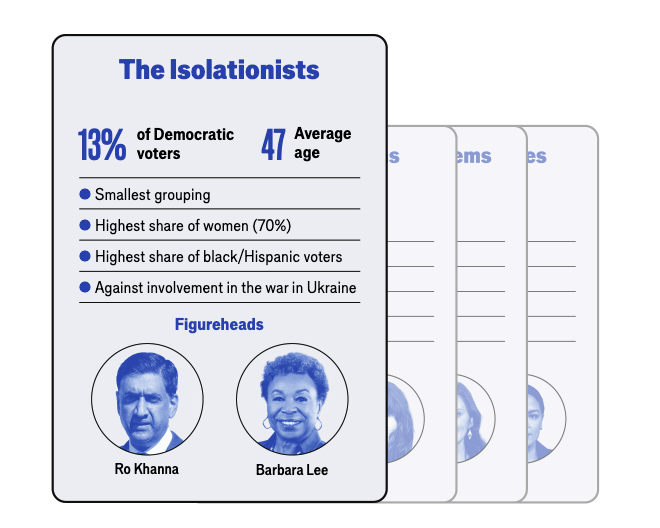
The Isolationists are the smallest group (13% of Democratic voters). They align with progressives on many domestic issues. They stand out on matters of foreign policy. Around eight in ten think America should not be involved in the wars in Ukraine (77%) or Gaza (82%). They are overwhelmingly female, have the highest share of black and Hispanic supporters of any cluster, and are the least likely to hold a college degree. Their most notable figures are two outspoken politicians who represent the San Francisco Bay Area. Barbara Lee, a longtime California congresswoman who became the mayor of Oakland in 2025, is known for being the only member of congress to vote against the authorisation for use of military force in the wake of September 11th. Ro Khanna, of California’s 17th congressional district, has also argued for a more restrained role abroad.
The party will not cohere, if it ever does, until the 2028 presidential primary is over. But this work makes clear that the eventual winner of that contest cannot afford to alienate the party’s progressive bloc, which has swollen during the Trump era.[4]
Why 'bootstrap'? People should pull themselves up by their bootstraps? ↩︎
= anti-welfare? ↩︎
Note they don't use their own tribal names. ↩︎
What about bringing the party together? If you downplay foreign policy, going more isolationist, and downplay 'white privilege' you could get some or a majority of isolationalists and bootstrappers (the off left). ↩︎