There’s Another Reason Gen Z Can’t Find Work | Jessica Grose
#soon #should
body

Credit... Eleanor Davis
In March, Times Opinion published a discussion with 12 white-collar job-seekers in their teens and 20s. Their view of their prospects was incredibly bleak. These young people, who had a mix of political leanings, careers, and racial and geographic backgrounds, used words like “horrible,” “rough” and “messy” to describe the job market.
A Black Democrat named Michelah, who works in customer service and had applied for at least 30 jobs in the past six months, described the market as “dry.” When the moderators asked her to elaborate, she said, rather poetically: “It’s like a desert. There’s nothing really there. You can be out there, but you’re not being hydrated.”
I had been hearing the same thing from other members of Gen Z, who told me in November that they found the job search “dystopian.” Twenty-somethings who do manage to find work, like Michelah, aren’t necessarily feeling great, either. They report higher levels of mental despair than their counterparts did decades ago.
Rising Young Worker Despair in the United States | David G. Blanchflower, Alex Bryson
Between the early 1990s and 2015 the relationship between mental despair and age was hump-shaped in the United States: it rose to middle-age, then declined later in life. That relationship has now changed: mental despair declines monotonically with age due to a rise in despair among the young. However, the relationship between age and mental despair differs by labor market status. The hump-shape in age still exists for those who are unable to work and the unemployed. The relation between mental despair and age is broadly flat, and has remained so, for homemakers, students and the retired. The change in the age-despair profile over time is due to increasing despair among young workers. Whilst the relationship between mental despair and age has always been downward sloping among workers, this relationship has become more pronounced due to a rise in mental despair among young workers. We find broad-based evidence for this finding in the Behavioral Risk Factor Surveillance System (BRFSS) of 1993-2023, the National Survey on Drug Use and Health (NSDUH), 2008-2023, and in surveys by Pew, the Conference Board and Johns Hopkins University.
Indeed, the job market for the Class of 2026 has been described elsewhere in this paper as the grimmest in years, but it isn’t solely because of A.I.’s impact on hiring for office jobs, and it isn’t just because of the state of the economy. For those who think trade jobs are a cure-all, the employment numbers for non-college graduates are not looking so cheery either — some of them have stopped looking for work entirely. It is true that we are in a period in which not many people are getting hired or fired, which leads to a kind of logjam for new entrants to the work force. But this stasis is just the rancid icing on the spoiled cake of much longer trends.
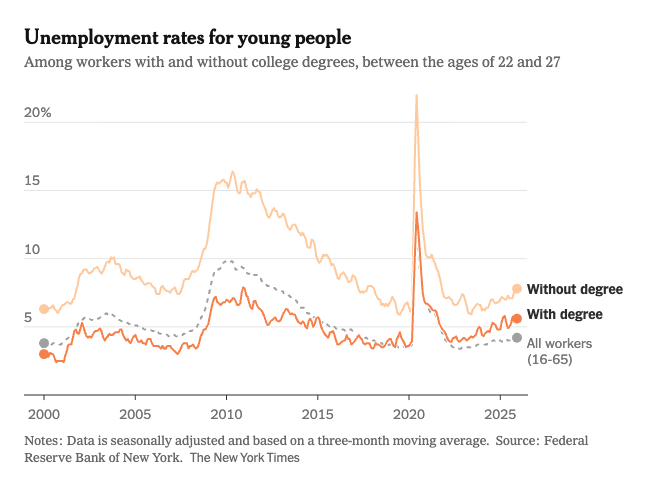
source: College Graduates Are Facing the Grimmest Job Market in Years | Sydney Ember
A new working paper from three economists explains how the U.S. job ladder has been breaking for 40 years. This decades-long problem doesn’t affect just Gen Z but has also stymied wage growth for Americans in their 30s, 40s and 50s. This could be why the midlife millennials I interviewed a few years back felt that they were physically in their 40s but economically in their 20s, unable to find a career that felt secure.
In a working paper for the National Bureau of Economic Research, Niklas Engbom, Aniket Baksy and Daniele Caratelli analyzed Current Population Survey federal data from 1982 to 2023 to try to figure out why wage growth has been weak over four decades. They estimate that “employed workers today are about half as likely to receive a better-paying outside offer as they were in the 1980s,” and major salary jumps often happen when you move to another company.
It’s not because there isn’t demand for workers, and it’s not because the supply of jobs has diminished, Engbom explained to me when I called him this month. He said that employed workers are “increasingly stuck in low-paying jobs” — which may be one reason for so much young worker despair. “They’ve seen a complete collapse of the job ladder,” Engbom said. And who would leave a job in this uneasy economy?
Engbom and his colleagues offer two main arguments for why American workers are less likely than they used to be 40 years ago to receive competitive offers. The first is “increased +employer concentration,” he told me, which reduces the scope of job shopping for workers.
The media industry is a great example of this. There used to be a thriving network of local newspapers and TV and radio stations to work for, but more and more of those outlets have shut down or are owned by a handful of conglomerates. Consolidation has also gone up in the tech and health care industries.
The other reason Engbom and his co-authors offer for the broken job ladder is the rise of noncompete agreements that prevent employees from working for a competitor, often in a defined geographic region and for a specific amount of time. While state laws concerning noncompete clauses vary, Engbom said that in the 1980s, courts started siding with employers more and allowing these agreements to be enforced. The Federal Trade Commission issued a rule banning their use in 2024, but business groups sued to get the rule overturned, and later that year the ban was blocked by the courts.[2]
A 2023 Government Accountability Office report about the impact of these clauses on the U.S. work force cited a study estimating that 38 percent of workers had been subject to a noncompete agreement at some point. But these restrictions weren’t applied just to high-flying executives who might know trade secrets that would plausibly damage a company if shared with a competitor. Over half of employers that told the G.A.O. that they used noncompete clauses said all of their hourly and part-time workers had to sign such agreements.
A main reason employers said that they used noncompete agreements was to prevent the recruitment of their staff by other companies. Relatively few workers even understand what the agreements are when they sign them, the G.A.O. found.
The G.A.O. also found that the restrictions depressed wages. One study, from the economists Michael Lipsitz and Evan Starr, that the G.A.O. cited to support this assertion used data from Oregon, which banned noncompete agreements for lower-wage and hourly paid workers in 2008. The study’s authors compared the wages of hourly workers from before and after the ban on noncompete clauses, and found that hourly wages increased after the ban by 2 percent to 3 percent on average. There were knock-on effects to the Oregon ban, as workers experienced better job mobility and were more likely to get a salaried job.
Even with the F.T.C. rule out of the picture, more states could ban or curtail noncompete clauses.
I already have so much sympathy for Gen Z-ers because of the chaotic world that they are meeting as they try to figure themselves out, as all young adults are attempting to do. Anybody who is still judging teenagers and 20-somethings as lazy or unserious because they are struggling to launch should understand that they’re trying to climb an economic ladder that started to splinter before they were even born. They’re hanging on for dear life.
End Notes
- If you want a deeper look at the broken job market for young people, I highly recommend Noam Scheiber’s new book, “ Mutiny: The Rise and Revolt of the College-Educated Working Class.” Scheiber writes about labor for The New York Times, and the portraits of these scrappy 20-somethings who are trying to make working conditions better for themselves and their peers is equal parts invigorating and depressing.
- I know that last week I recommended “Pagan Peak,” the Austrian/German Alpine serial killer show. It is still a very good show, but as I move through the first season it is so freaking scary I can watch it only in 20-minute intervals.
- A less scary recommendation for crime lovers: Patrick Radden Keefe’s new book, “ London Falling,” which is about a young fabulist who died mysteriously, and how his grieving family tries to get to the bottom of his untimely demise. Keefe is such a master at weaving in history — both of the boy’s forebears and the underworld characters he encounters — that I was riveted throughout.