Checks and Balance newsletter: A fix for Donald Trump’s jobs problem | The Economist
body
Donald Trump’s political rise was propelled in no small part by an observation and a promise. Globalisation and an indifferent elite had failed too many American men; Mr Trump vowed to boost their prospects. “We have to stop our jobs from being stolen from us,” he declared in 2016—a refrain he has repeated for most of the past decade. So how is the president doing? His war with Iran has pushed up petrol prices. Housing costs remain stubbornly high. That pain is borne by Americans regardless of gender. But on one issue in particular, Mr Trump’s second term has been singularly bad for men: jobs.
The president has not only failed to spark a jobs boom for men; the number of jobs held by men has fallen. This is partly because male boomers are retiring. But it also reflects a mismatch between the sectors that have traditionally employed men and the sectors that are hiring. This is bad news both for Mr Trump and the men he vowed to help. Yet if the president adopted a different approach, he could be uniquely suited to solve the problem.
Before getting to the fix, let’s review what’s gone wrong. Many presidents have romanticised manufacturing, with only red barns rivalling factory jobs as vessels for national nostalgia. But Mr Trump’s attention to the sector has been particularly extreme and futile. In his inauguration speech last year, he asserted that “America will be a manufacturing nation once again”. Ten weeks later, in his announcement of sweeping tariffs on “Liberation Day”, he predicted that “jobs and factories will come roaring back”.
They have not. There are now fewer manufacturing jobs, 70% of which are held by men, than when Mr Trump took office. That trend is unlikely to change much. As factories become more automated, manufacturers’ installed base of robots is projected to grow by more than 20% each year through 2030.
It’s not just manufacturing that has failed to deliver jobs. Employment has fallen in transportation and warehousing (about 75% male) and grown only modestly in construction (about 90% male). Jobs in oil and gas (90% male) saw a temporary bump in February, but have since resumed their slide, with the industry able to pump more oil with fewer workers.
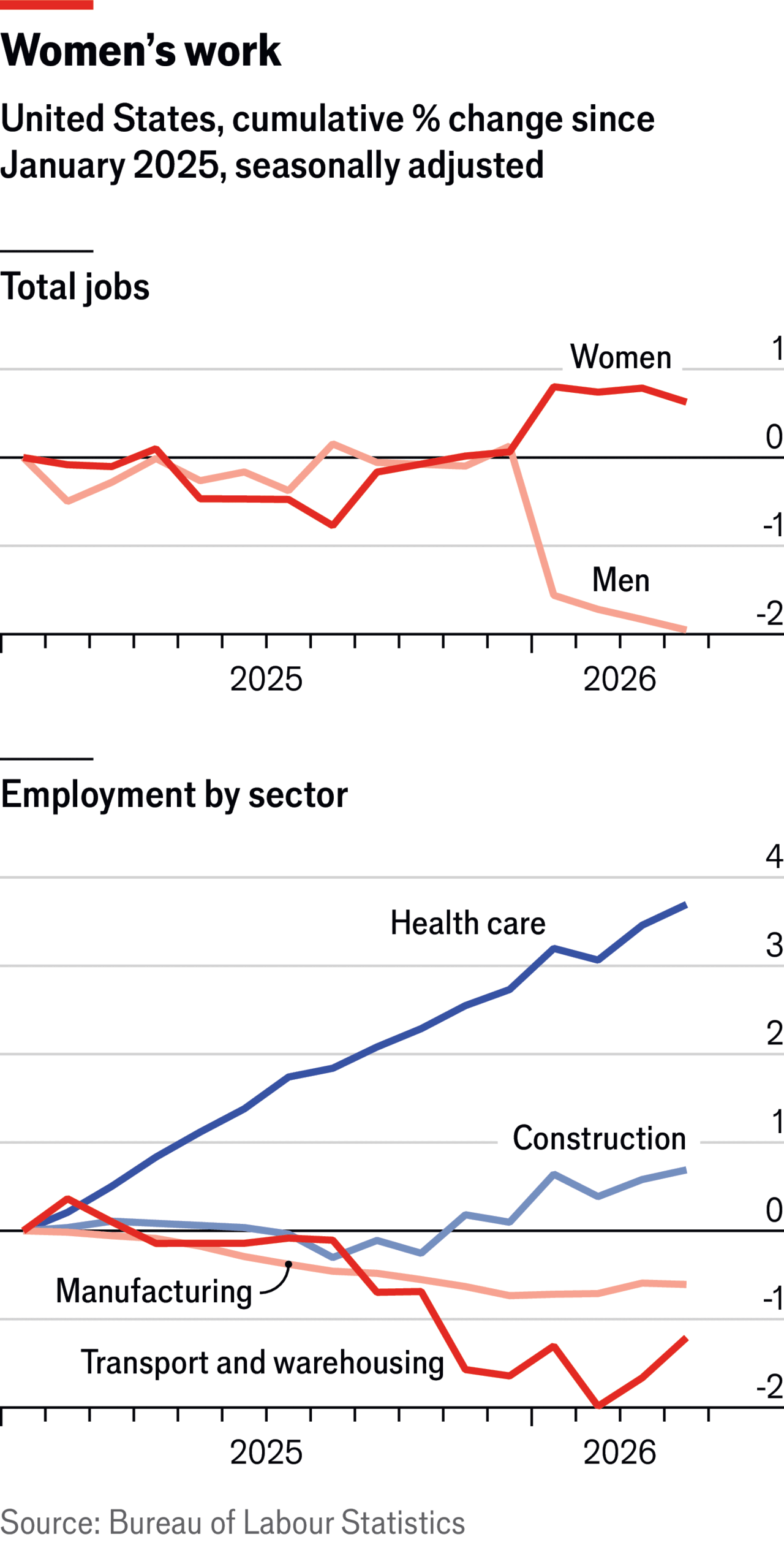
Chart: The Economist
Sectors dominated by women, in contrast, have seen robust growth—notably health care (see chart), but also education and social assistance. Amid growing fears of an AI jobs apocalypse, health and education are among the sectors least vulnerable to automation.
What’s more interesting than the surge in these jobs, which is not new, is that so few men are pursuing them. Betsey Stevenson, an economist at the University of Michigan, has for a decade argued that manly men need girly jobs. However the share of men in positions such as nurses, teachers and medical assistants—what the social scientist Richard Reeves calls the HEAL economy (for health, education, administration and literacy)—has fallen since 1970. The result, Mr Reeves and his colleagues argue, is both a missed opportunity for men and a dearth of male representation in some of the roles society deems most important.
Part of the problem is that some of these jobs have lower pay than, say, a unionised manufacturing worker. There is also the thorny issue of stigma. Workers have a tendency to cling to the identity of their past work. The barriers to seeking a new role are that much higher when a profession is perceived as women’s work.
Mr Trump would be well placed to help, were he so inclined. To date he has done more than any president since Teddy Roosevelt to endorse a particular form of virility. He has posted altered images of himself as a muscle-y Jedi and a crazed commander from “Apocalypse Now”. For his birthday next month, he will transform the White House lawn into an Ultimate Fighting Championship (UFC) arena. Having established his macho cred, might Mr Trump consider exalting not just men who break limbs but men who treat them?
One path presented itself in April, when Mr Trump posted an image that seemed to portray himself as Jesus. That was not a good idea. However the president may have been on to something when he claimed the image actually showed him as a doctor. The last time I checked, there were vanishingly few job postings for Jedi Knights. The role of God is taken. But Donald Trump as a nurse practitioner? Now that would be some practical propaganda.