For Nearly 150 Years, Parking Has Driven New Yorkers to the Brink | Andy Newman
body
1957
Eddie Hausner/The New York Times
1974
Don Hogan Charles/The New York Times
1999
Ozier Muhammad/The New York Times
1919
Byron Company/Museum of the City of New York
From court cases to political scandal to murder, the city has long been racked with conflict over what to do with cars when they’re not being driven.
To car-owning New Yorkers, the freedom to park — for free — on a residential street may seem as inalienable as the right to fold a slice of pizza.
But this was not always the case. Even before there were cars, in fact, it was considered illegal to park on the street in New York City.
One morning in 1879, a man named Pischel Cohen was walking on the Lower East Side when a passing ice carriage bumped a parked grocery wagon and knocked a piece of wood-and-iron hardware onto his head, killing him. The state’s highest court held the city liable because it had improperly sold the grocer a permit to park in the street.
“The highway may be a convenient place for the owner of carriages to keep them in,” the judges wrote, “but the law, looking to the convenience of the greater number, prohibits any such use of the public streets.”
Once cars came along, fights about parking only became more heated. Though storing cars on the street was eventually legalized, the humble New York City parking spot has been the subject of periodic crackdowns, halfhearted reforms, scandalous monetization schemes and the occasional murderous struggle.
Where Do Cars Belong?
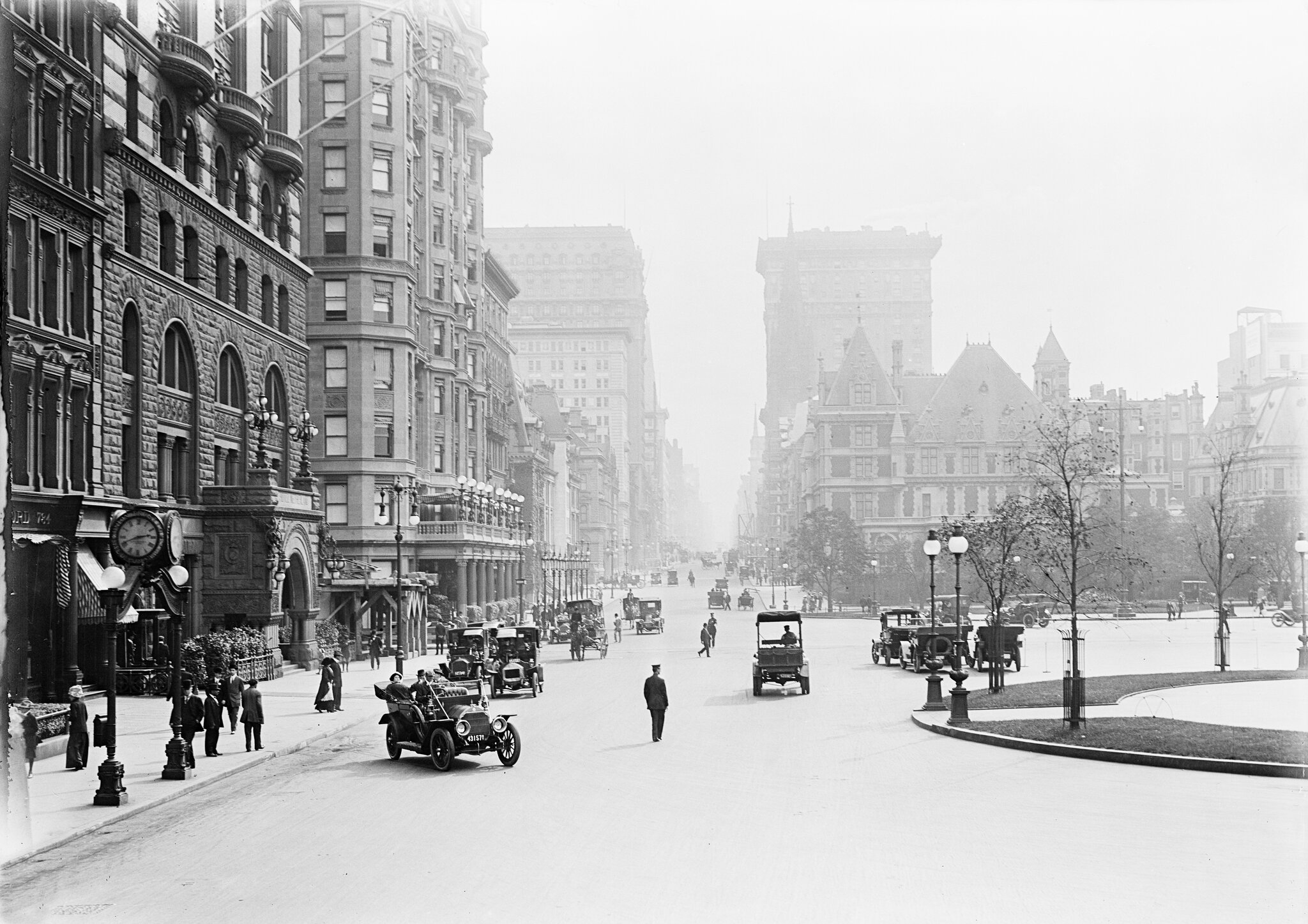
Fifth Avenue near 60th Street in Manhattan circa 1910. As New York City filled up with cars, it struggled to figure out where they should be stored when not in use. Universal History Archive/Universal Images Group, via Getty Images
1915
As automobiles become more popular, a car dealer complains to the Manhattan borough president about the shortage of “public parking places,” lamenting that because of ordinances against street parking, thousands of businessmen who drive into the city “are handicapped in being unable to stable their cars satisfactorily during business hours.”
1917
In Brooklyn, business interests demand off-street parking, in garages and lots, to discourage drivers from leaving their cars on the street. The Brooklyn Eagle applauds a police commissioner who cracked down on parking for “ordering that the streets shall not be encumbered to suit the convenience of people who park their automobiles here, there and everywhere.”
1918
A city official declares New York’s traffic the heaviest in the world and Columbus Circle the most congested spot in the city, with 39,210 vehicles passing by in one day.
The Garage Boom
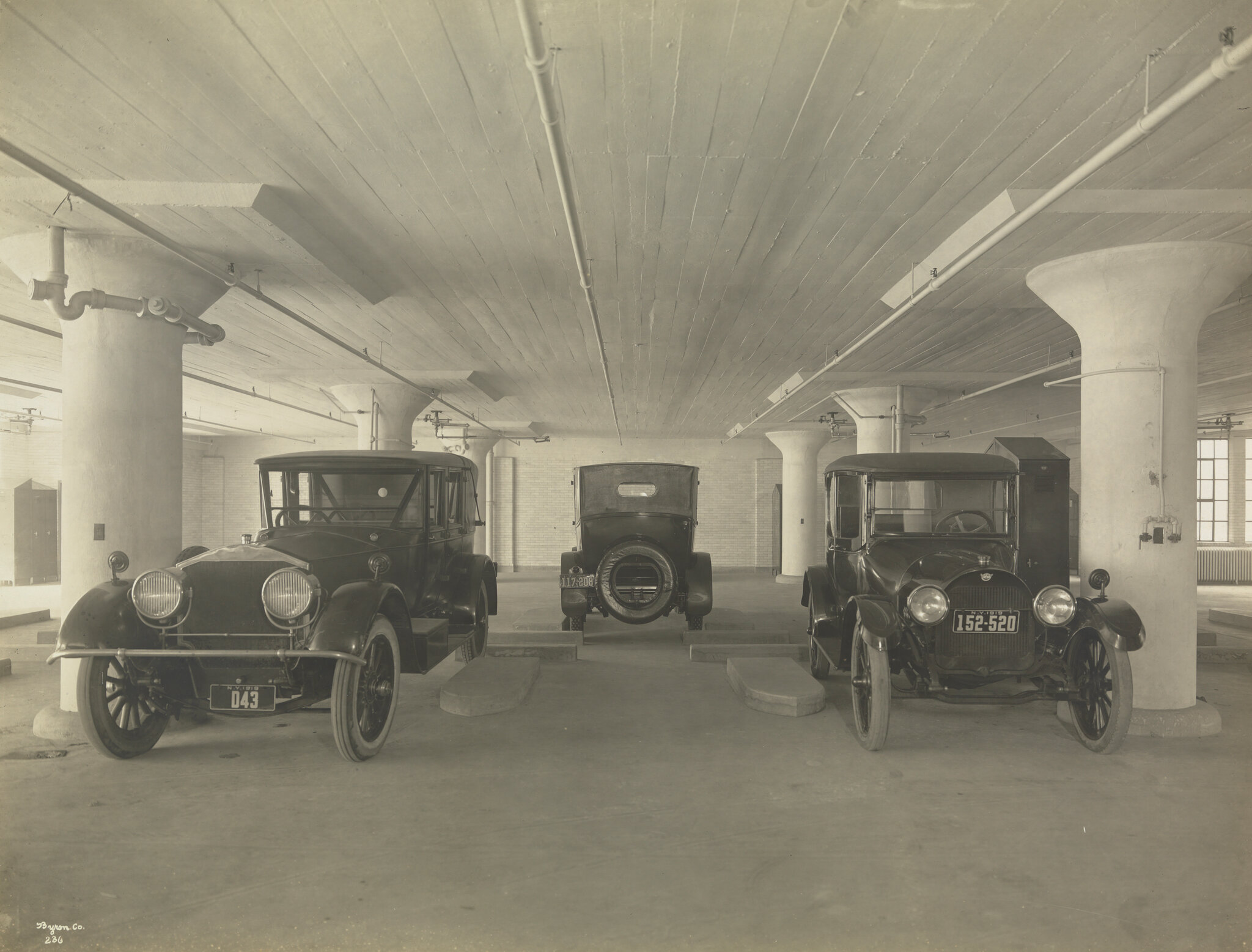
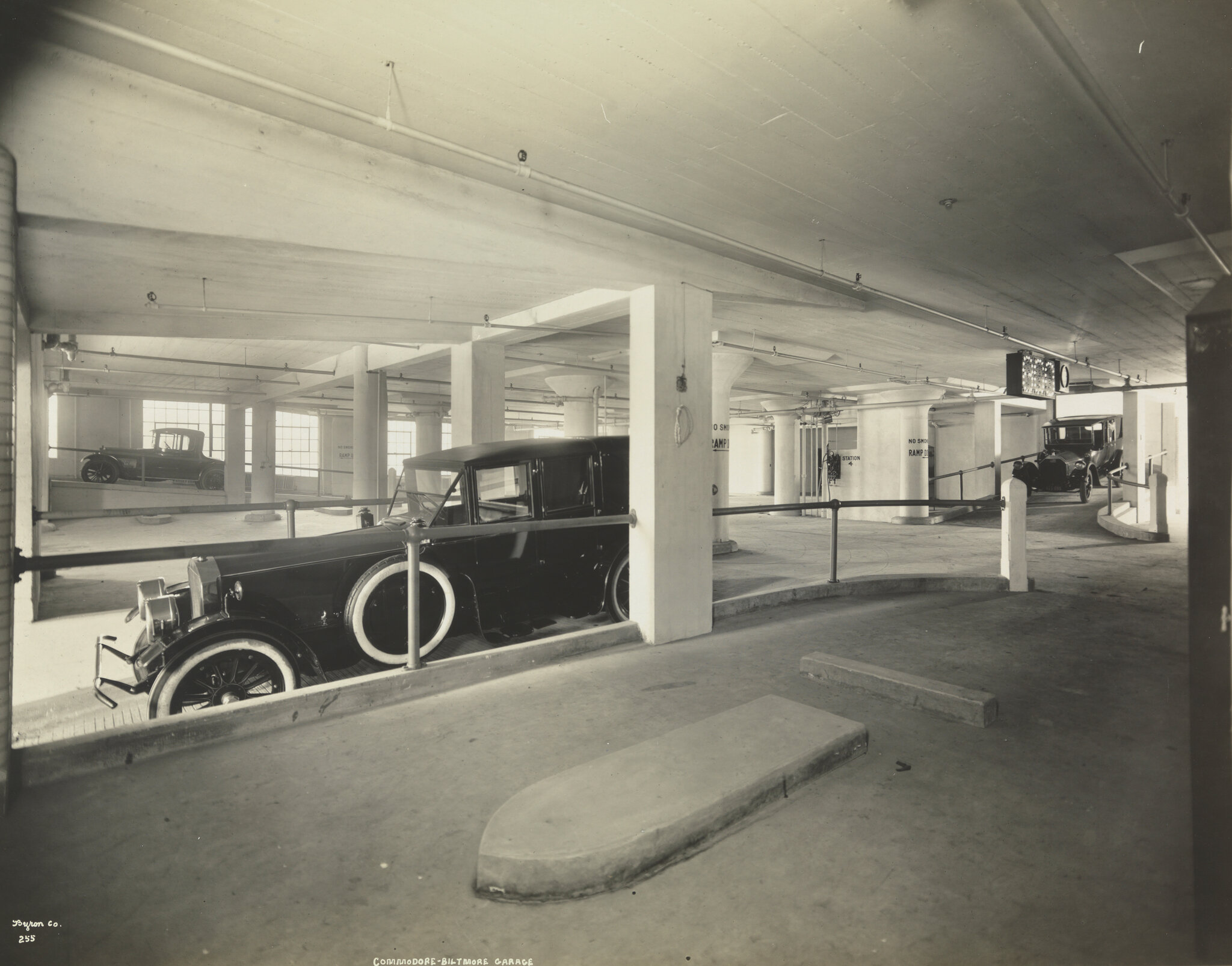
The architecture firm that built Grand Central Terminal designed a four-story garage nearby that went with the Biltmore and Commodore Hotels. Byron Company/Museum of the City of New York
1920
By the 1920s, parking on the street is legal, but for no more than an hour at a time. The New York Times boasts of the “magnificent structures which have been erected all over the city for garage purposes,” including a 12-story lot, complete with elevator, that holds 800 cars.
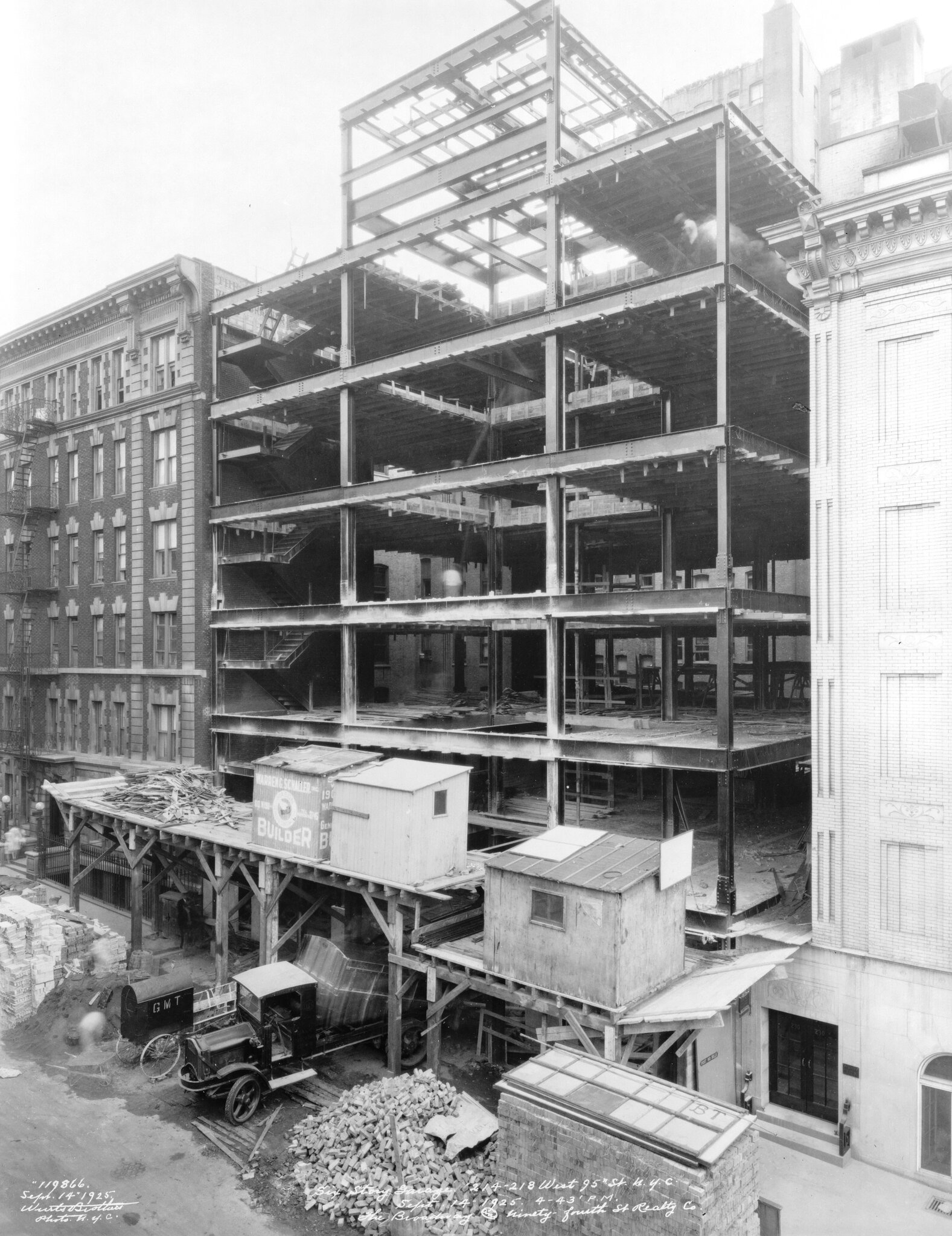
This six-story parking garage on West 95th Street in Manhattan has since been replaced with an apartment building. Wurts Bros./Museum of the City of New York
1921
A city traffic official proposes a 30,000-car garage beneath Central Park to accommodate theatergoers and shoppers, promising it “would not disturb even a tree.” It is never built.
1923
Police Inspector William T. Davis declares illegal street parking “one of the most serious problems facing the Police Department.” He chides motorists who park on Lower Manhattan streets while a nearby public lot sits mostly empty, saying they are “hurting the city.”
1929
A survey by the Citizens’ Street Traffic Committee finds “general disregard of the parking limits in all districts of the city,” The Times reports, noting that 22 to 35 percent of cars violated the one-hour parking limit.
1931
Garage owners in Park Slope, Brooklyn, complain that illegal overnight street parking costs them $3.5 million annually and also provides “ambush points for holdup men.” To pressure drivers to instead use their lots, garage owners in Bay Ridge hire spotters to report street parkers to the police.
1935
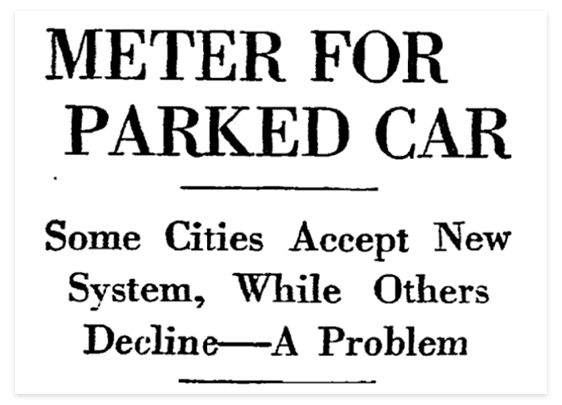
The first parking meters go into service, in Oklahoma City, and quickly spread across the country. But New York City resists adopting them, despite the entreaties of merchant groups.
1937
The New York Times
Parking meters are legalized everywhere in New York State except New York City.
Overnight Street Parking Cannot Be Stopped
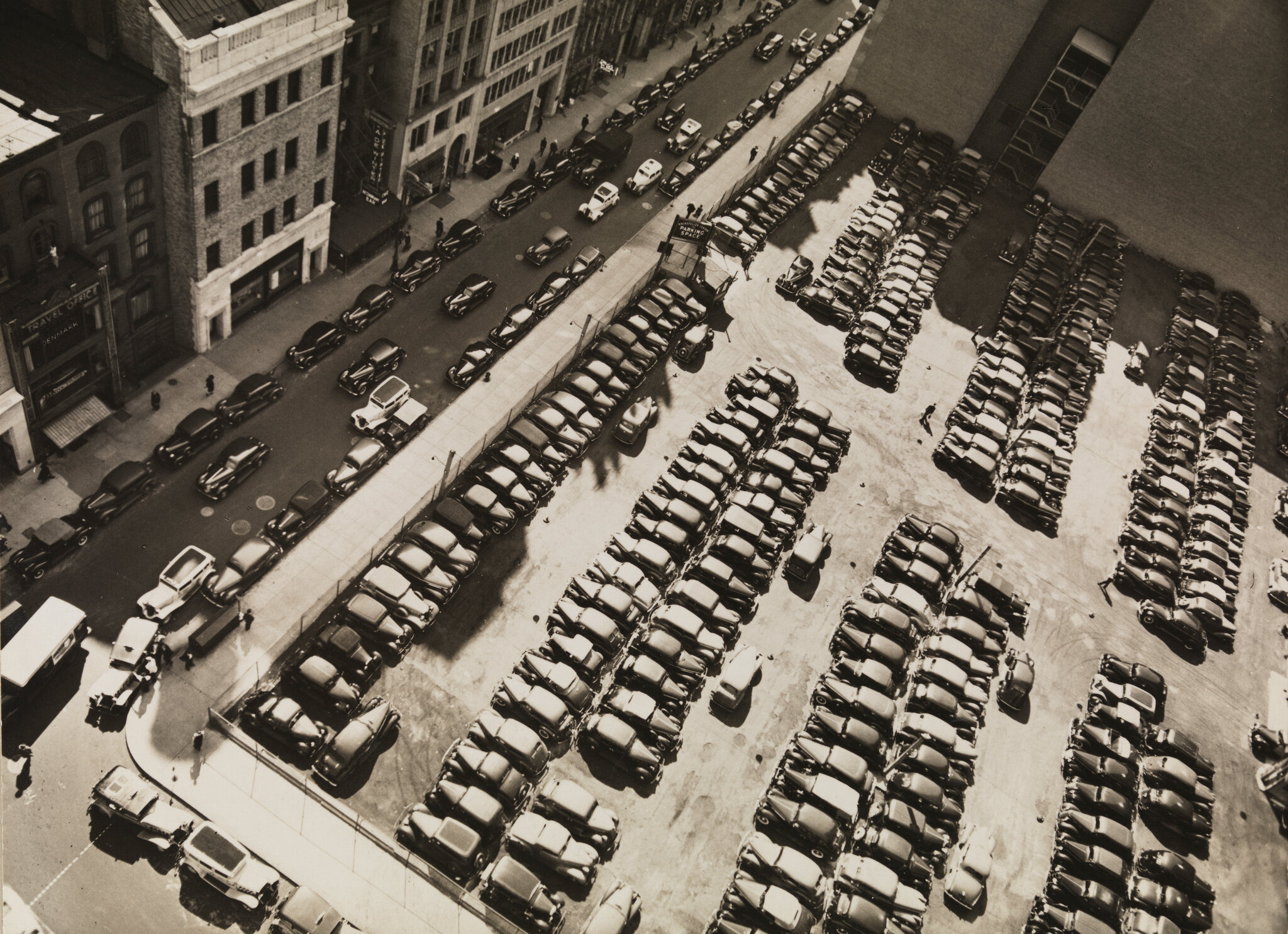
The photographer Berenice Abbott shot a parking lot in Rockefeller Center in 1938 for her project “Changing New York,” done for the federal Works Progress Administration. Berenice Abbott/Museum of the City of New York
1938
A Times editorial argues that a ticketing blitz against overnight parkers would not halt the practice because many motorists “regard several fines a year, which is about the average hazard, as cheaper than garage rent.”
1938
The City Council briefly considers requiring motorists to mark “conspicuously on their cars the time at which they park” to help the police figure out which cars have been parked for longer than the one-hour limit.
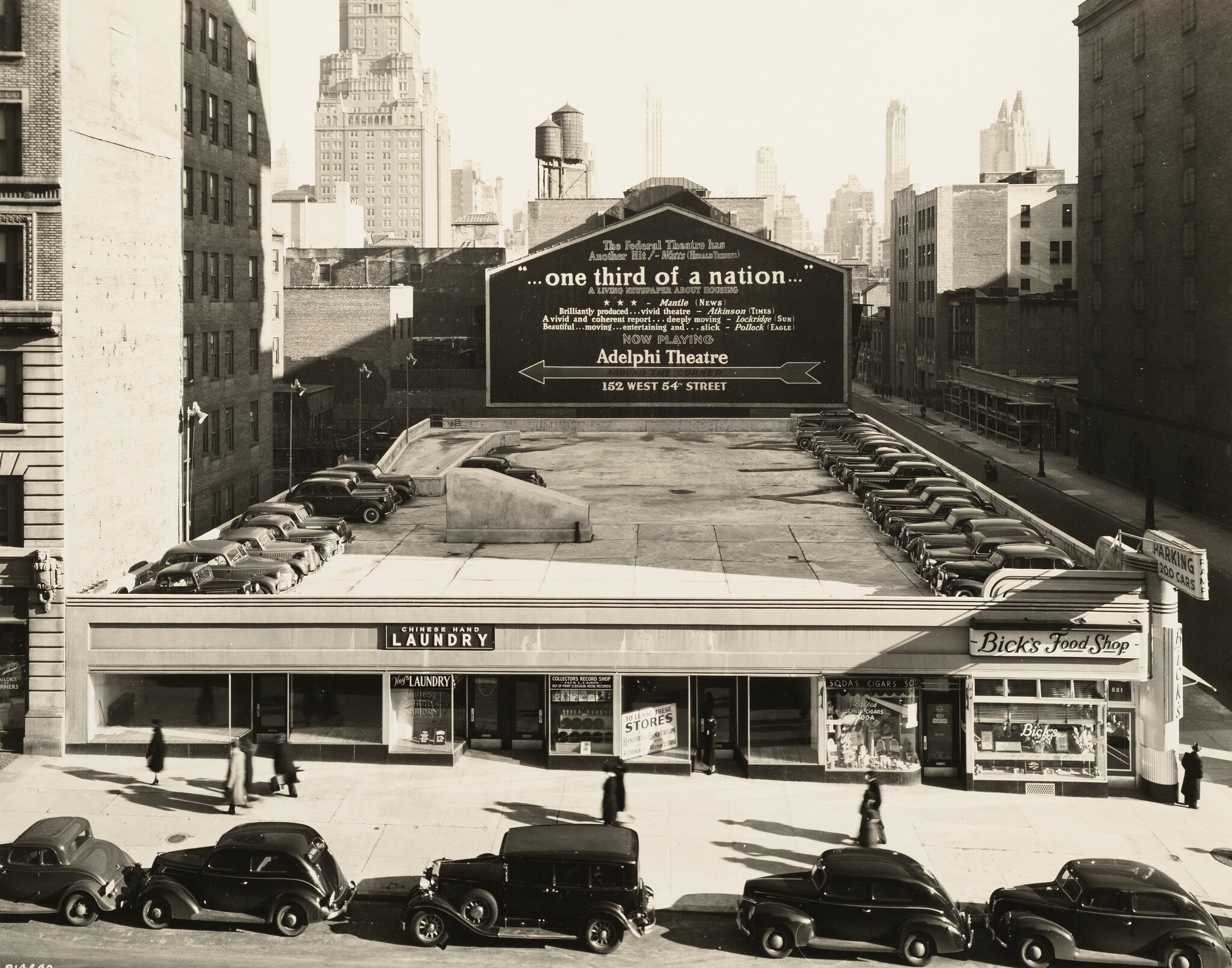
A rooftop parking deck on West 53rd Street, in Manhattan’s theater district, in 1939. Wurts Bros./Museum of the City of New York
1945
The city’s chief magistrate announces jail sentences of up to 30 days for “persistent and habitual” parking scofflaws. Nobody appears to have actually served time under this initiative.
1945
Mayor Fiorello La Guardia institutes a parking ban on some major commercial arteries in Midtown Manhattan. It immediately reduces congestion by up to 75 percent, the police say.
1947
The Automobile Club of New York, an increasingly powerful lobbying group that represents the interests of drivers, backs a suit seeking to end the ban on overnight street parking in neighborhoods with insufficient space in garages and parking lots.
1947
Police officers are accused of taking bribes to turn a blind eye to garage operators who park their customers’ cars on the streets at night so that they can overbook their garages.
1950
Alternate-side parking is rolled out, requiring many drivers to move their cars at least once a week so that street-sweepers can clean trash and leaves out of the gutters. Andrew Mulrain, the sanitation commissioner, declares it “the most practical idea for facilitating street-cleaning and refuse collection I’ve come across in my 30 years with the department.”
The Parking Meter Finally Arrives
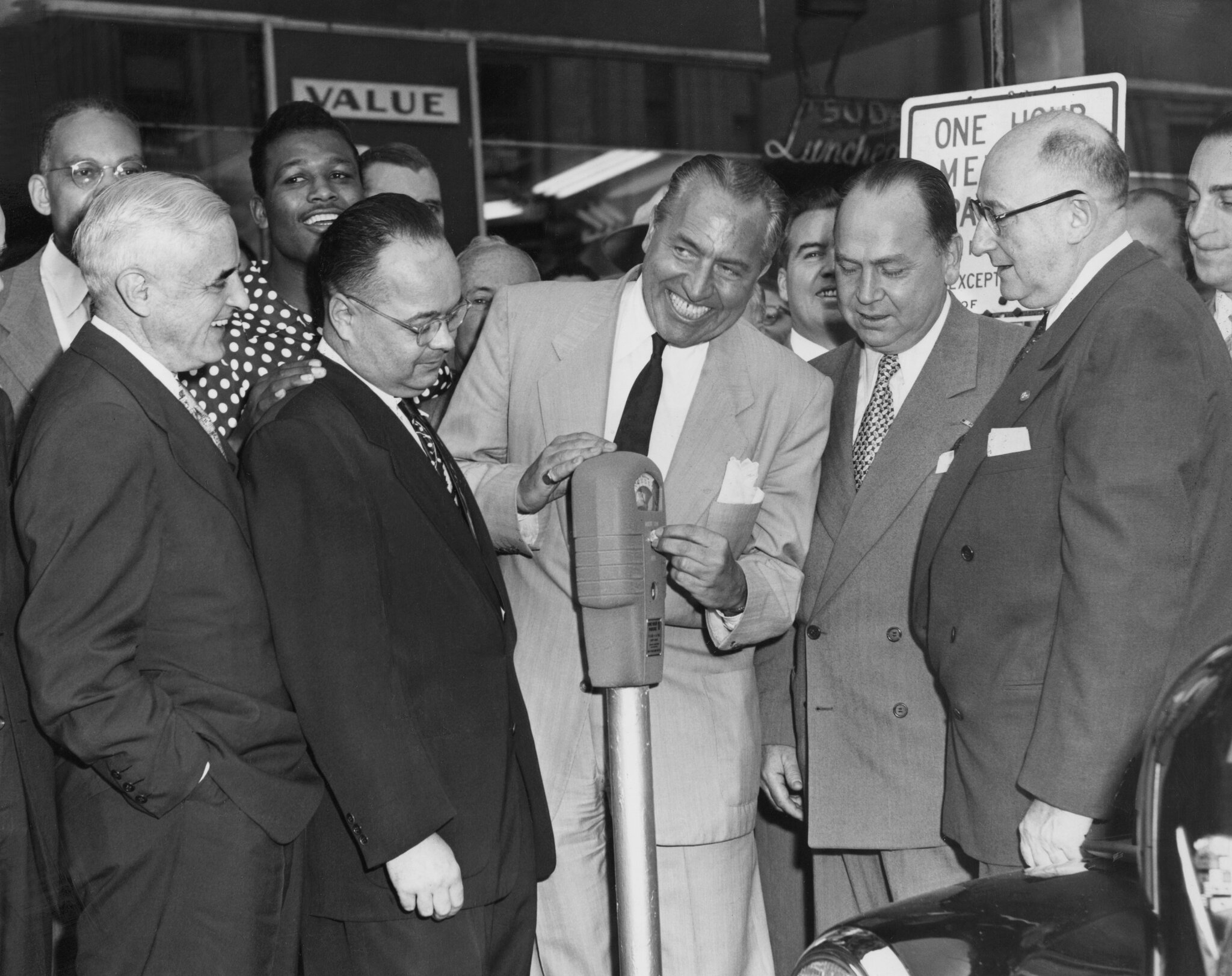
Joseph T. Sharkey, the acting president of the City Council, test-drove one of the city’s first parking meters on West 125th Street in Harlem on Sept. 19, 1951. Larry C. Morris/The New York Times
1951
Sixteen years after the advent of coin-operated parking meters, New York City begins using them. Vandals, thieves and crooked civil servants will go on to find a dizzying array of techniques to extract their contents.
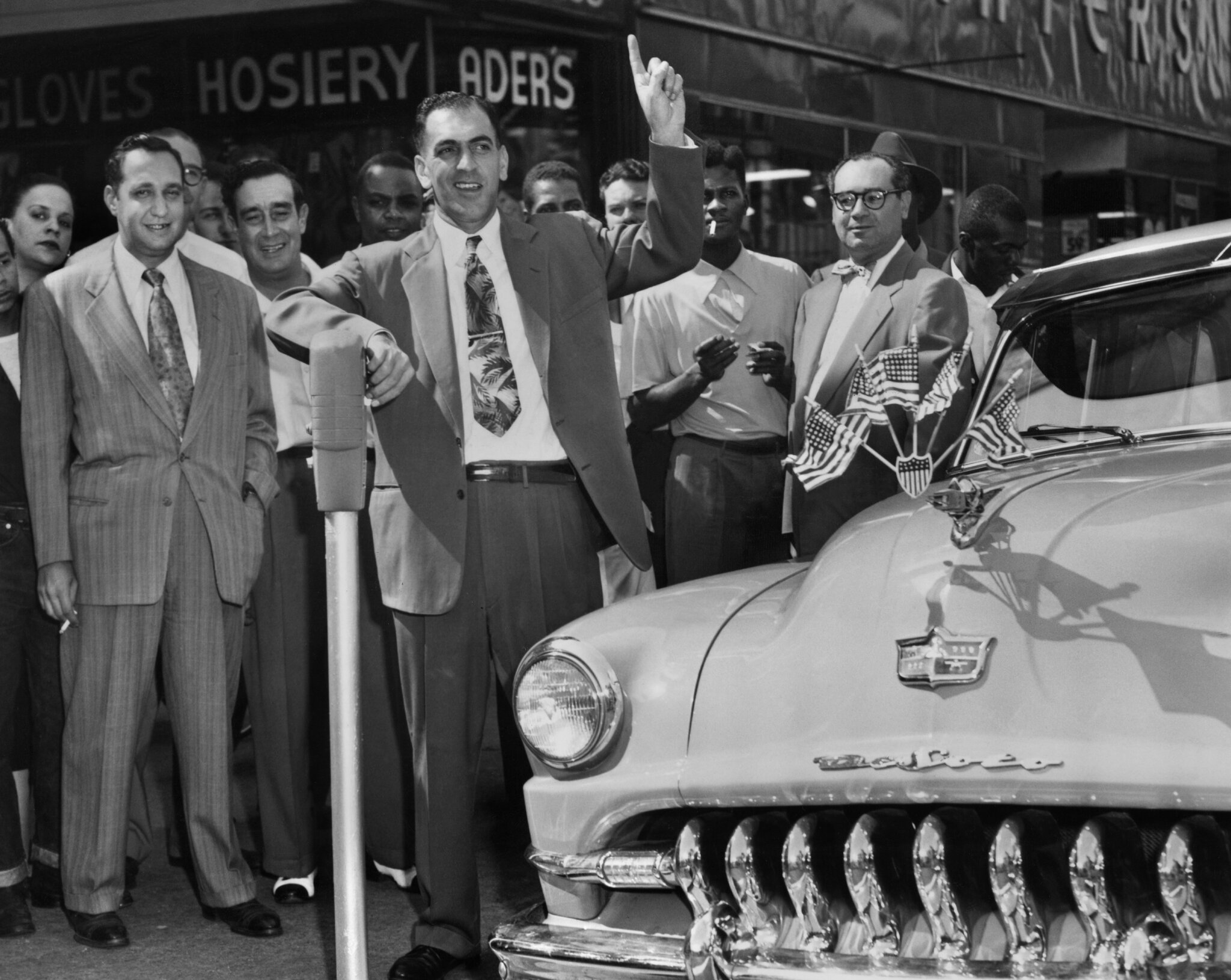
Omero C. Catan, a collector of “firsts” and fixture at opening ceremonies, claims to be the first paying customer to use a New York City parking meter. Mike Lien/The New York Times
1952
Mayor Vincent R. Impellitteri, facing a yawning deficit, proposes that the city raise $12.5 million, or $157 million in today’s dollars, by treating overnight parking like other ineradicable vices: legalize it, but tax it. (The city does eventually legalize it, but never quite gets around to taxing it.)
1952
The City Council approves an annual overnight parking tax of $60, equivalent to $742 today, but another municipal body, the Board of Estimate, votes to “forget” it.
1952
A paper alternative to the parking meter, called the Park-a-Tab, is proposed by four brothers who run a clothing company. It would be sold at stores and police stations; purchasers would tear off tabs showing when they parked and leave them on the dashboard. The city’s traffic commissioner says the invention has “sufficient advantages to warrant further investigation” but quickly shelves it.
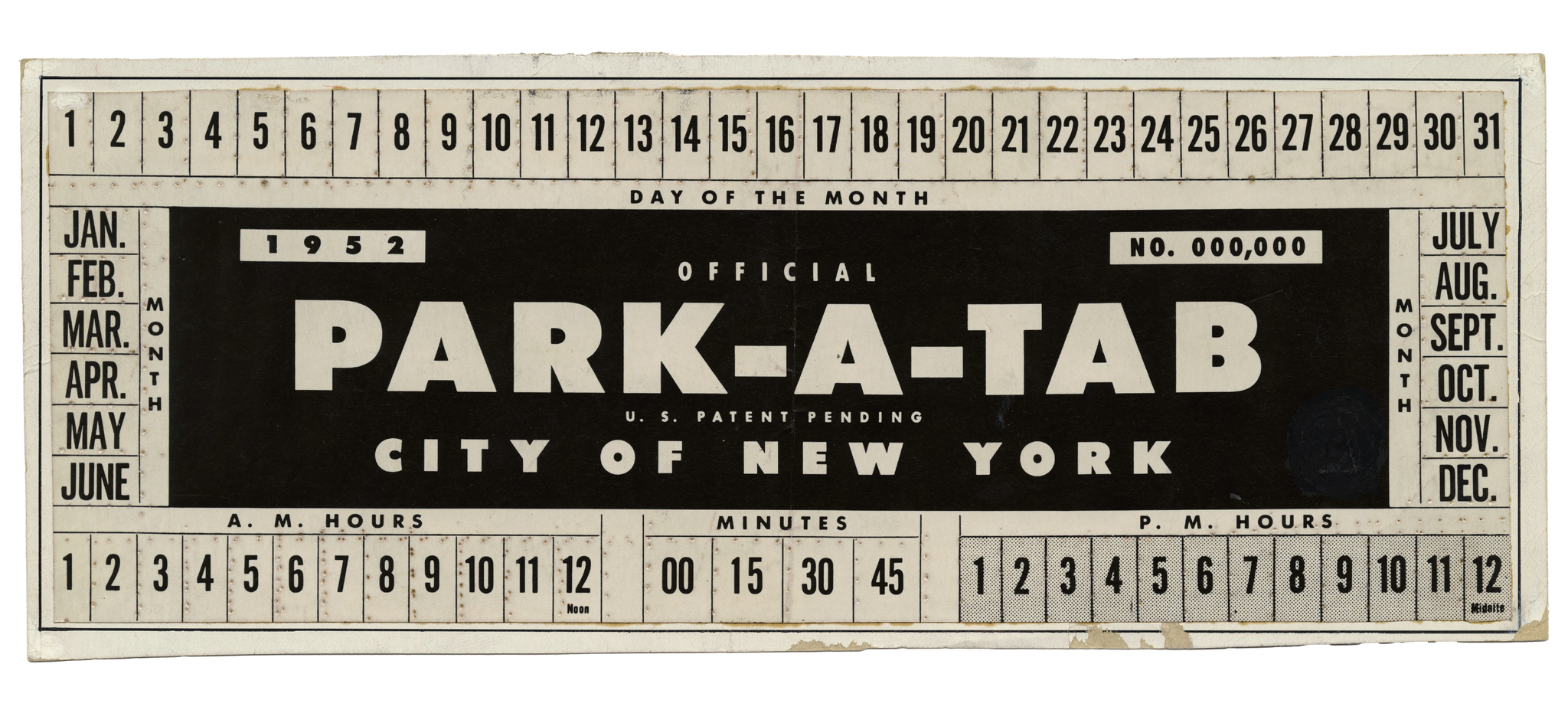
A paper ticket that says “OFFICIAL PARK-A-TAB” and has months and dates on it.
1953
The city ends the one-hour limit on daytime and evening parking at spaces without meters, but keeps the ban on overnight parking.
1953
The city reports that prohibitions on parking, standing and unloading on 23rd Street, a major crosstown artery in Manhattan, led to “clear curbs and unhampered movement of traffic.”
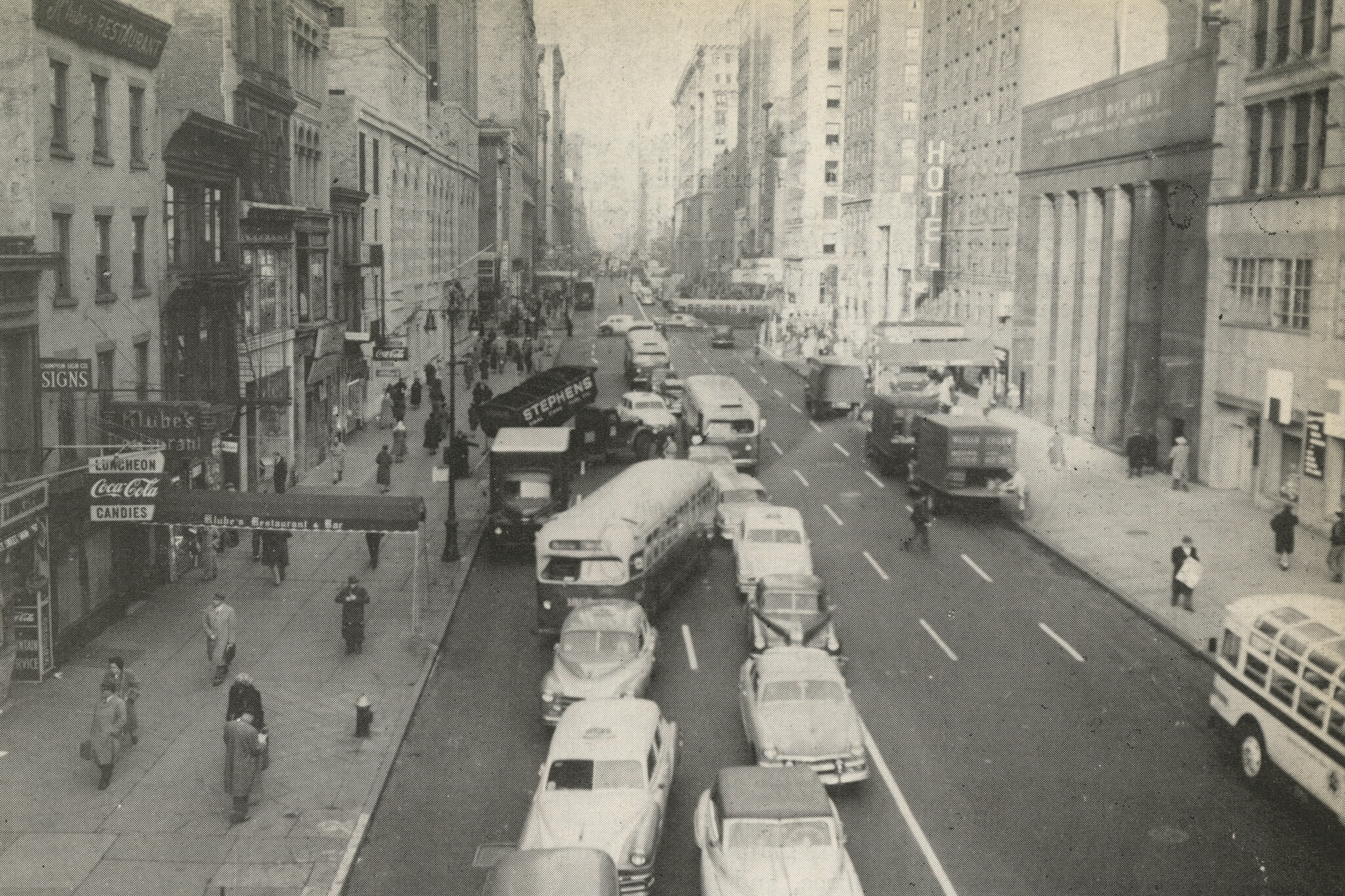
East 23rd Street before and after parking bans. New York City Department of Records
1954
The New York Times
The Times laments that “twenty-five years of experience and 67 traffic studies have failed to develop an overall integrated parking policy for New York City.” An editorial in the paper months later urges adoption of the overnight parking tax, noting that at least half a million cars are kept on the street each night. “There is no reason why those who use the public streets as a garage shouldn’t pay for the privilege,” it argues.
1954
Taking long-term street parking to a new level, a Police Department employee named Victor Kaminsky keeps a 1937 Chevrolet coupe on his Brooklyn block for at least six years. He says neighbors who object are complaining simply “because they want my parking place.”
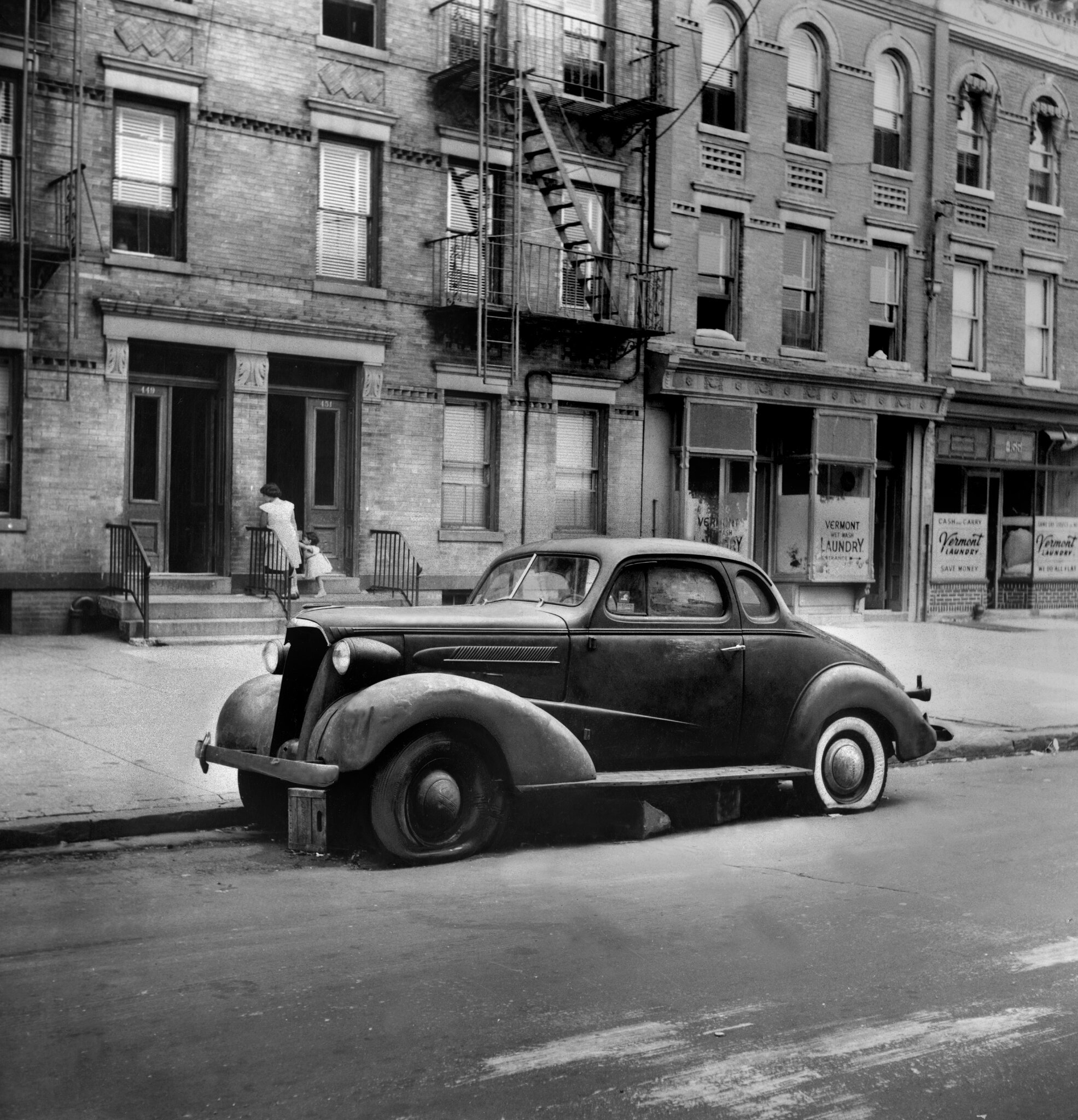
Carl T. Gossett/The New York Times
Overnight Parking Prevails, and Meters Become Targets
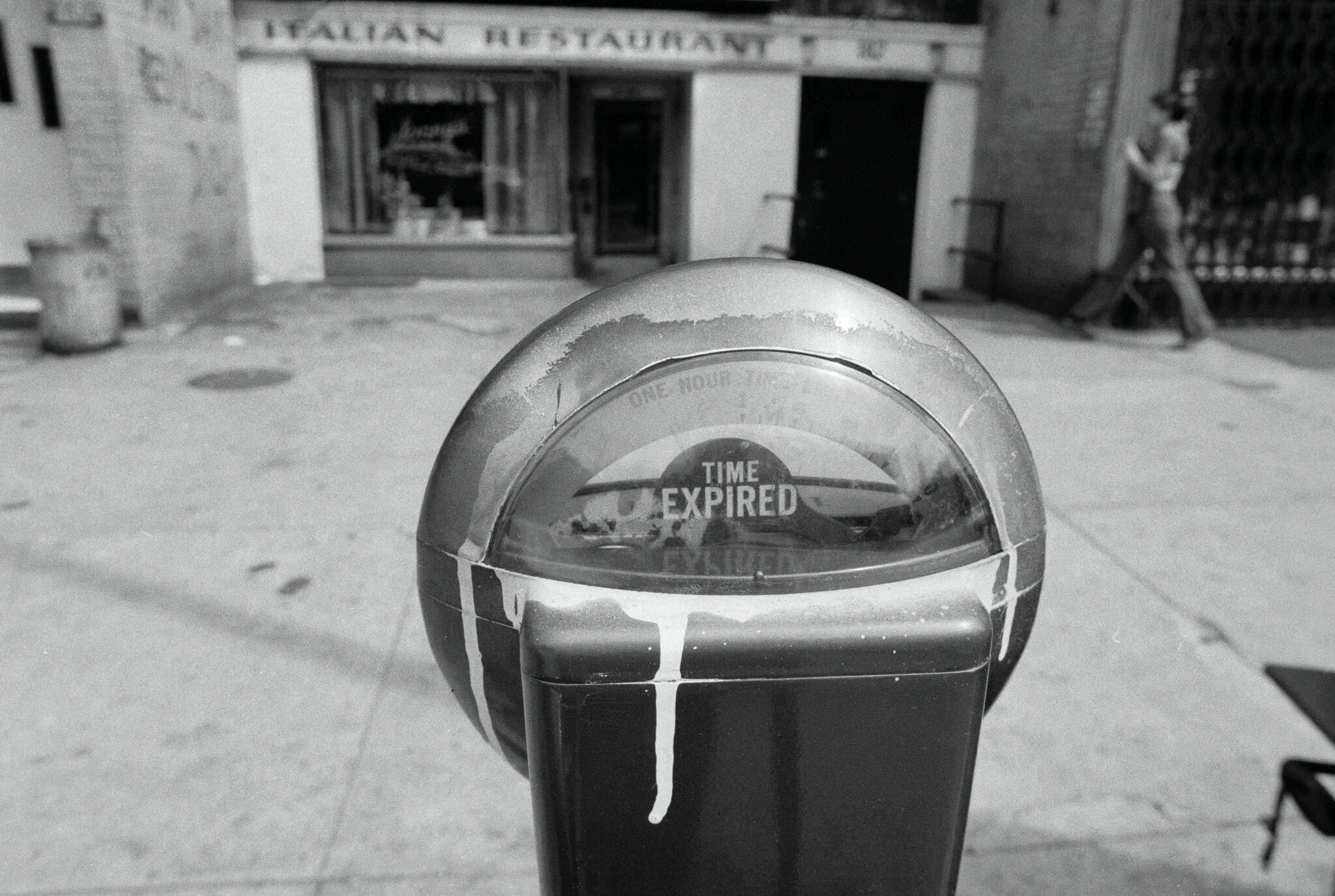
Coin-powered parking meters were frequently vandalized. Jack Manning/The New York Times
1954
The city legalizes street parking for up to 24 hours, noting that well over 99 percent of overnight parkers are not ticketed anyway: Officers are writing about 150 tickets per night, against an estimated 600,000 cars kept on the street. Rules forbidding parking for more than 24 hours remain on the books, if largely ignored, until the current seven-day maximum is codified in 1997.
1957
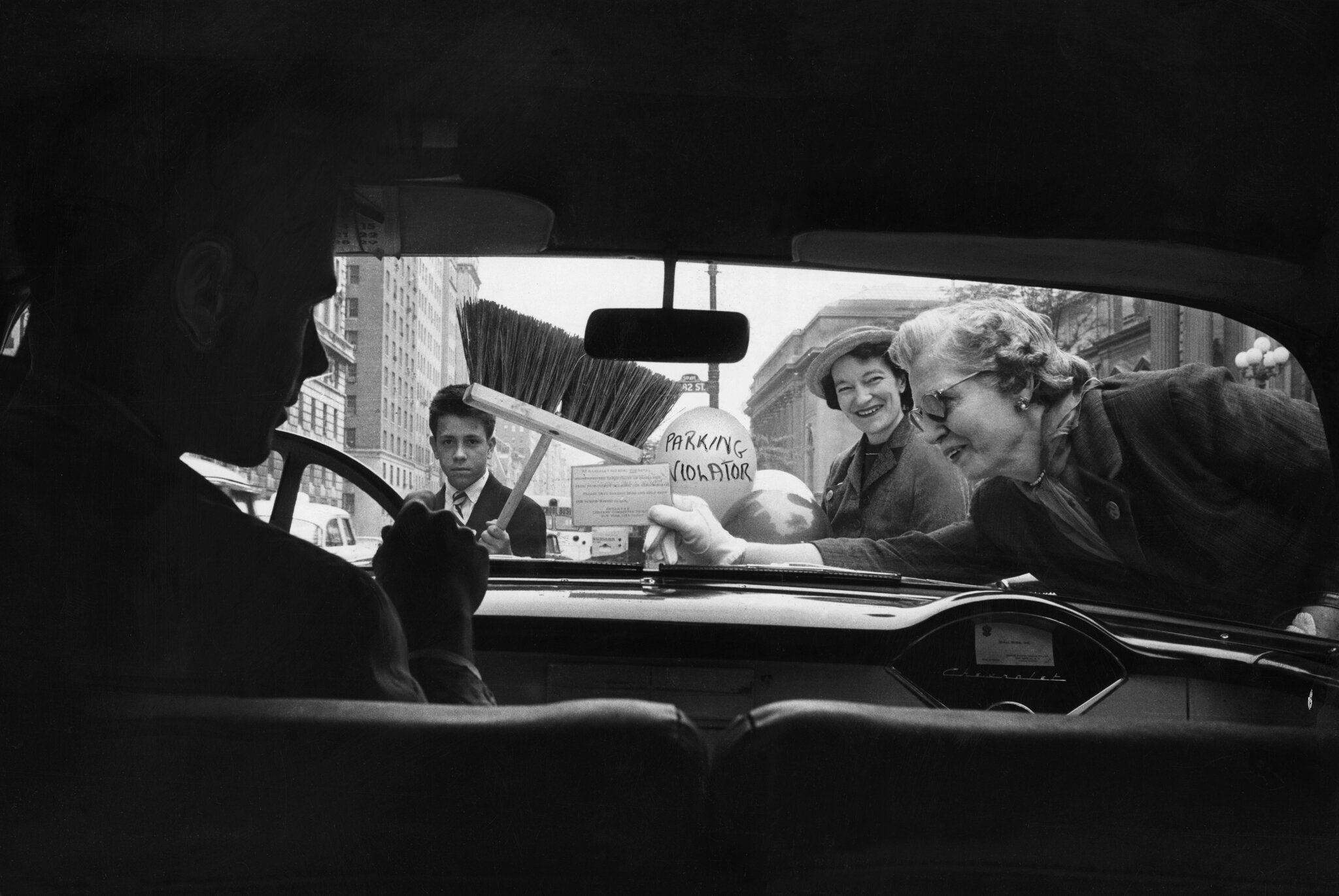
The Citizens Committee to Keep New York City Clean uses brooms, balloons and printed warnings to urge Upper East Siders not to violate alternate-side parking rules.
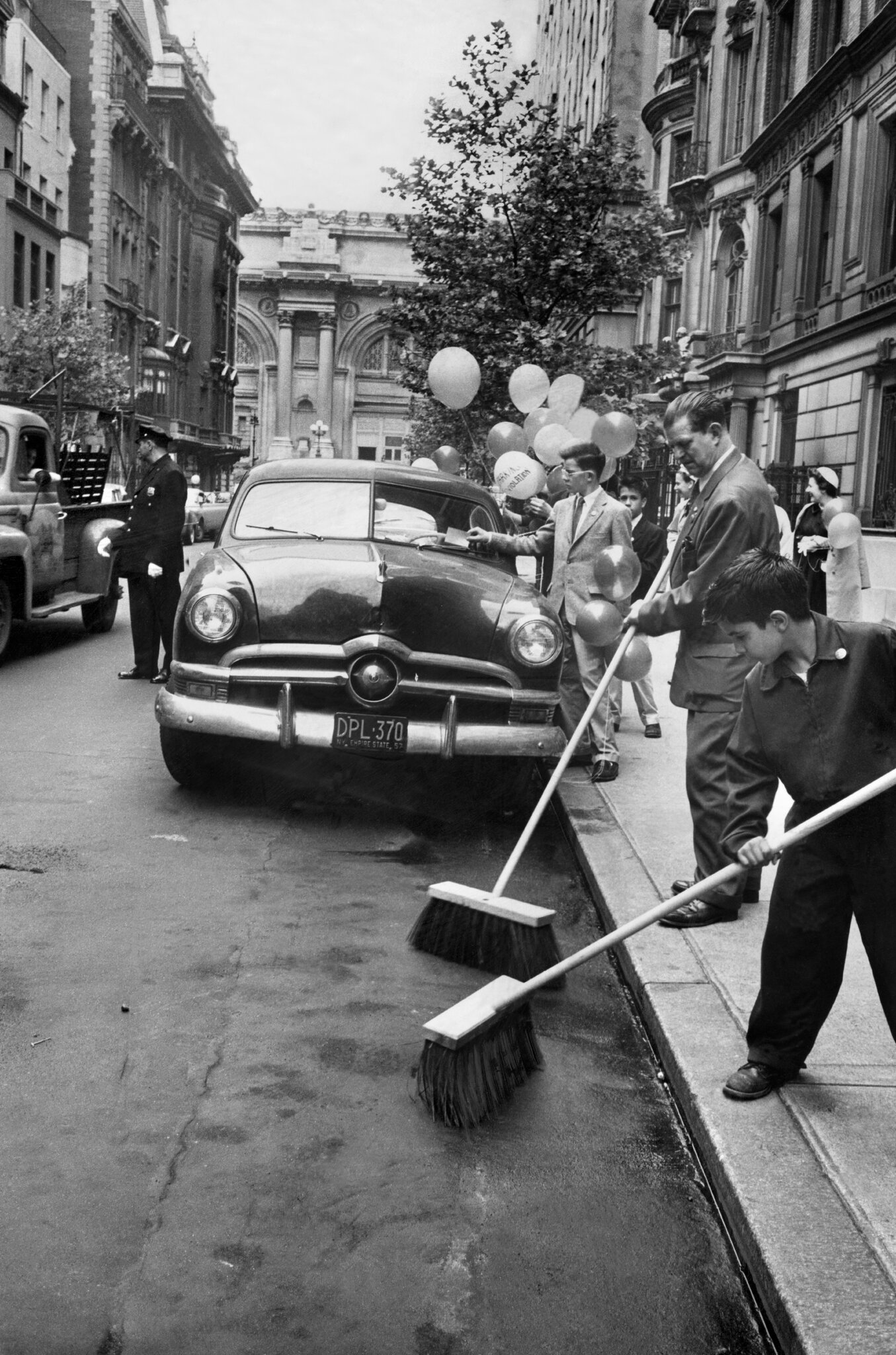
Ed Hausner/The New York Times
1959
Mayor Robert F. Wagner Jr. refuses to impose the overnight parking tax because the city would have to guarantee car owners a parking spot in return. “We concluded that this was nothing more than a ‘hunting license’ for spaces we cannot produce,” he says.
1960
The city’s first civilian parking enforcement agents hit the streets, taking on a job that had previously been done by the police. Most are women, and they are commonly called meter maids.
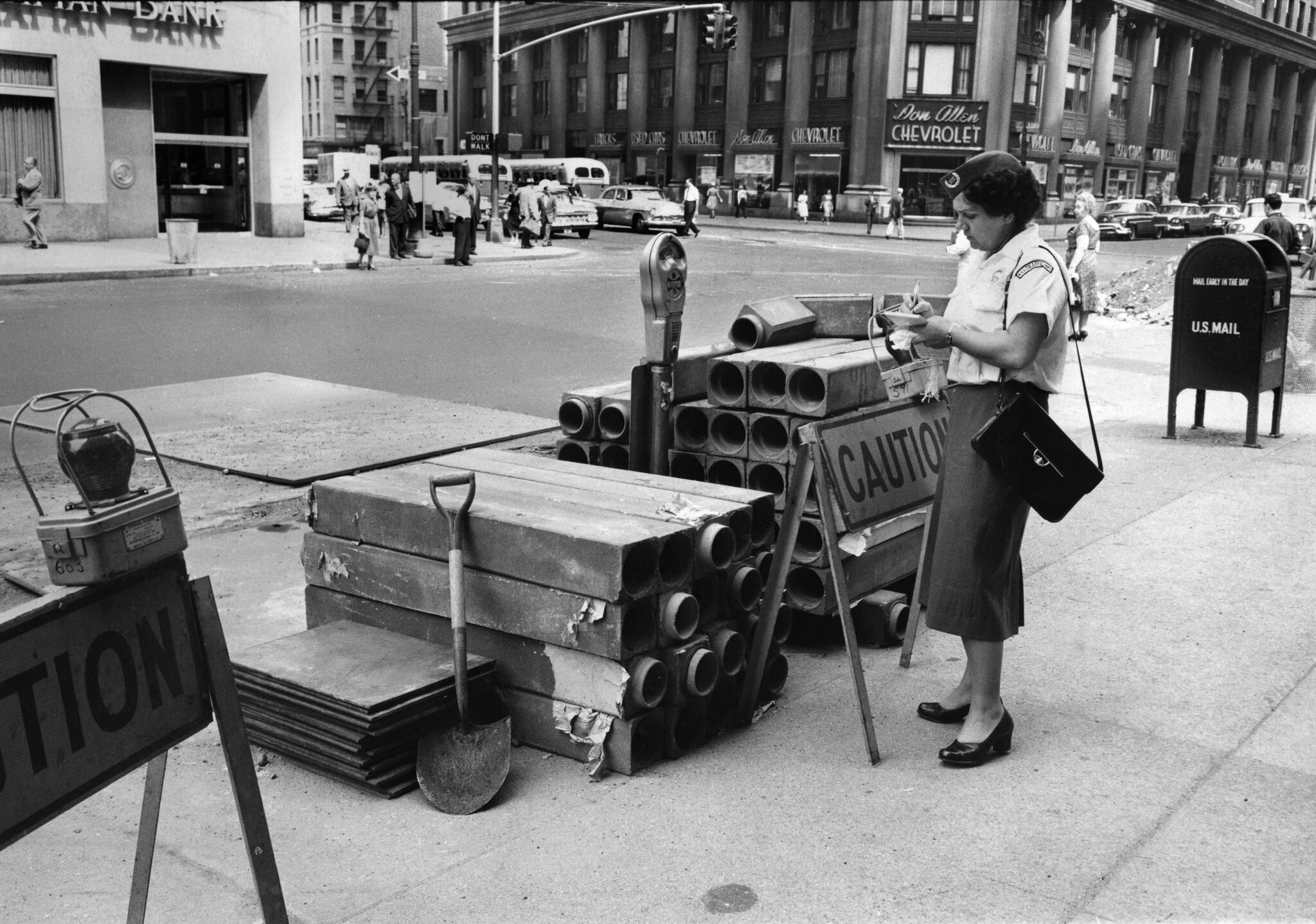
Construction material blocking a parking meter draws the attention of a parking enforcement agent. Allyn Baum/The New York Times
1966
The police break up a burglary ring that made master keys to the city’s parking meters and rented them to thieves on a weekly basis. After a weekslong chase, the masterminds of the ring are arrested in a hotel room in Cleveland.
1968
More than half of the city employees who collect and transport money from parking meters are believed to have taken part in a theft ring that skimmed more than $5 million from the city’s meters. Investigators put coins with chemical markers in some meters to track whether they are being stolen.
1969
A city program tows illegally parked cars in Midtown by the tens of thousands to a pound on the Hudson River piers. “Recently a motorist became so upset while he was in the property clerk’s office on Pier 96 that he bit a patrolman,” The Times reports.
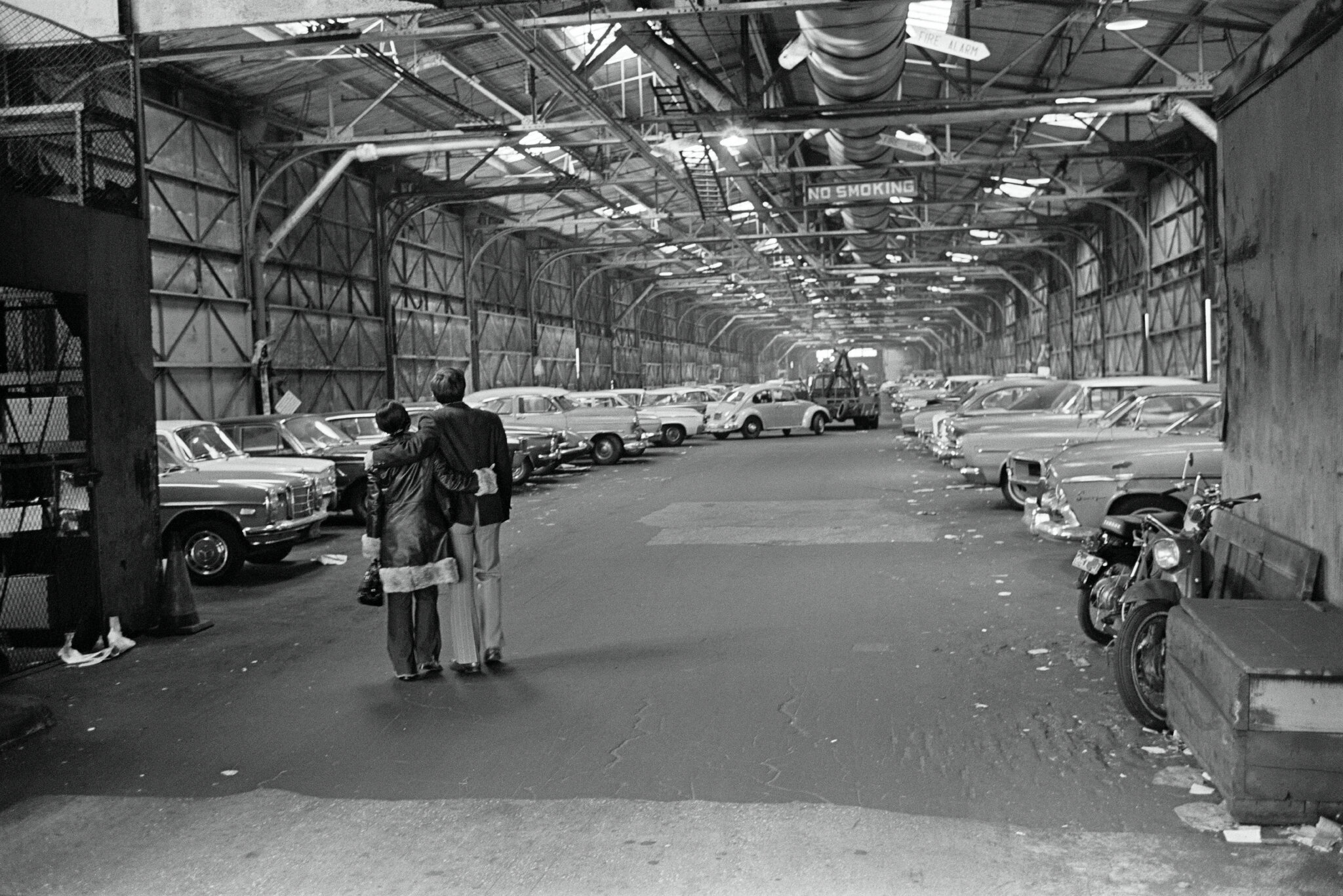
This couple paid $25 to recover their towed car from a pier on the Hudson River. William E. Sauro/The New York Times
1971
Residents of Greenwich Village protest new parking meters placed in the middle of the sidewalk, perilously close to stoops and playgrounds. Their congressman, the future mayor Edward I. Koch, rails that the city is “destroying the sidewalk.”
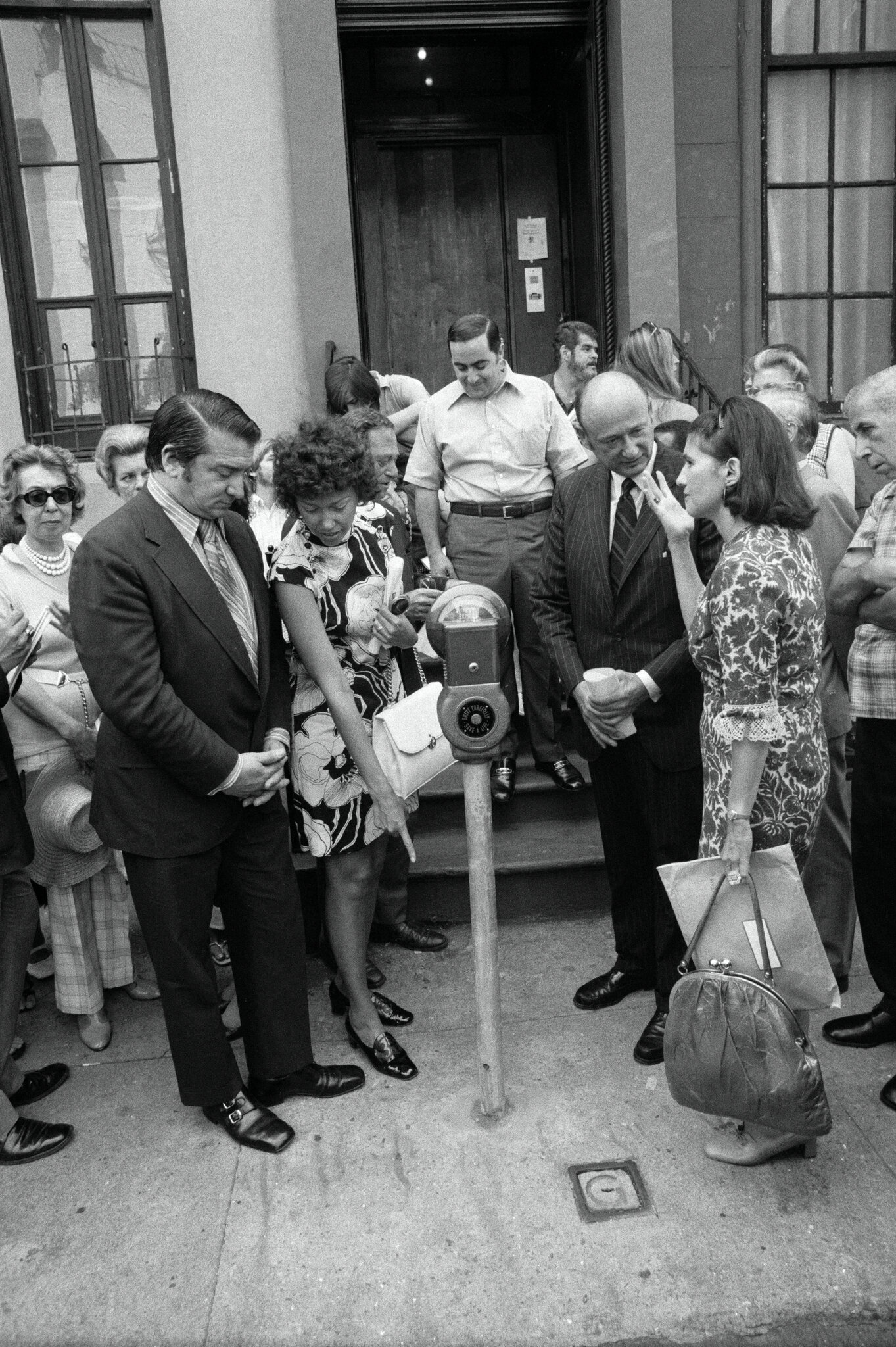
An array of elected officials and candidates, including Edward I. Koch (right, in suit) and Miriam Bockman (left, pointing), inspect a problematically placed meter in Greenwich Village. Robert Walker/The New York Times
1972
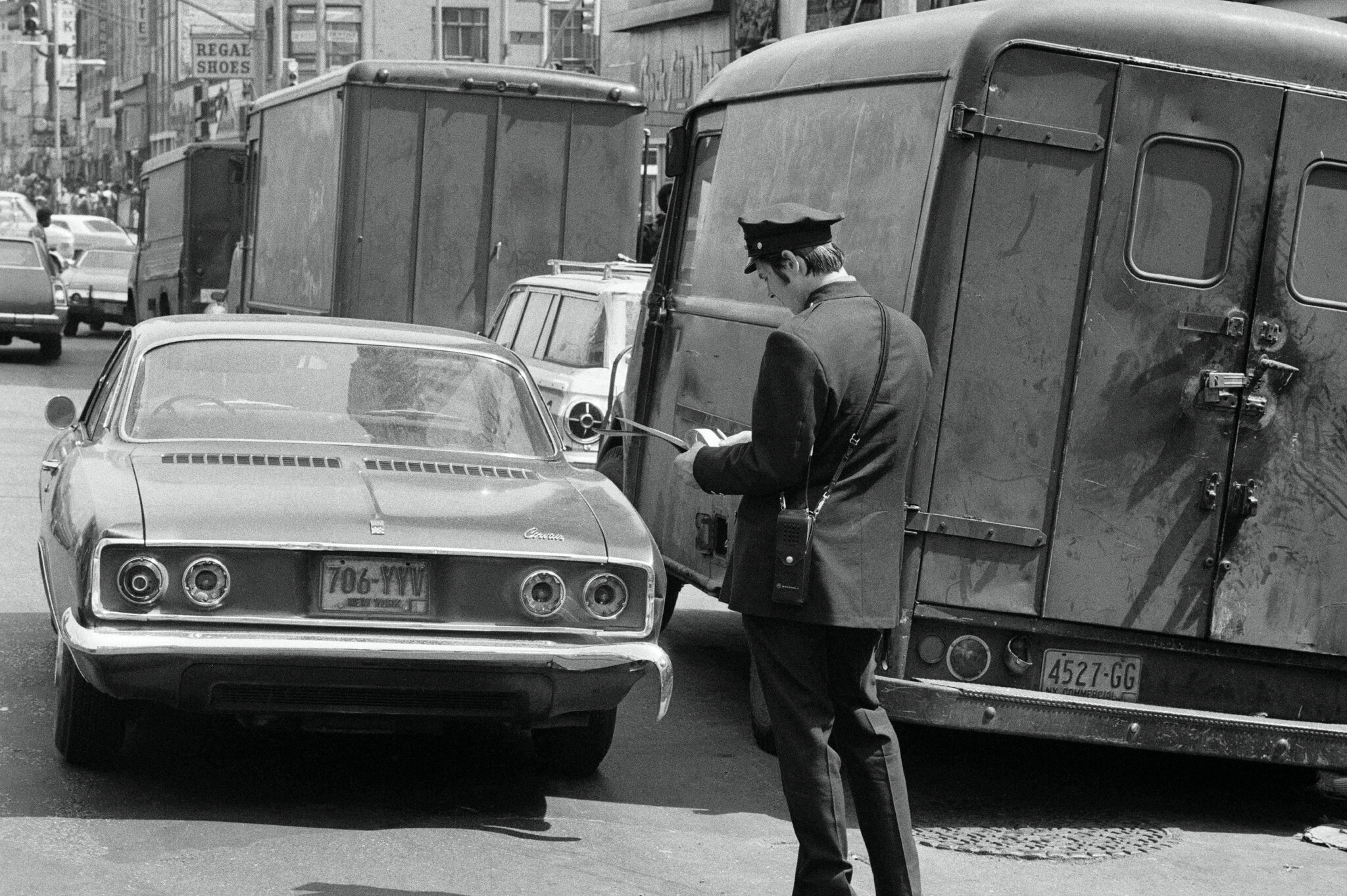
A study of three of Manhattan’s most congested neighborhoods finds that 45 percent of parked cars are parked illegally.
A police officer writing a ticket for a double-parked car on West 125th Street. Don Hogan Charles/The New York Times
1973
Two drivers, a man and a woman, vie for the same vacant parking spot on the Upper West Side. The man pulls in first. The woman fatally shoots him and then drives off.
1977
The Environmental Protection Agency orders New York City to ban most parking in Manhattan south of 59th Street to comply with the Clean Air Act. The agency eventually backs off.
1983
A crackdown on double-parking enrages Upper East Siders who “have come to consider double-parking something they are entitled to,” The Times reports. Neil Isman, a gallery owner, fumes, “‘What with my child-support payments and everything, I can’t afford to pay $200 to $225 a month for a garage.’”
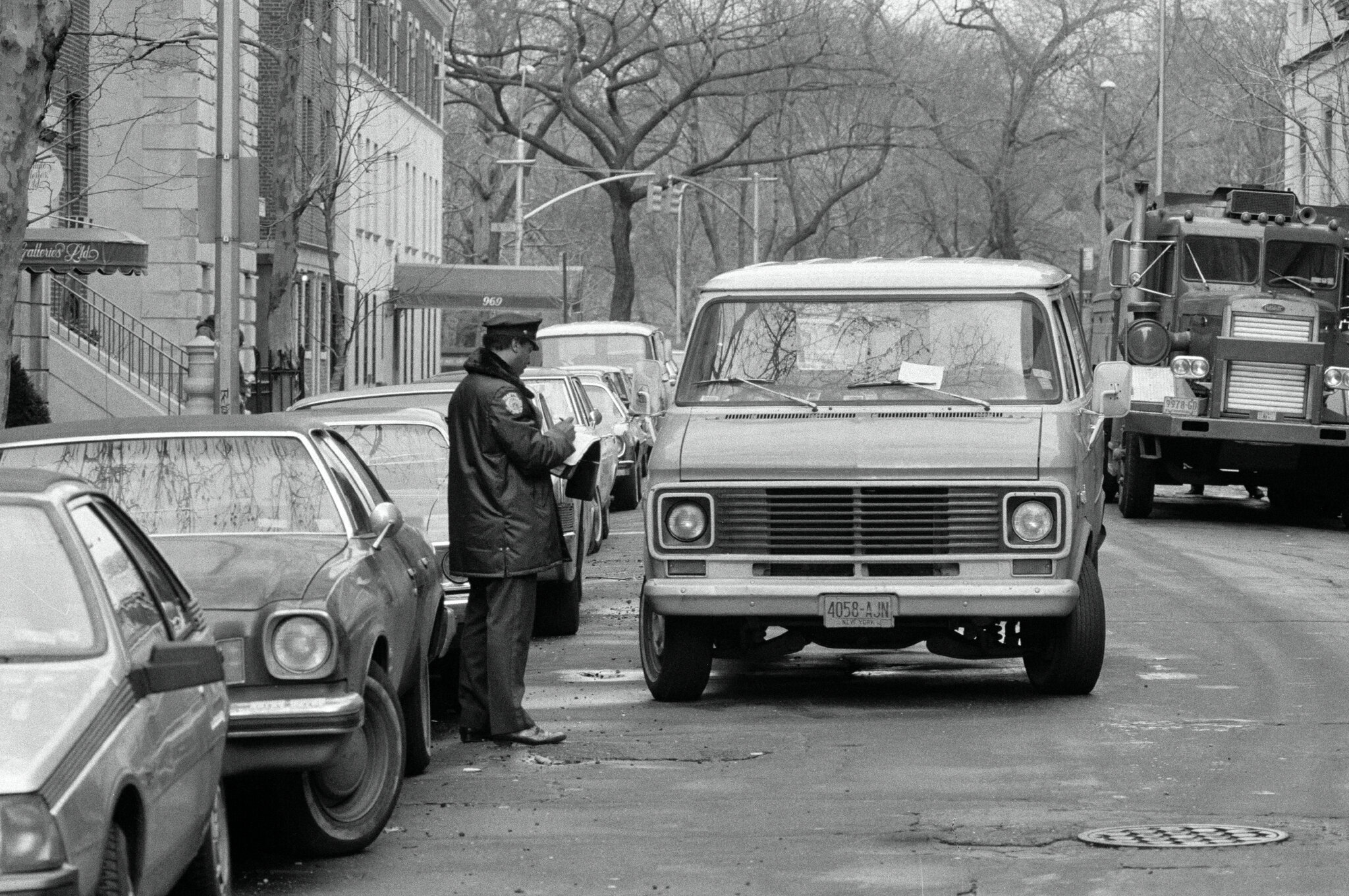
A van gets a ticket for double parking on East 78th Street. Vic DeLucia/The New York Times
Paid Parking Evolves
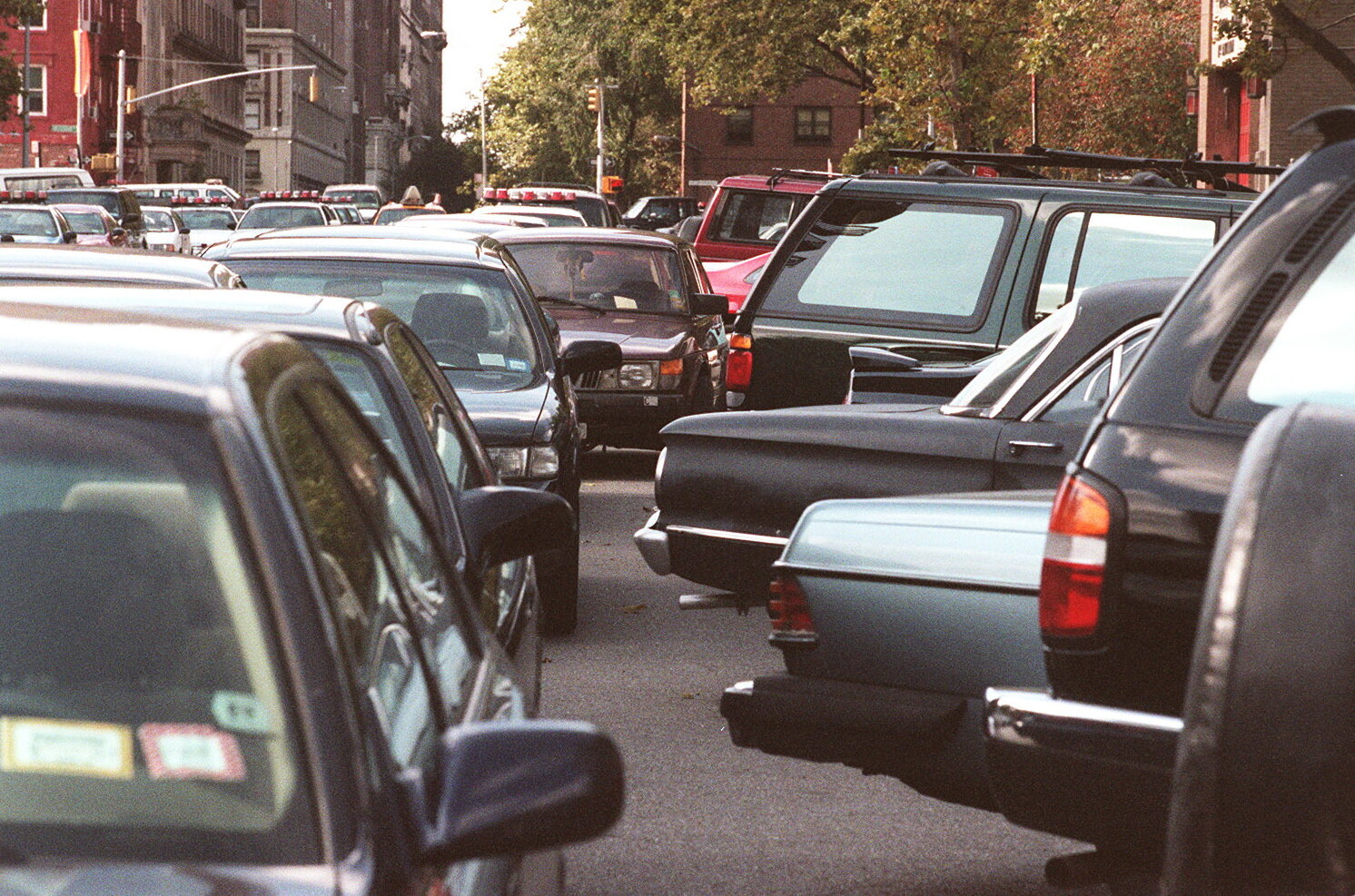
Outside the 24th Precinct station house on West 100th Street, double- and triple-parked cars belonging to police officers hit a nerve with residents in the late 1990s. Edward Keating/The New York Times
1986
The Transportation Department unveils a parking meter that will accept payment via special prepaid credit cards. Mayor Koch calls it “the wave of the future.” Ten years later, it is put into use.
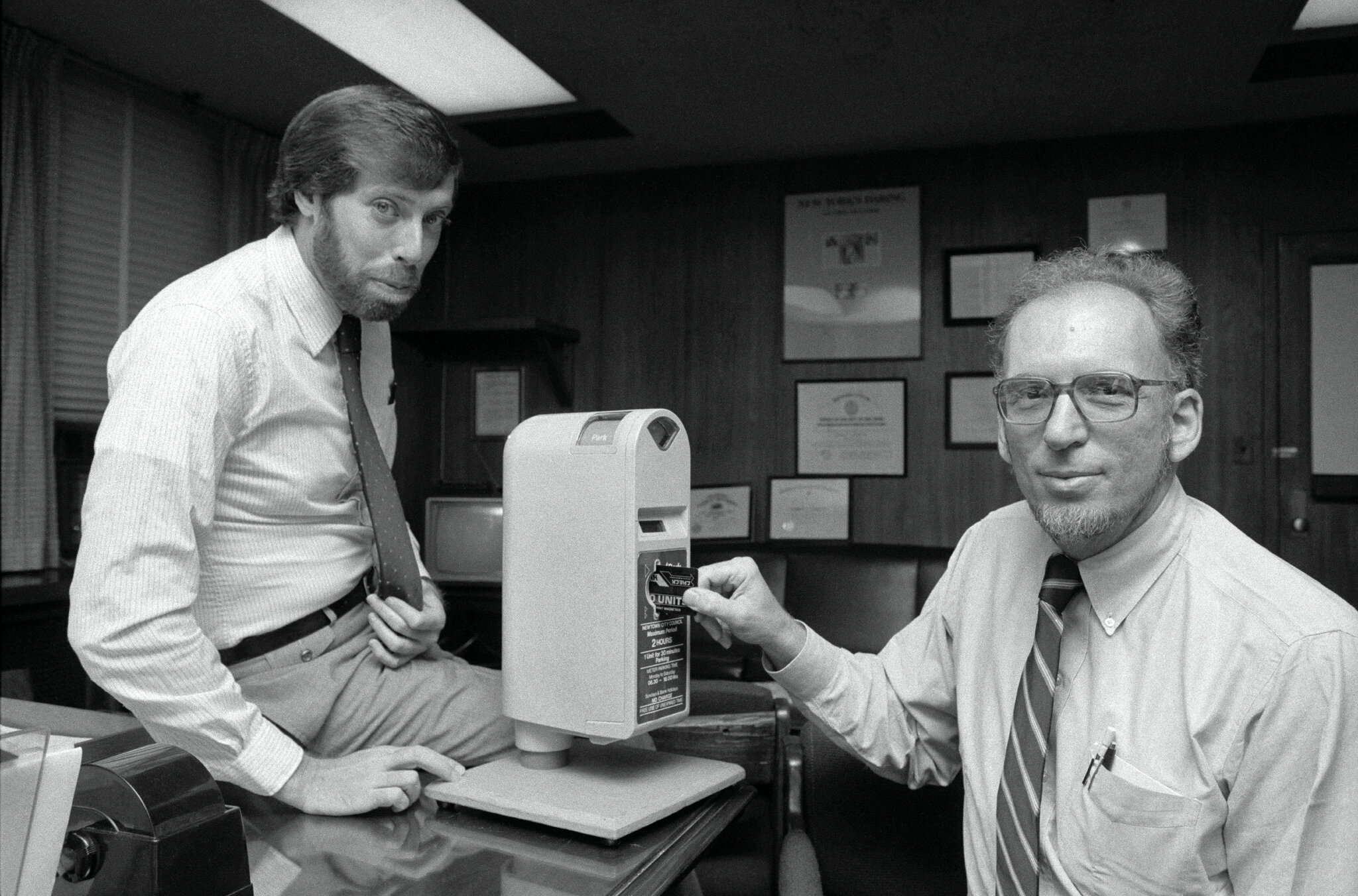
“The parking meter as we know it will be obsolete” by the year 2000, the city’s deputy transportation commissioner, Samuel I. Schwartz, left, said as his boss, Commissioner Ross Sandler, previewed a newfangled meter. Chester Higgins Jr./The New York Times
1986
A many-tentacled scandal centered on the city’s Parking Violations Bureau leads to dozens of convictions and a politician’s suicide. Prosecutors say that party bosses took bribes and kickbacks from towing companies and firms that sold hand-held summons printers to the city.
1987
Workers who collect money from parking meters are charged with skimming more than a million dollars in quarters. The city creates a unit to prevent such thefts. Six years later, 20 workers from that unit are charged with stealing another $1 million.
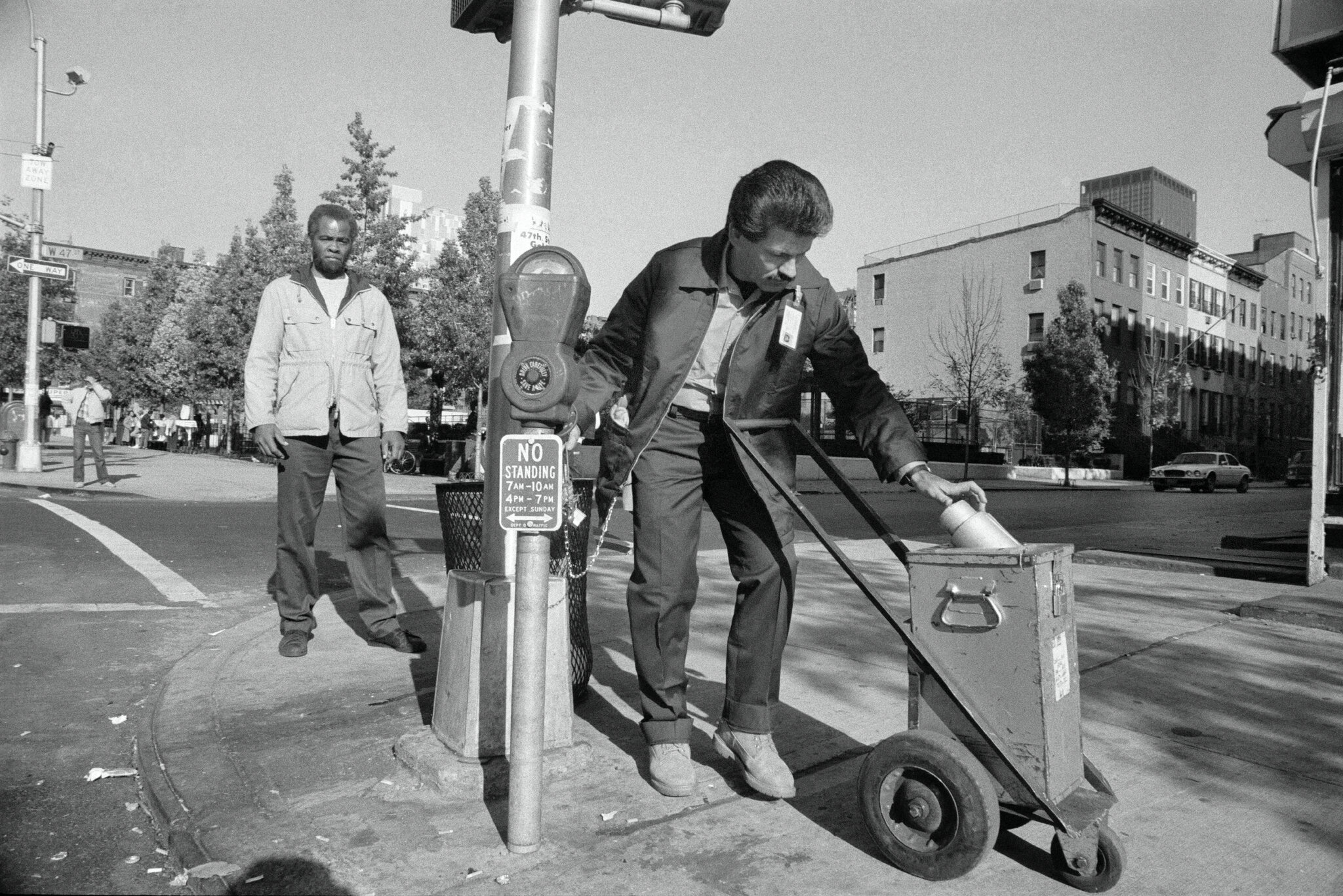
Jackson Velez, a meter collector, making his rounds on Ninth Avenue in Manhattan in 1986. A year later, he would be charged with stealing from meters. Larry C. Morris/The New York Times
1993
The city’s 68,000 parking meters are vandalized an average of seven times each over the course of the year. Parking is free when meters are broken, so vandals simply break them rather than pay.
1996
Mayor Rudolph W. Giuliani shifts the city’s corps of parking enforcement agents from the Department of Transportation back to the Police Department, a change that critics later say led to looser enforcement.
1996
The city parking meter vaults into the future as digital timers replace mechanical tickers. When a coin is inserted, The Times explains, “a small green indicator light starts blinking, and a gray and black liquid crystal display counts down the hours and minutes until expiration.”
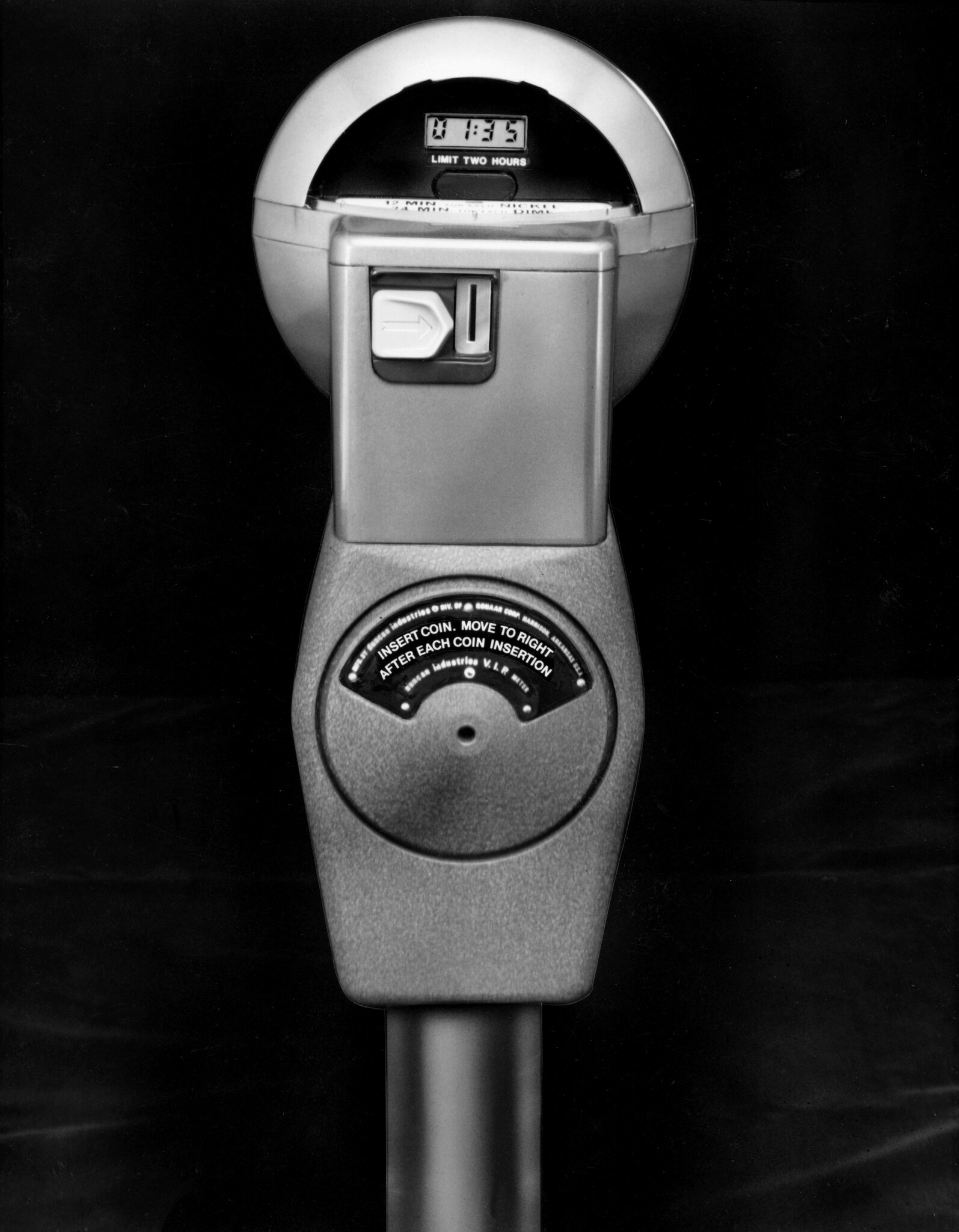
Duncan Industries
1998
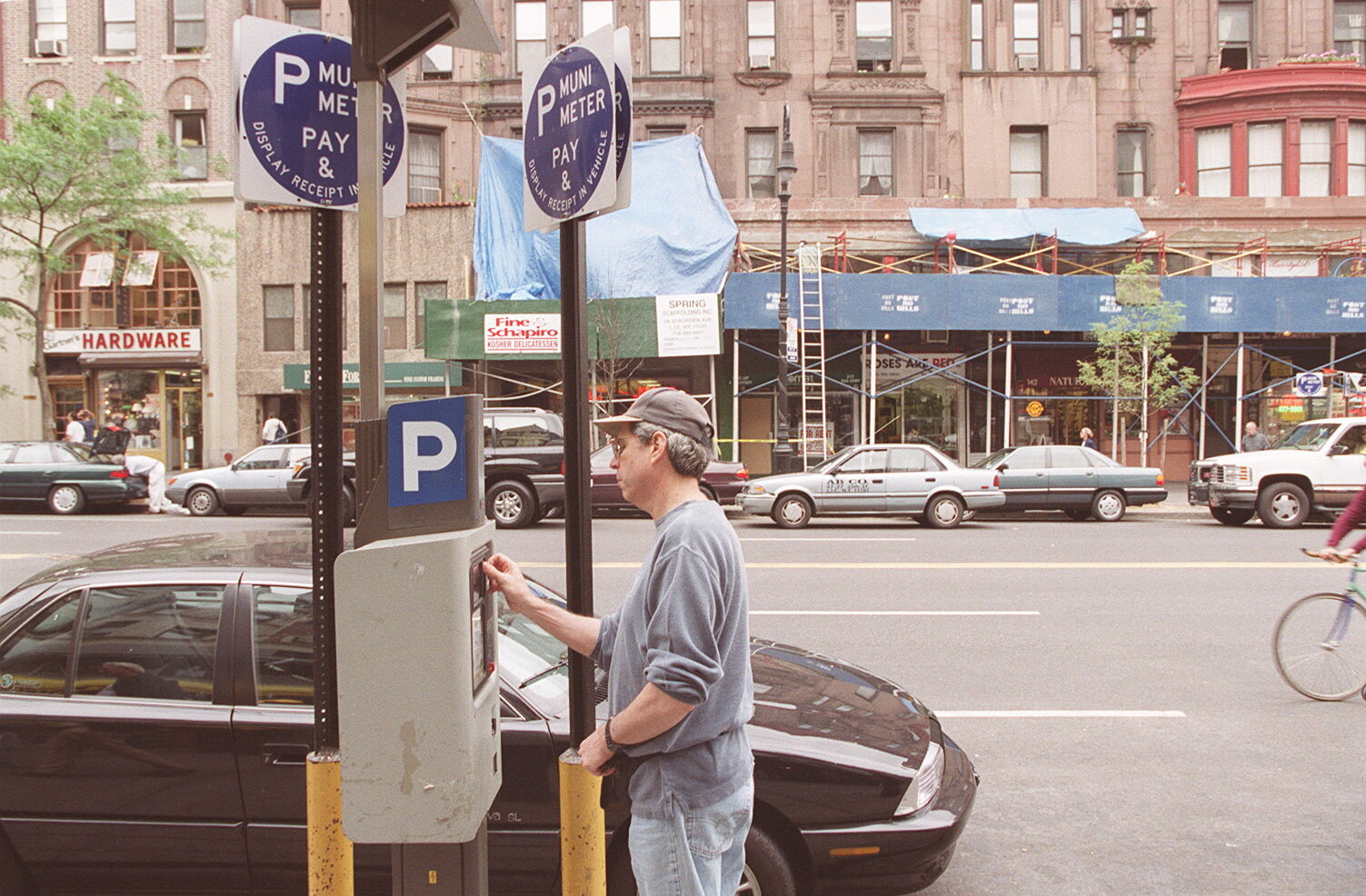
The city introduces Muni-Meters, each of which governs a dozen or so parking spots and spits out a receipt that the driver then places on the dashboard.
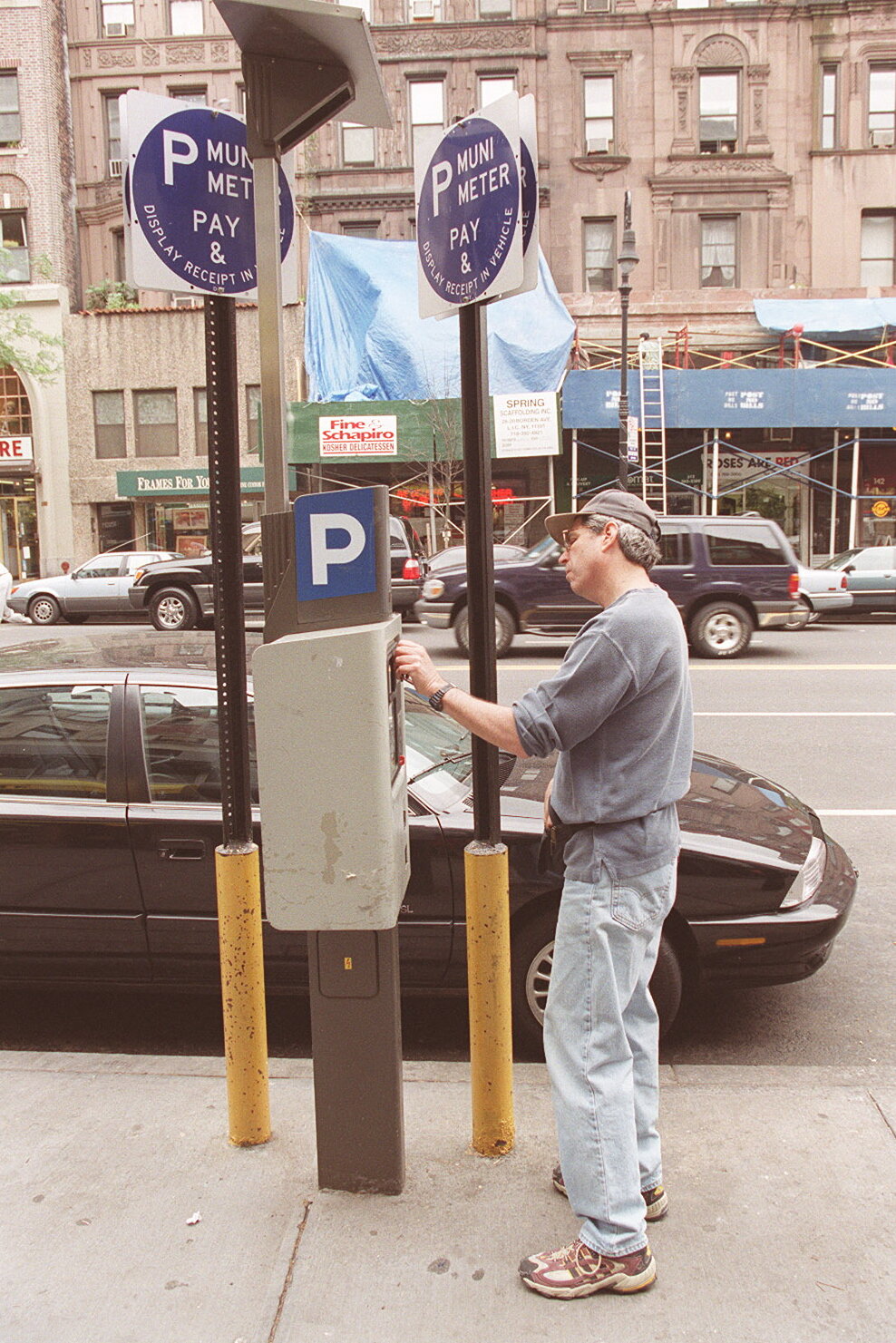
The Muni-Meter, which governed multiple parking spots and required drivers to take a receipt and place it on their dashboard, caused widespread bafflement when it was introduced. Ozier Muhammad/The New York Times
2005
Parking meters that accept regular credit and debit cards are introduced. In addition to making paying for parking more convenient for motorists, The Times reports that the meters will be a lot harder to steal from: “To guard against theft, no city employee will have access to the information” on the credit cards.
2007
Mayor Michael R. Bloomberg proposes congestion pricing: charging drivers to enter the most crowded parts of Manhattan. Anticipating that areas just outside the tolling zone would be flooded with drivers looking to park there, he also explores a residential parking permit system — a cousin of the overnight parking tax proposal that has been discussed for 50 years. In certain neighborhoods, parking would be limited to residents who buy permits. The effort stalls.
2011
The city’s last coin-operated parking meter is removed. “The cause of death, officials said, was an acute case of obsolescence,” The Times reports.
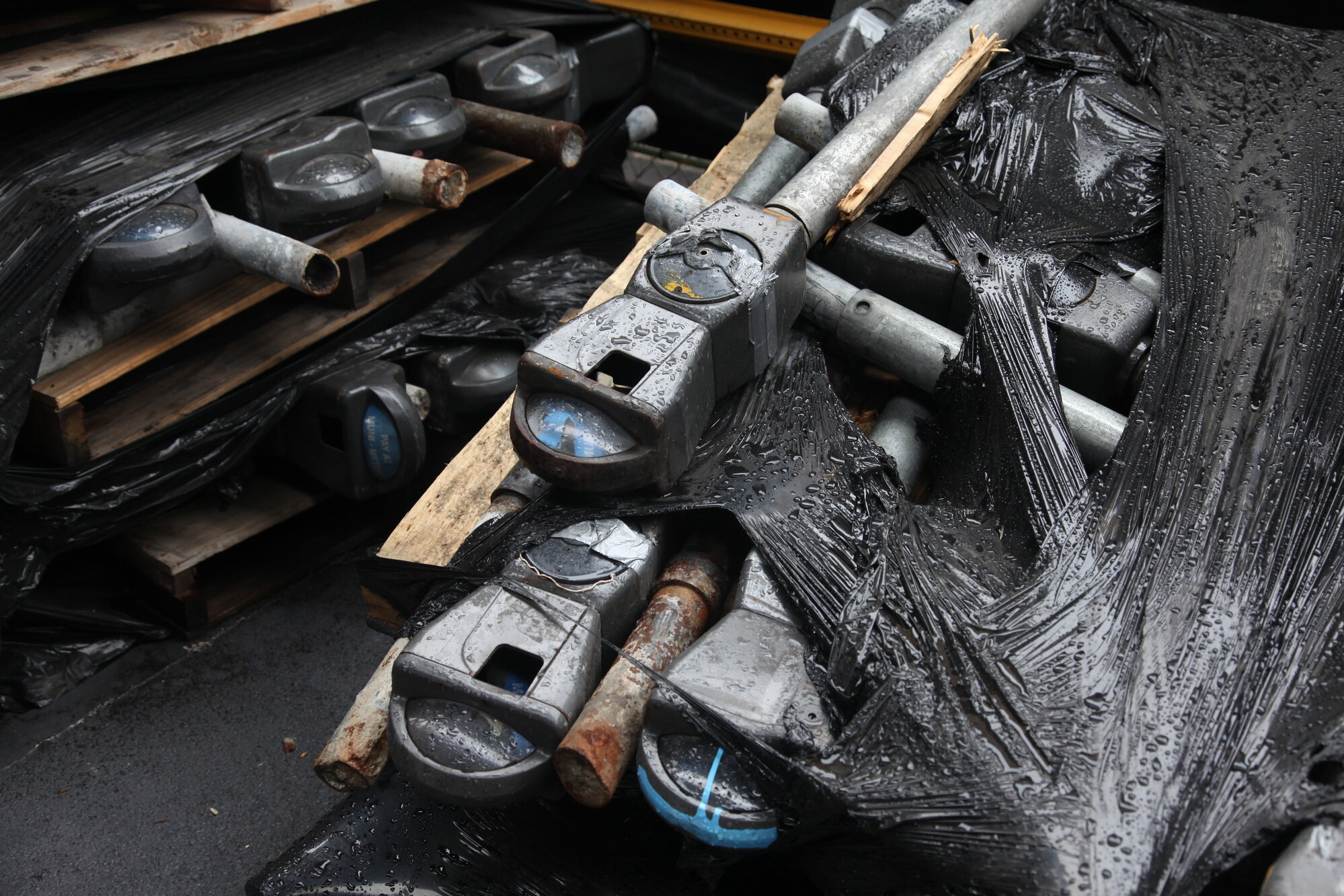
The death of the coin-operated meter, The Times wrote, “means an end to some of New York’s smaller pleasures: the satisfying clunk of a coin in its slot, the illicit thrill of finding an extra few minutes still counting down.” Todd Heisler/The New York Times
Meters Begin to Vanish, but Parking Battles Do Not
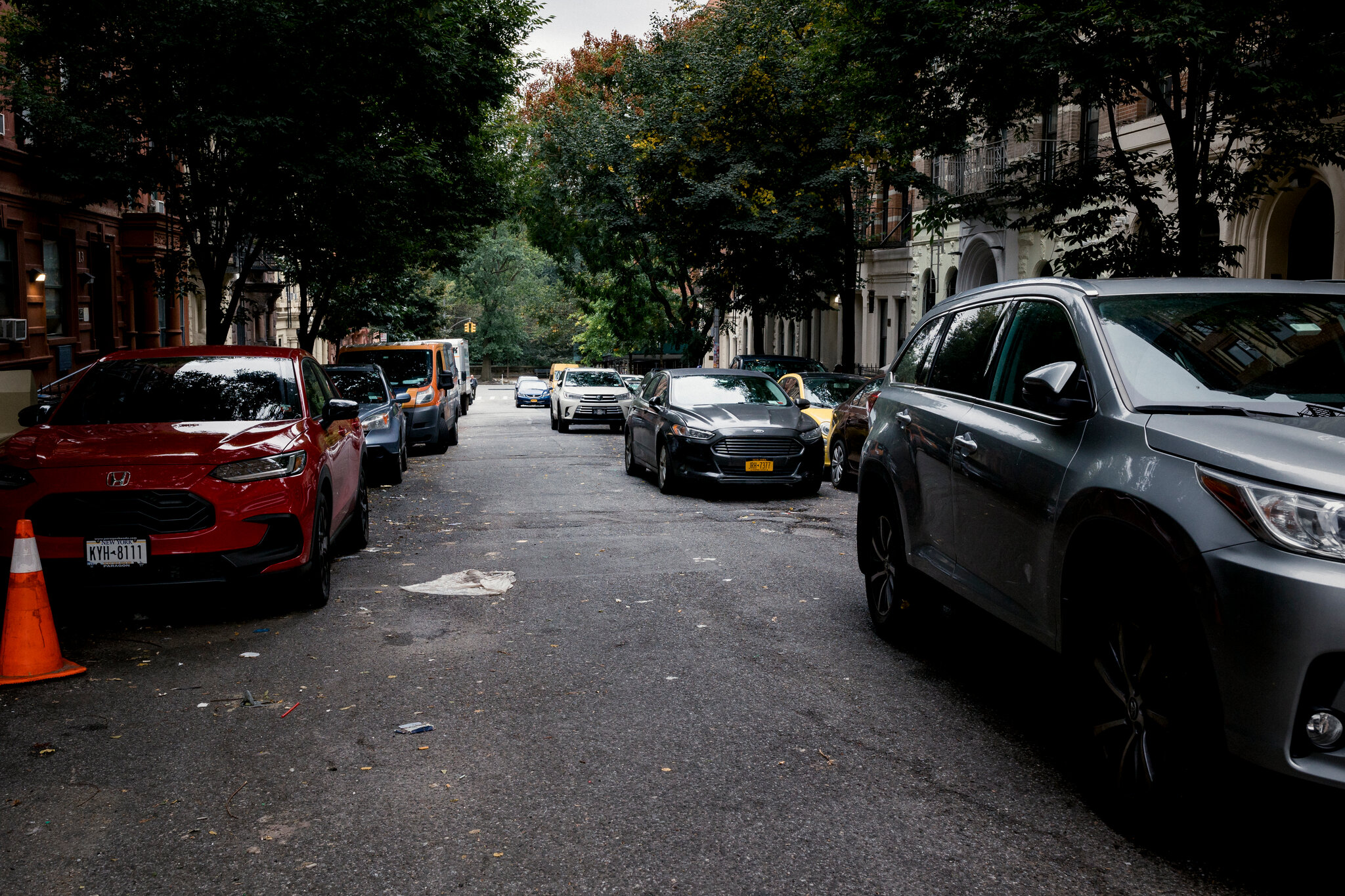
Double-parking while waiting for the street sweeper to come through remains a weekly ritual in much of the city. Sara Naomi Lewkowicz for The New York Times
2016
Paid parking goes fully digital with the ParkNYC app, which lets drivers feed the meter from the convenience of their cell phones.
2018
In a flurry of legislative enthusiasm for residential parking permits, three City Council members propose them for Upper Manhattan in anticipation of the demand congestion pricing will create. The City Council’s transportation chair calls for a citywide permit program. The bills go nowhere, though congestion pricing itself becomes law years later, in 2025.
2025
The city converts about 70 parking spaces on the Upper West Side from free to metered as part of “a comprehensive effort to reimagine the city’s curb space.” After several weeks of public outrage, the city makes the spaces free again.
2026
Mayor Zohran Mamdani’s first deputy mayor, Dean Fuleihan, is asked what he thinks about instituting dynamic pricing for parking meters — charging more when demand is high — and adding meters to many spaces that are currently free. He says the city “should be looking at all these things,” adding, “ It’s not a no.” His response sets off fresh speculation about plans to reform parking in the city.