‘AI is just amplifying that weakness’: The dangers of having AI draft difficult conversations for you | Lindsay Dodgson
-
- dry-chatting
body
AI can write the perfect difficult email—but should it? As leaders and workers outsource hard conversations to chatbots, experts say the real cost may be losing the ability to handle conflict at all.
‘AI is just amplifying that weakness’: The dangers of having AI draft difficult conversations for you
“No more reading emails, OK?” says tech founder and content creator Jason Yeager’s satirical boss character MyTechCeo in a recent TikTok skit. “I want your AI reading my AI-generated email—and answering my email.”
It’s a parody, but only just.
AI emails are proliferating across industries. In October, LinkedIn’s CEO Ryan Roslansky said he uses AI for almost every “super high-stakes” email he sends. And a recent survey from the email verification software company ZeroBounce found that one in four respondents admit to using it daily for drafting or editing their own emails.
On Reddit, employees swap stories about bosses who use AI “ to answer every email at work and thinks no one notices ” or who “ only communicate through AI-generated emails and it’s giving me anxiety.” When unsure, the most realistic response is to use AI too. Plug your message into a chatbot, tweak what comes out, and send it back.
But if you receive a message that was likely written by AI, especially in the midst of a disagreement, you can tell—something’s off.
It sounds a little too well drafted. The tone is reasonable and balanced. And while the problems are addressed, there’s something missing: the voice of the person you’re communicating with. (A dead giveaway, of course, is when the prompt is left in.)
Emails may sound smoother this way, but experts worry that outsourcing difficult conversations also bypasses the relationship-building that makes workplaces function. When you ask a chatbot to rewrite your message to be more “concise” or “professional,” it can also strip away the emotional substance of the exchange—an act that may be shaping the future of work for the worse, incubating a generation of professionals who can’t talk to one another.
The great social offloading
There is some reported benefit to “ dry-chatting ” with AI—practicing tricky topics with a bot first so you can tackle the issue directly and clearly with someone afterward. Used as rehearsal, AI can be an effective tool in building confidence.
But when used as a substitute, it does the opposite. Filling the gap entirely, with one person’s ChatGPT effectively talking to another person’s Claude, can create distance. This runs counter to what companies say they want when bringing colleagues back into the office: creativity, collaboration, and stronger working relationships.
“When it handles the hard conversation, the human never builds the muscle of doing that,” Leena Rinne, vice president of leadership, business, and coaching at the workplace skills management platform Skillsoft, tells Fast Company. “It’s not just that the interaction risks feeling like AI—because it does—but you’re actually compromising trust with the person.”
Rinne calls this outsourcing of difficult conversations “social offloading.” It’s particularly problematic when leaders resort to it, Rinne says, because it “almost regresses their ability to have the hard conversations.”
“Now you’re less in the moment and less able to do this thing that leaders need to be able to do,” she says. It’s a problem for everyone involved: The boss isn’t developing the skill of communicating more clearly, and the employee isn’t figuring out how to effectively push back and ask for clarity.
Carla Bevins, associate teaching professor of business management communication at Carnegie Mellon University’s Tepper School of Business, tells Fast Company she’s increasingly seeing people rely on AI-generated language in high-stakes moments.
“In some cases, both parties are doing this, which means the exchange is technically happening, but the relational work is not,” she says. From a business communication perspective, this distinction matters because difficult conversations are about so much more than just clarity or tone.
“They are where leaders signal judgment, accountability, and intent in real time,” Bevins says.
The temptation makes sense
The appeal is understandable. Sarah Wittman, an assistant professor of management at George Mason University’s School of Business, tells Fast Company that a lot of people have never been formally trained in how to have difficult conversations or resolve conflict constructively.
She points to social media and short-form content shrinking attention spans, along with the perfunctory exchanges that are familiar to many workplaces. At the same time, employees are busy and often anxious about getting laid off.
“We’re on the clock, messaging on Slack or Teams, or in meetings where, in the best of cases, there might be some social chit-chat,” Wittman says. “In this world, it seems logical that people are turning to a tool that can give them quick answers to solve problems that they may not know how to solve.”
For people navigating power imbalances or tense workplaces, AI can also feel like a way to protect themselves from saying the wrong thing or escalating a conflict.
Caitlin Collins, an organizational psychologist at the performance management software platform BetterWorks, tells Fast Company this signals that a workplace isn’t providing psychological safety for its workers. “AI is just amplifying that weakness,” she says.
Over time, the concern is that more and more conflict avoidance will reshape workplace culture for the worse.
Send the messy draft
Communication is especially important to learn in our early careers. Those who spent their university years, and even their first few professional years, on a laptop are in particular need of strengthening this muscle.
In organizations that are flattening and removing middle managers, leaders already have less time to dedicate to mentoring and nurturing them.
“When this layer is compressed and AI fills the gap, employees at both levels lose the chance to observe and practice,” Bevins says.
Instead, Rinne argues, leaders should set the tone by sending the messy first draft. It’s more honest, and conveys what they really mean.
“There is an element of authenticity that shows up when I make a mistake—when I flub the conversation,” she says.
“Me going back and saying, ‘Hey, I’m really sorry’, or ‘I wish I would’ve handled that differently’, builds trust,” she adds. “It can’t be my AI apologizing for me.”
The final deadline for Fast Company's Brands That Matter Awards is Friday, May 15, at 11:59 p.m. PT. Apply today.
ABOUT THE AUTHOR
Lindsay Dodgson is a digital culture writer based in London who has covered everything from startups to scams, including careers and the workplace, Gen Z and millennial culture, personal finance, human behavior, psychology, and mental health.. Her stories have been published in Business Insider, The Independent, The Mirror, Live Science, Inc., The Register, and Thought Catalog More
Explore Topics
Featured Video
This founder didn’t wait for permission to start her brand
Bringing AI to the edge: How Motive’s new AI Dashcam Plus can make roads safer
A next-generation dash cam uses real-time AI inside the vehicle to help detect more risk, act faster, and prevent more accidents
Bringing AI to the edge: How Motive’s new AI Dashcam Plus can make roads safer
While much of Silicon Valley’s AI hype centers on knowledge work, the highest-stakes applications live in the physical world—on roads and worksites where vehicles, equipment, and people intersect. In these environments, legacy safety systems are often reactive and cloud-dependent, surfacing insights only after harm occurs.
Meanwhile, America’s roads are becoming more dangerous. Nearly 40,000 highway fatalities and 6 million collisions were reported in 2024. According to, risk can be highly concentrated, spiking at specific times and in certain operating environments, with collision risk peaking at 3 a.m., when it triples compared to midday.
The report also concluded behavior is a clear predictor of danger, with speeding, hard cornering, and lane swerving most strongly linked to collisions. Cell phone use—especially in the late afternoon—along with in-cab distractions such as smartphones, digital cockpits, and smoking behind the wheel (which Motive’s report detected nearly 4,000 times per day last year) further increase risk.
In response, companies are turning to real-time AI to strengthen driver safety before incidents happen.
A NEW APPROACH TO DRIVER SAFETY
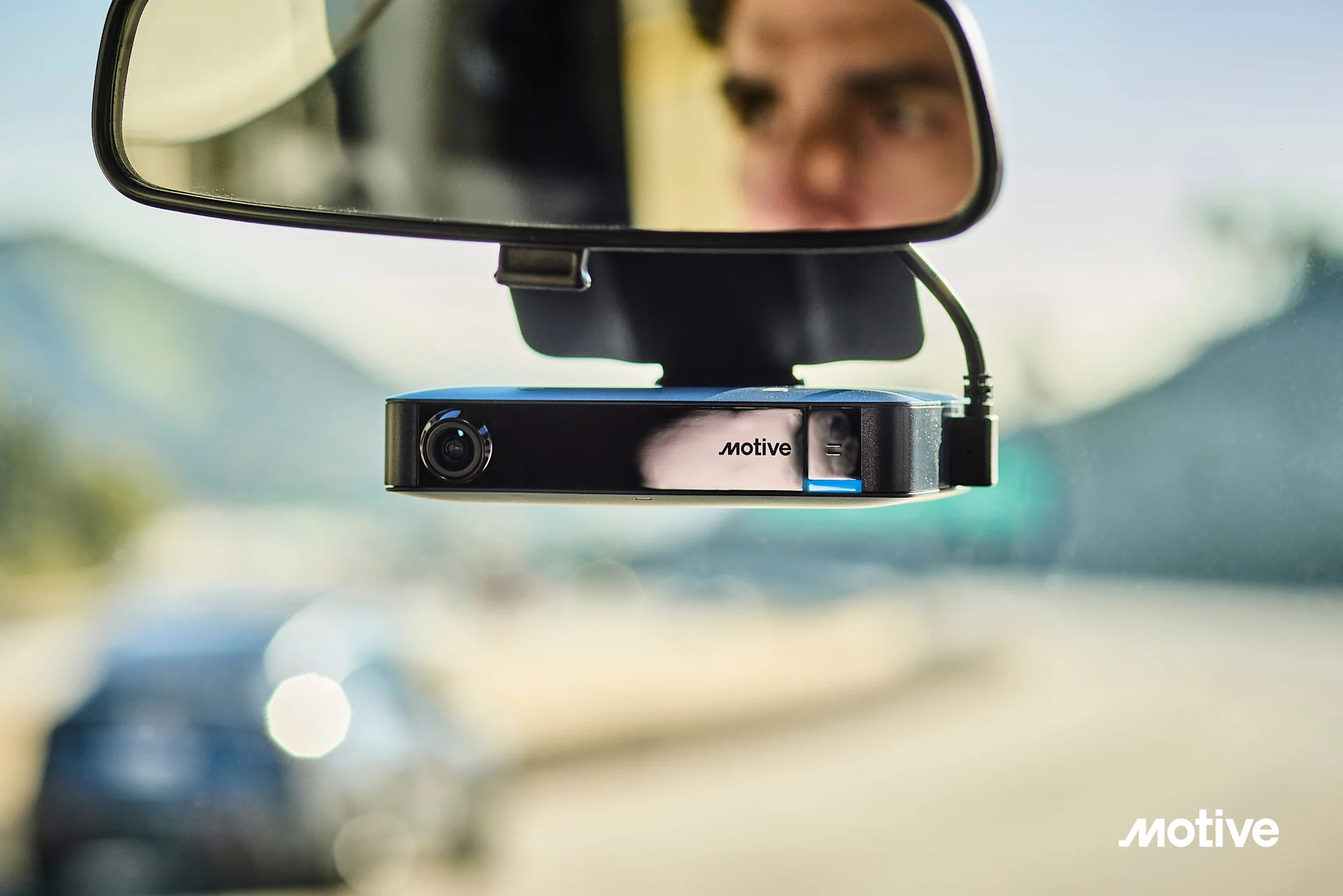
, a San Francisco–based company, builds AI for physical operations across industries including transportation and logistics, construction, field service, manufacturing, the public sector, and more. Its new is a first-of-its-kind dash cam that brings enterprise-grade reliability into one unified device, going beyond recording incidents to help actively prevent them.
Powered by the Qualcomm Dragonwing QCS6490 processor, AI Dashcam Plus delivers three times more processing power than other leading dash cams, enabling it to run more than 30 high-precision AI models simultaneously. It can detect unsafe behaviors such as lane swerving, fatigue, mobile phone use, forward collision risk, and close following—surfacing early signs of danger before they escalate.
“Real-time AI at the edge turns the Dashcam Plus from a passive witness to an active copilot,” says Motive CTO. “When you’re moving 40 tons of steel down a highway, you can’t wait for the cloud—the AI has to run inside the vehicle to see what’s happening and act in milliseconds.”
Motive’s advantage also comes from scale. Its models are trained on data from more than one million vehicles and assets on its platform, helping improve detection accuracy while reducing false positives.
HARNESSING EDGE COMPUTE
Edge AI, which processes video and sensor data directly inside the vehicle, is baked into nearly every part of the AI Dashcam Plus. “In addition to the video from multiple lenses, it takes motion data, as well as GPS and telematics and audio, and runs all that information in real time,” Babu says. “The compute detects collision-risk behaviors like lane swerving and can alert the driver when there’s still time to avoid a crash.” Sensor fusion technology—similar to that used in advanced fighter jets—coordinates this data seamlessly.
AI Dashcam Plus also offers first-of-its-kind stereo vision for superior depth perception with dual forward-facing lenses, allowing it to judge distance and closing speed more accurately. The two synchronized lenses provide “a human-like sense of depth perception,” as Babu puts it, helping increase the accuracy of alerts to reduce rear-end and sideswipe collisions.
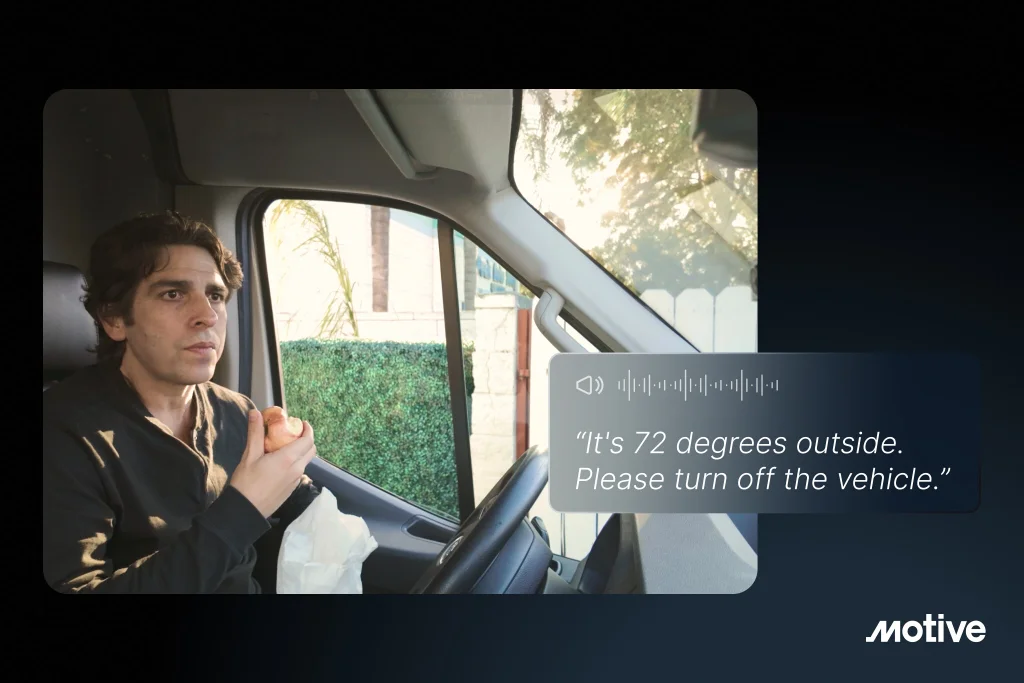
Beyond collision prevention, the device is designed to address additional safety and operational risks. Live two-way calling will let managers instantly reach drivers during fatigued driving, weather emergencies, or route changes. “A manager might get a weather update about an approaching storm and call a driver to have them reroute or pull over,” says Motive’s product marketing lead. An upcoming AI Voice Assistant is designed to respond to “Hey, Motive” voice commands, letting drivers save critical footage, check drive time, or run other queries hands-free, with dual microphones reducing background noise.
Motive AI Automations will prompt drivers to quickly correct issues like critical fault codes and excessive idling, while Automated License Plate Recognition, enabled by a 1440p zoom lens, will help capture clear plate details in motion or poor weather, helping speed investigations and to exonerate drivers.
MOTIVE HELPS MTM TRANSIT REDUCE SAFETY INCIDENTS
, senior director of maintenance for MTM Transit, a medical- and public-transportation provider, oversees more than 1,500 passenger vehicles, including vans, taxis, and fixed-route buses. After deploying Motive’s AI Dashcams across his fleet, he saw quick results. Within a year, road incidents triggering recordings dropped from 8.7 events per thousand miles to 1.2, while in-cab smartphone use plunged 96%.
Seber also points to a program (that Motive helped set up) in which drivers involved in close-call events are brought in to review video footage captured by the Dashcam. “We’ve had drivers with decades of experience who were surprised—even grateful—to see how they were following a vehicle too closely or rolling through a stop sign,” he says. These sessions, Seber adds, also help cushion the company’s bottom line. “We estimate saving $1 million to $2 million every year, just in the accidents that never happened because our drivers changed their behavior.”
These numbers aren’t just metrics. They represent safer passengers, reduced liability, and more predictable operations. Since 2023, Motive estimates its AI Dashcam has helped prevent more than 170,000 collisions and saved approximately 1,500 lives. Based on an internal survey, the top quartile of surveyed customers reported reduced.
LOOKING AHEAD
Improving driver and vehicle safety is among the top priorities for carriers adopting new technology, according to 451 Research’s Supply Chain Digital Transformation Survey 2025. AI-powered solutions that deliver real-time coaching, automated in-cab alerts, and proactive risk detection are becoming central to how fleets strengthen safety and accountability. AI Dashcam Plus reflects that shift, delivering proactive feedback when a quick correction can prevent a collision and help reinforce safer habits across operations.
As Babu states, a modern enterprise dash cam is no longer just a recording device. It’s “a windshield-mounted safety-focused computer that has to see the road, understand context, detect threats, and make decisions in milliseconds—and do this reliably in conditions that are often harsh and messy.” Switching to the language of a CTO, he adds that Motive has “set a foundation for the next generation of AI-driven capabilities that can help fleets move from merely reactive tools to proactive connected operations that drive safety and efficiency.”
In a world where speeding, distraction, and fatigue remain persistent risks, real-time intelligence inside the vehicle can make a measurable difference—for fleets and for everyone who shares the road.
