Empowering American Workers in the Age of AI | Bharat Ramamurti
- [/] •workfutures.io +unions +sectoral bargaining •AI +AI backlash: Empowering American Workers in the Age of AI | Bharat Ramamurti #soonish #investigate
body
The journalist Jasmine Sun recently published a long piece in the New York Times with the provocative title, “Silicon Valley Is Bracing for a Permanent Underclass.” Her thesis is that while “Silicon Valley has long warned about the risk of rogue A.I., it has recently woken up to a more mundane nightmare: one in which many ordinary people lose their economic leverage as their jobs are automated away.” Specifically:
Whether you talk with engineers, venture capitalists, founders or managers, or with doomers, accelerationists, lefties or libertarians, the so-called San Francisco consensus on the impact of A.I. for workers is bleak. Many are convinced that advanced A.I. will soon surpass human capabilities. This would produce tremendous growth and scientific achievement, but it would also displace millions of jobs as fewer people are needed to run the economy. The technology will depress economic mobility and exacerbate inequality, while ferrying power and wealth to the A.I. companies and the existing owners of capital.
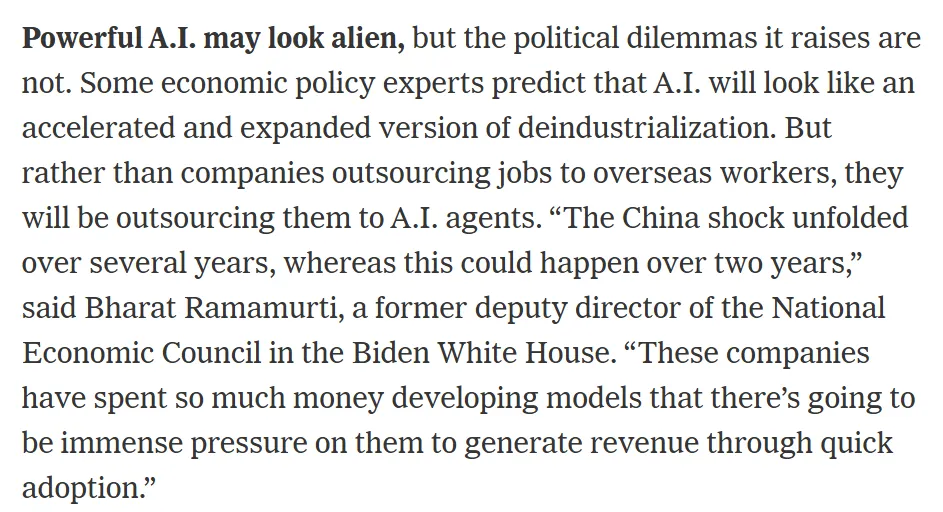
As readers of The Bully Pulpit know, I share a lot of these concerns. I co- wrote a piece last July that predicted that over the next decade, “artificial intelligence will probably replace the jobs of millions of American workers and reshape the working experience for millions more,” and that “[j]ob losses and disruption from AI could be the biggest economic issue in the 2028 presidential election.” As I said to Sun when I spoke to her for her piece, there’s a chance these disruptions happen very quickly given the financial pressure on AI companies to generate revenue and the looming possibility of a recession that spurs employers to accelerate attempts to replace human labor with less expensive AI:
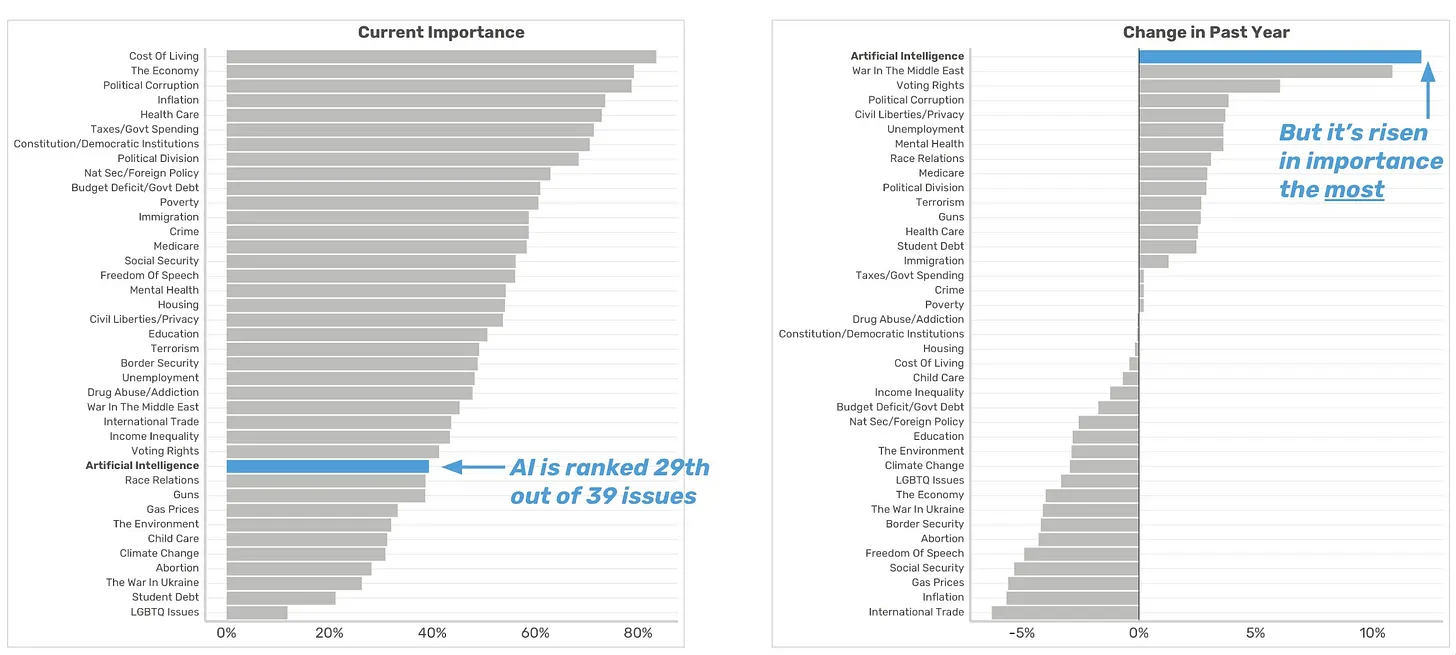
Meanwhile, the public’s concern about AI is rising. According to polling from Blue Rose Research, AI remains a lower-tier concern for the public now,[1] but it is climbing up the list of concerns faster than any other issue. If it stays on this trajectory, it will likely be a top-tier economic concern by the time the 2028 presidential primaries start in earnest.
That’s why I’m surprised that US policymakers have offered few ideas for empowering workers to withstand this coming onslaught. There has been a flurry of policy development on data centers — from bans to moratoria to efforts to make sure developers don’t raise local energy prices. Policymakers have offered ideas to tax AI companies to offer compensation to affected workers or provide wage enhancements to workers in other fields. And there have been proposals to rethink training programs to help workers displaced by AI find new jobs. But there has been relatively little policy development on ways the government can shape the initial deployment of AI to account for the needs of workers or give workers more power to shape AI deployment directly.
In our piece from last July, we pinpointed worker empowerment as one of our preferred responses to the emergence of AI. Here is an excerpt from that section of our piece:
While we are skeptical of other options, we urge policymakers to consider ways to empower workers so they have more ability to shape how their employers deploy AI in their workplace.
Consider the 2023 Writers Guild of America strike. The strike led to the successful negotiation of AI usage protocols requiring studios to disclose AI use to the public, prohibiting studios from using AI to generate original content in place of human writers, and barring studios from requiring writers to use AI to help create content. In that case, the existence of a unionized workforce permitted workers to bargain directly with management and protect their core interests—including their continued ability to engage in the artistic expression of writing—in the face of potential AI adoption.
This type of firm-by-firm or industry-by-industry negotiation could help workers effectuate their priorities and work through tradeoffs unique to their firm or field. For example, while the screenwriters seemed interested in limiting AI adoption in order to protect the creative elements of their job, other types of workers might happily trade more AI usage in their workplace for higher pay and better benefits. Others might prioritize a four-day work week rather than more compensation. Still others might welcome the introduction of AI with no additional compensation because it eliminates mundane tasks they would rather not do. But Hollywood screenwriters are the exception, not the rule, because only 6% of private-sector workers in the US are unionized. In fact, research from the Brookings Institute shows that the sectors most exposed to AI are also the ones with disproportionately low levels of unionization. The workers that could most benefit from collective bargaining in the face of AI are the ones least likely to have access to it.

Policymakers should explore options for empowering workers in this critical moment. That could certainly involve traditional efforts to make it easier to join a union and collectively bargain, like the PRO Act. But policymakers should also consider new forms of worker empowerment tailored specifically to the rise of AI. One model could be sectoral bargaining over AI use: allowing workers across an industry—not just within a single firm—to collaborate with employers to set standards for how AI is adopted.
A recent precedent is California’s Fast Food Council, which was established through legislation that fast food workers and the Service Employees International Union (SEIU) supported. The council is not a traditional union with collective bargaining power, but it includes worker and employer representatives and has the authority to set binding standards on wages, working conditions, and safety.
Similar models could be used in industries with high risk of AI disruption and low unionization rates—like computer programming, HR, finance, and more—to ensure workers have a say in how AI is introduced. Policymakers could also consider initiatives that require companies to consult with worker representatives before implementing AI systems, drawing inspiration from Germany’s works councils, which provide formal mechanisms for workers to influence technology decisions in the workplace.
Our proposal is not the only pathway to worker empowerment, of course. While America largely has been stuck in neutral on this topic, other governments have plowed ahead. Here is a sampling of the leading international approaches.
Foreign Models for Addressing the Impact of AI on Workers
The European Union Model: Focusing on “High-Risk” Uses of AI
The EU has embedded AI-related worker protections into both its technology regulations and its labor laws. Under the EU AI Act, many workplace AI systems — like those used for hiring, performance evaluation, or termination — are classified as “high-risk,” requiring transparency, human oversight, and risk management. In parallel, the Platform Work Directive gives what we might call “gig workers” rights to understand and challenge algorithmic management, mandates human review of key decisions, and limits intrusive surveillance practices.
In the US, Colorado attempted to adopt a similar approach. The Colorado Artificial Intelligence Act would “protect people from artificial intelligence systems which are ‘high-risk’ because they make or substantially help to make ‘consequential decisions’ regarding humans.Consequential decisions include the decision to provide or deny education, employment, lending, government services, health care, housing, insurance, or legal services.” The business community pushed back against the law, and a subsequent lawsuit resulted in a court blocking the law before it took effect. Colorado is now considering an alternative, lighter-touch approach to replace it.
The Japan Model: Steering AI Deployment Towards Labor Augmentation
Japan has used a variety of hard and soft power tools to push companies towards adopting AI as a supplement to human labor, rather than as a replacement. Its Society 5.0 initiative emphasizes using AI to address labor shortages and improve worker productivity rather than displace employment. Guidelines issued by the Ministry of Economy, Trade and Industry and the Ministry of Health, Labor and Welfare encourage firms to deploy AI in ways that complement human work. In practice, this has led companies to focus AI investments on assistive tools in manufacturing, logistics, and elder care, where technology fills gaps created by an aging workforce.
Japan has reinforced this approach through subsidies that reward augmentation. Public funding programs tied to productivity enhancement often require firms to demonstrate workforce upskilling or job retention alongside automation investments. The result is a system that doesn’t ban labor-replacing AI but channels deployment toward collaborative human-machine models.
The Nordic Model: Negotiating AI Deployment Through Existing Labor Institutions
The Nordic countries have embedded AI deployment within their broader “flexicurity” and collective bargaining systems, which give workers and unions a formal role in shaping how companies introduce new technologies. Sectoral agreements and co-determination rules often require consultation before major workplace changes, including automation or adopting AI systems that affect job conditions. This model has often enabled deployment of advanced technologies because unions have been willing to agree to adoption in exchange for concrete concessions. In Norway, for example, labor groups have supported automation in exchange for workers receiving guarantees around job transitions, training, or wage protection. This bargain — accepting technological change in exchange for security and voice in the workplace — has helped avoid the adversarial dynamic seen elsewhere.
The Singapore Model: Investing Heavily in Worker Re-Skilling
Singapore has embraced rapid AI adopting but paired it with aggressive and lifelong re-skilling programs. Through programs like SkillsFuture, the government provides every adult with credits to pursue ongoing education and training, with additional subsidies targeted at mid-career workers. Agencies such as Workforce Singapore partner with employers and training providers to identify emerging skill needs — especially in AI, data analytics, and digital operations — and rapidly scale courses aligned to those demands.
Singapore reinforces this model with direct incentives for firms to invest in their workers alongside adopting new technologies. Government grants often require companies to commit to workforce transformation plans that include retraining, job redesign, or redeployment rather than headcount reduction. Singapore has also rolled out mid-career transition programs and wage support schemes to help workers move into growing sectors.
America’s response to AI has been anemic compared to these foreign models. It seems, at times, that our federal and state governments are so sclerotic that they cannot act preemptively, even in the face of strong evidence and public desire for action. Instead, most policymaking happens after problems have reached crisis levels, at which point it is too late to pursue the most effective solutions. If, as all evidence suggests, the Trump Administration is uninterested in worker-centered AI reforms, then states should act now. Maybe AI’s impact on workers will fall short of the most dire predictions, and our current tools like unemployment insurance will be all we need to weather the transition. But the cost of underreacting now seems far worse than the cost of overreacting.
Note that even now it’s still a bigger concern than child care, climate change, abortion, student debt, and guns — all issues that politicians spend a lot of time talking about. ↩︎