The Superior Of Capital | Stowe Boyd
body
The Superior Of Capital
Abraham Lincoln | Yet Another American Experiment | Factoids
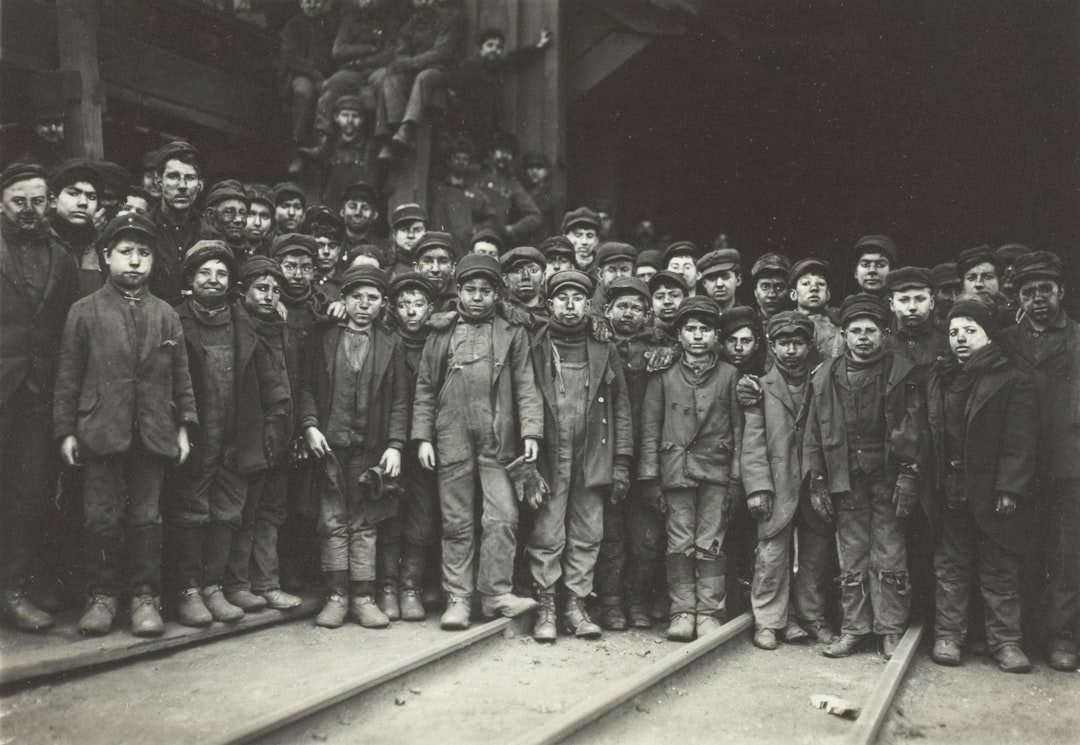
Photo by Art Institute of Chicago on Unsplash
…
Labor is prior to, and independent of, capital. Capital is only the fruit of labor, and could never have existed if labor had not first existed. Labor is the superior of capital, and deserves much the higher consideration.
| Abraham Lincoln, First Annual Message
…
Human beings, their projects and their institutions carve grooves into the future that structure the direction of change.
| John Fabian Witt, How to Save the American Experiment
Yet Another American Experiment
John Fabian Witt looks back to the turbulence of early and mid 1900s in America, and pulls out some threads that could presage a path forward for reclaiming democracy in the US:
As democracy in the United States spirals into a widening gyre of distrust, demagogy and violence, a question has been loosed in minds across America: How does this all end?
And the history lesson Witt delivers is uncannily mirror-like:
At the outset of the 1920s, a wave of attempted assassinations and political violence crested alongside new barriers to immigration, a campaign of deportations and a government crackdown on dissenting speech. America was fresh off a pandemic[1] in which divisive public health measures yielded widespread anger and distrust. Staggering levels of economic inequality underlaid a fast-changing industrial landscape and rapidly evolving racial demographics. Influential voices in the press warned that a crisis of misinformation in the media had wrecked the most basic democratic processes.
Even presidential elections eerily converge. In 1920, national frustration over an infirm and aging president helped sweep the Democratic Party out of the White House in favor of a Republican candidate offering the nostalgic promise of returning America to greatness, or at least to normalcy. A faltering President Woodrow Wilson gave way to Warren Harding and one-party control over all three branches of the federal government.[2]
Yet what is striking about the 1920s is that, unlike the German interwar crisis, America’s dangerous decade led not to fascism and the end of democracy but to the New Deal and the civil rights era. Across the sequence of emergencies that followed — the Great Depression and eventually World War II — the United States ushered in an era of working-class political empowerment and prosperity. The nation ended Jim Crow in the South and established free speech with court-backed protections for the first time in its history.
What series of steps led from Harding’s repressive heyday to FDR’s New Deal and Johnson’s civil rights legislation? The story involves a cast of people, many totally unknown to me.
Charles Garland was a scion of the Garland family, who was a VP of the First National Bank of New York -- whose inheritance funded dozens of non-profit organizations and activists, like Upton Sinclair and the ACLU, via the American Fund for Public Service, or the Garland Fund.
Dozens of ambitious 1920s start-ups received precious incubator funding. Beneficiaries included heterodox unions, innovative publishers and media outlets, as well as iconoclastic civil rights organizations. The fund sponsored research, education and news sources that would be outside the influence of the wealthy few. It supported Black civil rights, helping to start the campaign that culminated decades later in Brown v. Board of Education.
The fund eschewed demoralizing cycles of outrage at the oppressions of the age. It aimed instead to renew the fundamental institutions that shaped everyday people’s lives, structured their interests and animated their dreams.
Above all, this meant supporting an emerging new model of economic organization — the industrial union — as a novel way to connect large numbers of Americans to power and prosperity in the mass-production economy.
One of the many figures I learned about in Witt’s essay was Sidney Hillman, a Jewish political refugee, who was a founding influence in the Amalgamated Clothing Works union, and who advocated for large union organizations collecting together various trades and occupations, unlike the older guild-style unions. John Lewis used that approach for the United Mine Workers, as the first recipient of a Garland Grant.
Soon, with Hillman’s influence, bands of fund-supported labor intellectuals and organizers emerged to spread the gospel of the industrial union to fast-growing sectors of the economy, such as automobile manufacturing, electrical work and rubber production. By the middle of the 1930s, the industrial union project would even take on the mammoth steel industry.
The industrial union holds lessons for organizing a decent economic order in our own very different time. Here was an institution tailored by Hillman and his brain trust to match the economic conditions of the moment and to marshal the interests of the working class in the service of a common project.
Along with that shift of scale, Hillman championed a break with the prevailing left attitude of a war against capitalism, and reënvisioned the goal of unionization with
labor as an equal partner in the joint activity of the industrial firms with which it entered into collective bargaining arrangements. Labor, as Hillman’s group saw it, was entitled to both a decent share in the prosperity of the mass-production economy and a role in the economy’s direction. Industrial democracy, not class warfare, was their powerful watchword.
The catastrophes of 1929’s stock market crash, the Great Depression, and World War Two ‘supplied the energies propelling change in a country of 130 million people’ [emphasis mine]:
If forces like economic collapse and war supply momentum to big social change, they don’t dictate the shape of history. Human beings, their projects and their institutions carve grooves into the future that structure the direction of change. In the United States, a set of social formations emerged around the core of the industrial union. Quietly sustained in its fledgling years by the era’s leading liberal foundation, the industrial union helped steer American democracy down better pathways into the future.
Witt wonders about our time:
Where are the parallels to the deeper, more innovative efforts of a century ago, the experiments that aimed to go to the heart of our social life and create new institutions for a more decent and democratic future? Where are the new organizational forms for connecting great masses of Americans to one another and to the society in which we live? Where are the movements that promise to craft new institutions adequate to the task of aligning the people’s interests with the structure and scale of the contemporary world?
He answers his own question [emphasis mine]:
What American democracy needs now is grand experiments like those of a century ago: new institutional forms that provide a way for tens of millions of increasingly alienated Americans to connect to one another and to the prosperity of the richest nation in the world.
Recent entrants to the field hold promise. Fierce debates, for example, between abundance liberals and the debt collective left reprise struggles of a century ago between prosperity unionists in the Hillman tradition and their left-wing opponents. Other plausible efforts wait in the wings. For parts of the economy like home health care and gig work, union bargaining by sector rather than by employer augurs a next-generation advance on the industrial unions of the mass-production era. Some forward-looking actors are trying to turn the end of affirmative action into an occasion for a new coalition united by class-based policies, in place of the race-based ones that generated bitter divisions among American working families.
Just as the Coolidge administration tried to eliminate the Garland Fund’s tax-exempt status, Trump and his minions are attacking liberal foundations and wealthy philanthropists like George Soros. But, as Witt highlights,
A century ago, in the forgotten history of a decade just barely out of living memory, we found pathways to a better place. The answer to how this all ends turns on experiments we have only barely begun to launch.
I am singling out sectoral bargaining as perhaps the most ambitious and far-reaching experiment. What if retail food workers (including gig delivery drivers) put aside store-by-store and company-by-company bargaining, and instead demanded sectoral bargaining simultaneously across Starbucks, Chipotle, McDonald’s, Olive Garden, Domino’s, and Five Guys? Instead of threatening to shut down a single coffee shop or chain, what if all retail food stores in Texas threatened to strike or a sectoral union actually shut down all restaurants in New York City?
Consider the breakthrough 2023 strike actions by the United Auto Workers, led by Shawn Fain, in the automobile sector and the concessions gained from Ford, GM, and Stellantis in the first trilateral strike in the union’s history. It was, in effect, a sectoral approach, involving 145,000 UAW members, and rejecting the company-by-company model that Walter Reuther established in the 1945-1946 strike against GM.
Imagine if a dozen or more large sectoral strike actions -- including industries not generally unionized, like knowledge workers -- all threatened to strike together, demanding a more democratic future, a seat at the table, and a slowdown of the AI wave threatening work?
As Lincoln pointed out, ‘labor is the superior of capital, and deserves much the higher consideration’.
Let’s work to regain Lincoln’s ‘consideration’ and a return to industrial democracy.
Factoids
Jobs are hard to find.
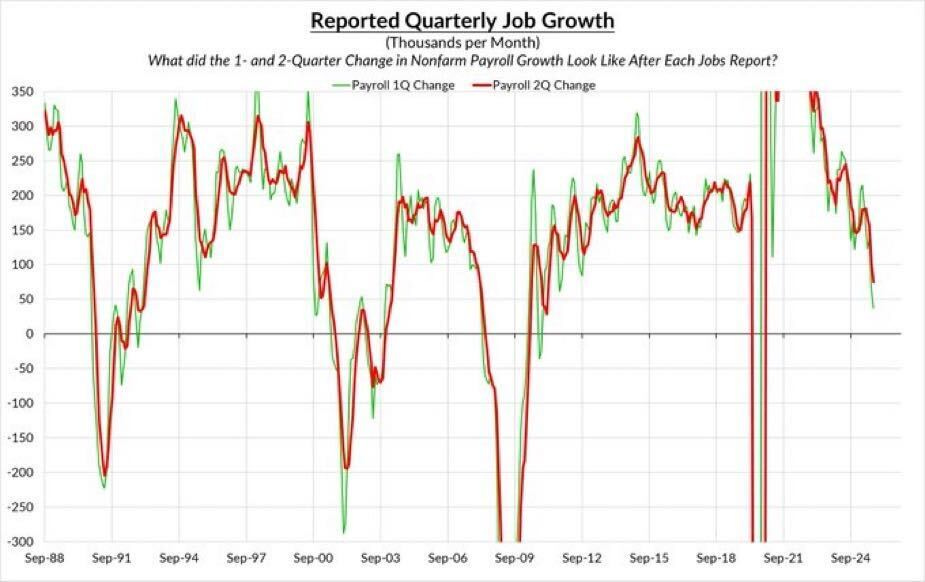
Reported 1-Quarter Job Growth Fell From 139k/month in June to 66k/month in July. Reported 2-Quarter Job Growth Fell From 156k/month in June to 102k/month in July.
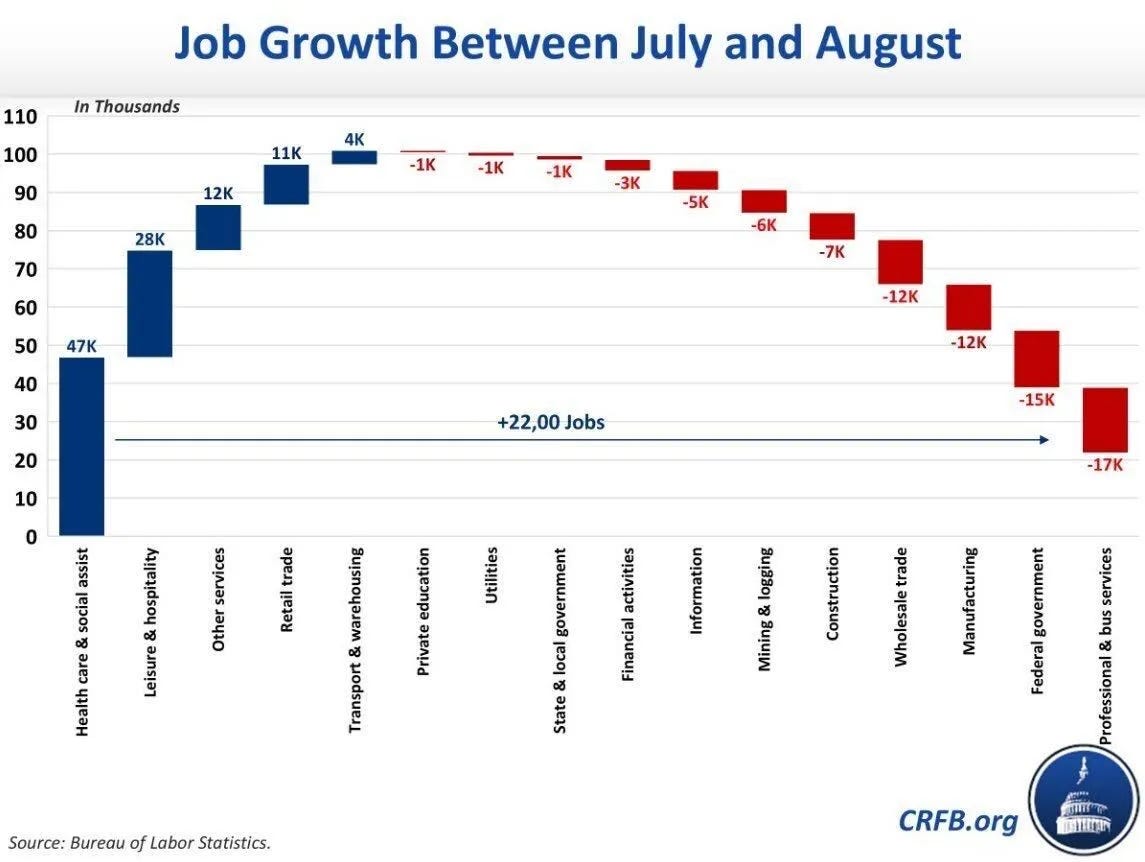
As reported by Campbell Ramble, ‘All job growth since July came from healthcare, leisure, and hospitality. White-collar employment is contracting. Professional services shed 17k jobs last month. The AI displacement isn’t coming - it’s here.’
Taylor Telford reports on job hunt sentiment:
Job seekers are feeling the worst about their prospects since 2013, when its Center for Microeconomic Data first started studying the trend. Job-finding sentiment plummeted by 5.8 percentage points in a single month to 44.9 percent in its August survey of consumer expectations.
This is a concerning trend, and now, even more federal workers are facing furloughs and job losses.
…
Worker empowerment is so 2023.
Dr Jean-Philippe Weisskopf, Philippe Masset, in Top 10 Hospitality Trends: What Shaped 2024 and What To Expect in 2025, report that the kid gloves are off [emphasis mine]:
Several signs indicate that the emphasis on employee empowerment is on the wane. Hospitality companies have reorganised and are now primarily focused on optimising performance. This trend is not unique to hospitality and reflects a broader return to pre-pandemic workplace practices. One example is the reversal of remote work policies by several companies, which signals a shift away from the flexibility and employee-centered approaches that gained traction after COVID-19. As reported in several studies, employees feel less valued at work and discouraged from participating in professional development. Employee engagement has suffered as a result. According to a Gallup poll, employee engagement in the U.S. dropped to a decade-low in 2024, with only 31% of employees feeling engaged. This trend is mirrored in other regions of the world as well.
…
Streetlights.
Cara Buckley, Danielle Amy explain Why Cities Are Putting Streetlights on a Dimmer:
In 2016, the American Medical Association warned that blue-rich LED streetlights suppressed melatonin and contributed to sleeplessness, poor daytime functioning and obesity, while also disorienting birds, insects, turtles and fish species that need darkness at night. Some research suggests that bright city lights worsen air pollution by hindering nighttime chemical reactions that clean the air.
Raise that point at the next city council meeting.