Federal employees are not ok | Don Moynihan
Guess what? Federal agency heads characterizing federal employees 'the enemy', trying to inflict 'trauma' on them, goading them to quit, and actively criticizing the goals of the federal agencies themselves leads to a highly disengaged workforce. And that, in turn, leads to poor service delivery. So says the Partnership for Public Service in a new report -- the Public Service Viewpoint Survey -- and it reveals a 'staggering collapse in employee engagement' at the federal government, as Don Moynihan lays out:
The headline figure is a government-wide Employee Engagement and Satisfaction Index Score of 32 out of 100. To put that in context: prior Best Places to Work scores, even at poorly rated agencies, rarely dropped below 50.
This is not a dip. It is a collapse.
The numbers are awful:
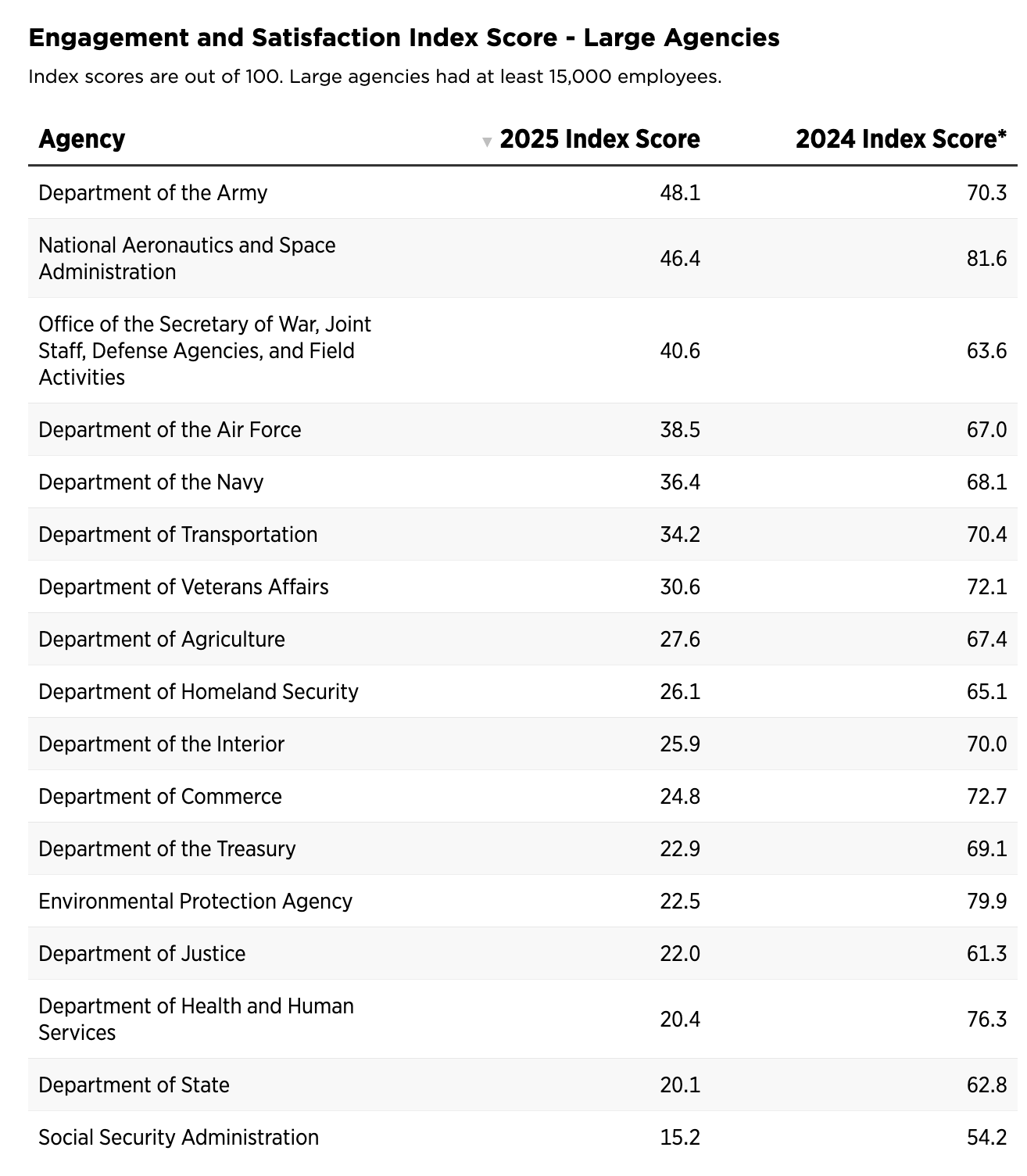
Here are the comparisons between 2024 and 2025 for larger agencies. The Department of the Army registered the highest score among large agencies — at just 48% out of 100 — with only 9% saying Secretary Pete Hegseth’s political team generates high levels of motivation. Every other large agency scored lower, some dramatically so. The average score by agency in 2024 is about 70% and 29.5% in 2025 — just over a 39 percentage point decline.
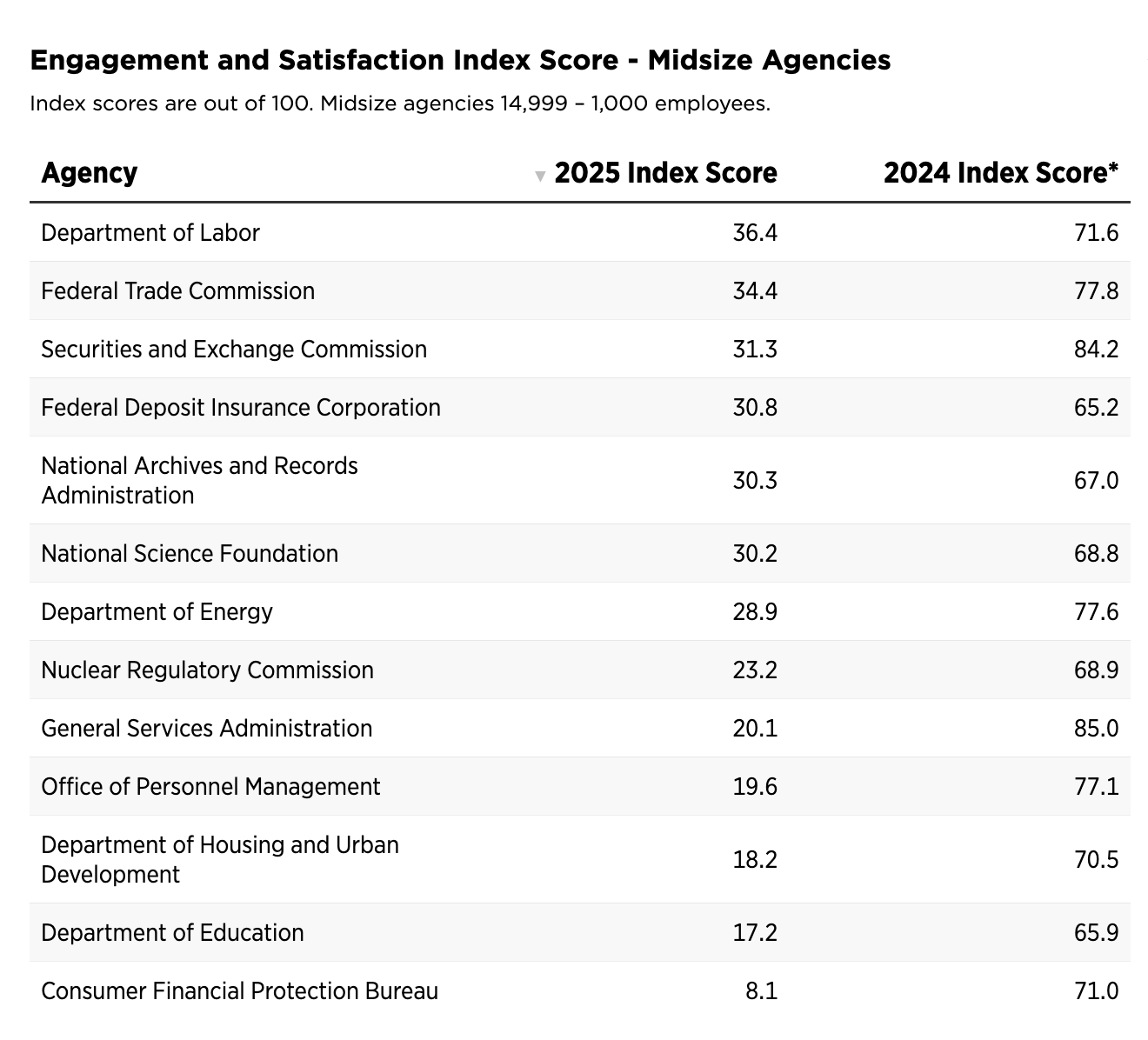
The picture at mid-size agencies is even worse. In 2024, the average score is 73% and in 2025 it is just over 25% — an astonishing 48 percentage point decline.
Of course, as in the private sector, poor engagement leads to lower productivity, higher churn rates, and worse service to clients. And for those in those jobs, it's like living in a psychic prison. It may take a decade for the federal government to recover from this crisis.
Elizabeth Linos of the Harvard Kennedy School, comments on the survey results:
By any historical measure, the new data released yesterday by the Partnership for Public Service is documenting the worst employee engagement and workforce sentiment I’ve ever seen for the federal government. To put this into perspective: in a typical year, agencies work hard to get their engagement scores from the high 60s to the mid-70s or even into the 80s (if you’re NASA). This year, the average is 32. No federal agency is a “best place to work” at this point.
body
Imagine you inherited a large, complex business. You don’t have time to run it yourself, but you recognize its importance. So you hire a management team. They promise to cut costs and boost productivity. A year later, costs are higher than ever, services look worse, and employees are leaving in droves. Those who remain say morale has never been lower.
That, in a nutshell, is what is happening to your federal government right now. A new data point shows just how bad things have gotten:
➡️ Federal employee engagement and satisfaction is only 32% and more than 58% of employees say they are less engaged than they were last year
➡️ Only 7.5% of survey respondents agreed that political leaders generate high levels of motivation for the federal workforce
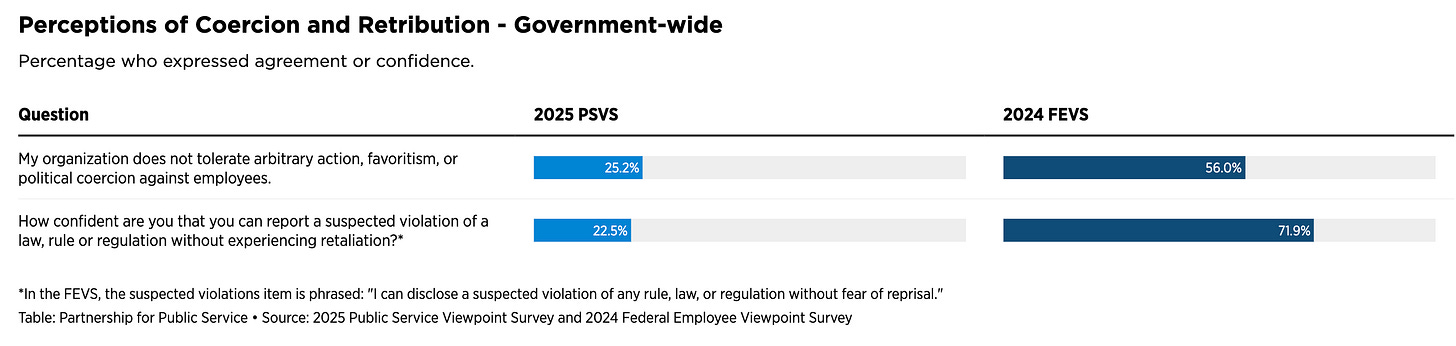
➡️ Only 1 in 4 employees believe they can report wrongdoing without retribution
➡️ 36.5% of the federal workforce say their work unit provides worse quality services compared to last year
All of these metrics are going not just in the wrong direction but sinking like stones.
It's worth taking a moment to explain the survey before I unpack the results. Every year, the Partnership for Public Service — a nonpartisan nonprofit whose core mission is making government work — publishes a ranking of the best places to work in the federal government, based on employee surveys. Historically, they worked directly with the U.S. Office of Personnel Management (OPM) who collected and shared data from the Federal Employee Viewpoint Survey (FEVS). This occurred consistently across four administrations — including the first Trump term — and was a widely accepted measure of which agencies were functioning well or poorly.
Last August, OPM canceled the 2025 survey entirely, despite it being required by law. Officials promised to bring it back eventually. But it is hard to ignore the timing: in the year of the most aggressive campaign against federal employees ever, the Trump administration simply chose not to ask those employees how they were doing.
The Partnership pressed on. It designed and administered its own version — the Public Service Viewpoint Survey — collecting responses from 11,083 current federal employees. It complemented this analysis with qualitative focus groups of employees, from which I will quote from below.[1] The results, released this week under the title Federal Public Service in Peril, are extraordinary.
A staggering collapse in employee engagement
The headline figure is a government-wide Employee Engagement and Satisfaction Index Score of 32 out of 100[2]. To put that in context: prior Best Places to Work scores, even at poorly rated agencies, rarely dropped below 50.
This is not a dip. It is a collapse.
Here are the comparisons between 2024 and 2025 for larger agencies. The Department of the Army registered the highest score among large agencies — at just 48% out of 100 — with only 9% saying Secretary Pete Hegseth’s political team generates high levels of motivation. Every other large agency scored lower, some dramatically so. The average score by agency in 2024 is about 70% and 29.5% in 2025 — just over a 39 percentage point decline.
The picture at mid-size agencies is even worse. In 2024, the average score is 73% and in 2025 it is just over 25% — an astonishing 48 percentage point decline.
Elizabeth Linos is the Emma Bloomberg Professor of Public Policy and Management, and Faculty Director of The People Lab at the Harvard Kennedy School, which focuses on government employees and performance. It is hard to think of anyone more qualified to comment. She wrote the following:
By any historical measure, the new data released yesterday by the Partnership for Public Service is documenting the worst employee engagement and workforce sentiment I’ve ever seen for the federal government. To put this into perspective: in a typical year, agencies work hard to get their engagement scores from the high 60s to the mid-70s or even into the 80s (if you’re NASA). This year, the average is 32. No federal agency is a “best place to work” at this point.
A record of leadership failure
If the engagement numbers are at a record low, the assessment of federal leadership is even worse. At Health and Human Services — which had been a top-five agency in prior years — only 2.6% of employees said Secretary Robert F. Kennedy Jr.’s political team generates high levels of motivation. At Treasury, just 6.6% said the same of Secretary Scott Bessent’s team. At DHS, 8.9%. These are not unfavorable ratings. They are near total rejections.
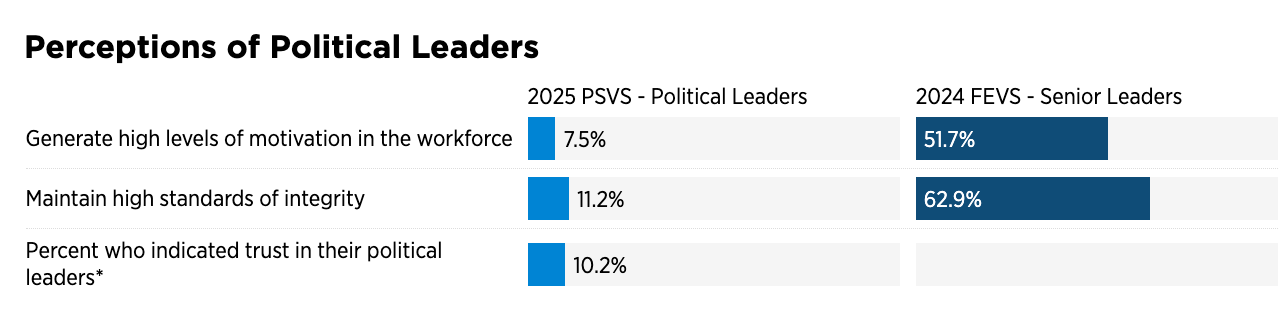
*This question was not asked in the 2024 FEVS. Those who indicated trust answered a 6 or greater to the question "On a scale from 0 to 10, where 0 means ‘no trust at all’ and 10 means ‘completely trust,’ how much trust do you currently have in each of the following people or groups?"
Will any agency leaders will be called before Congress to explain why their workforces feel leaderless and under siege? Probably not. This is a Congress that has shown little appetite for protecting even its own institutional prerogatives, let alone protecting the government workforce.
Republicans have long favored the argument that government should be run more like a private business. It is a fair question to turn back on them: what private organization, having presided over a collapse of this magnitude would be considered well-managed? What board of directors would look at these numbers and declare the strategy a success?
A demoralized workforce is not an effective one
Over the last couple of years, reporters have sometimes asked me how the public will see the effects of politicization and cuts in government capacity. The answer is sort of unsatisfying because it is hard to connect a specific personnel decision to a specific outcome. But I usually say:
- look for measurable declines in metrics of service provision for agencies that have direct interactions with the public (veterans services, IRS, TSA, Social security) and
- gaps becoming apparent during an emergency or after a scandal or undeniable failure.
The Iran war is exposing some of those gaps. The State Department and FBI have shed employees with specialized expertise on Iranian energy and counterintelligence. Those employees might be useful right about now. The Department of Defense gutted the office working on civilian casualty minimization — a fact became newly salient following a U.S. airstrike on a girl’s school in Iran.
Another way of assessing performance is to ask the federal employees if they are able to deliver. While these assessments are subjective, they offer insider knowledge from non-political actors and I think they are credible enough that I’ve used them in peer-reviewed research. And the federal employees closest to the work are telling a very different stories from the Trump appointees who insist that everything is fine.
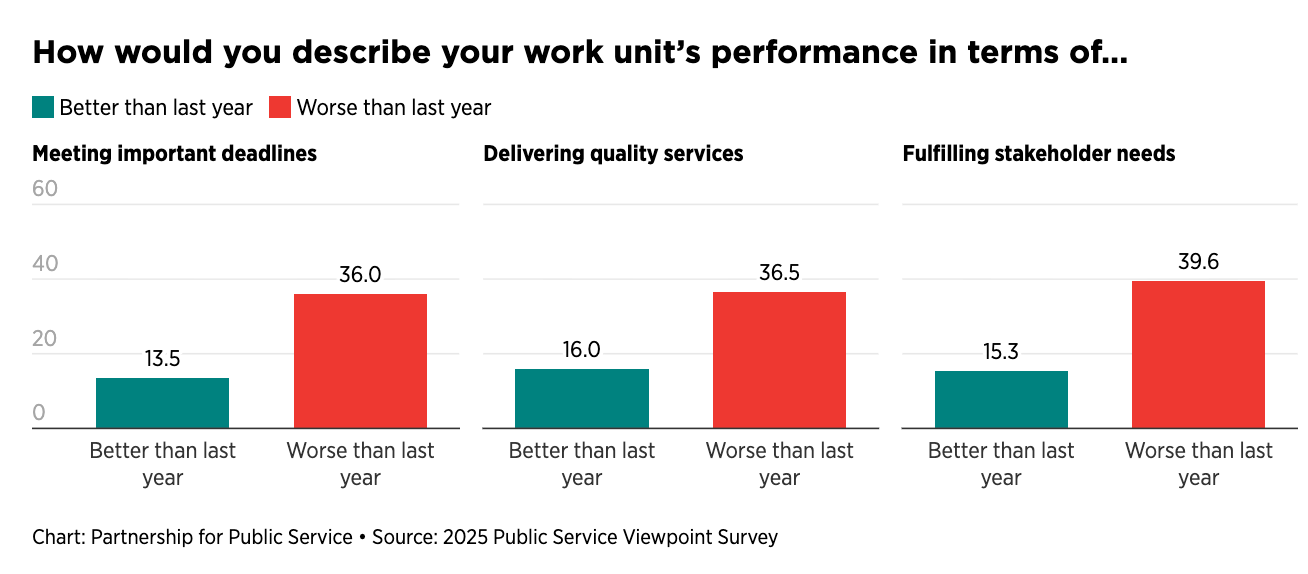
A decimated workforce is less able to produce. So too is a demoralized one — especially when that work depends on expertise, judgment, and institutional knowledge that is hard to measure and impossible to mandate. From Elizabeth Linos:
And all the evidence tells us the same thing: an engaged workforce is critical to effective service delivery. When engagement collapses, performance follows. Under these conditions, it’s hard to see how we sustain services in the near term—let alone rebuild a functional public sector over time.
The President of the Partnership for Public Service, Max Stier, agrees:
Significant research, including our own, has shown that when employee engagement suffers, our government’s ability to provide essential services to the public declines. No government can serve or protect the public effectively with such rampant dysfunction.
There is a well-established body of research on what scholars call “public service motivation” — the idea that many government employees are driven not primarily by pay, but by a genuine commitment to public service.[3] That motivation is a powerful predictor of recruitment, retention, satisfaction, and performance. It is also fragile. For example, one of my most cited research pieces pointed out that such motivation declines as employees get older, with the implication being that public organizations need to work actively to maintain one of their very few advantages over the private sector by rekindling the desire to serve.
Over the past year, the opposite has happened. Federal workers have been publicly characterized as the enemy. The Office of Management and Budget director stated explicitly that the goal was to “put them in trauma.” By this metric, the Trump administration is succeeding, but their desire to traumatize the federal public service runs directly at odds with the public interest in a competently run government.
Agency heads have actively opposed the core missions of the agencies they lead. A generation of newer employees has largely disappeared, while decades of institutional knowledge walked out the door every time experienced hands decided they simply had enough.
If you know people who work in federal government, none of this is surprising. The survey results are consistent with their accounts, consistent with the mass exodus of employees, and consistent with the open letters that workers across multiple agencies have published to raise the alarm about conditions inside their institutions.
An IRS employee described work conditions as “The beatings will continue until morale improves.” A Department of Education employee shared:
I’m a combat veteran and if I had to choose to relive this past year or go back to a combat zone, at this point, I think the combat zone would be a lot easier to deal with.
A scared workforce is bad for accountability
Another factor that jumps out from the survey is the growing pattern of politicization. Federal employees were already concerned about whether they can report wrongdoing without fear of retribution. This has gotten even worse. Only 1 in 4 employees now feel their organization doesn’t tolerate arbitrary action or political coercion. Roughly 3 in 4 employees no longer feel safe reporting suspected legal or regulatory violations.
An IRS employee said:
I’ll be honest, [at the] political level, I have minimal confidence that if we reported anything, any misbehavior, that it would be taken care of. In fact, quite honestly, I would fear retribution if we reported an ethical violation of a political level person in the IRS. I would do it anonymously. I’d probably do it through the union. I would not do it through the normal channels.
A Customs and Border Protection employee echoed this point:
I can tell you actively nothing happens [when incidents are reported]. The management above is too scared to do anything. And I mean raise it up, say anything about the incident, have a conference to air out the issue. It’s truly a dead silence, full stop. No one’s going to do anything. And that’s on low-level stuff. On high-level stuff, you might as well be talking to a brick wall for all the answer or response you’re going to get.
These are your employees
In any large organization of millions of people, you will find poor performers. That is true in government as it is everywhere. But the federal workforce, on the whole, is composed of people doing their best under increasingly difficult circumstances to keep the machinery of government functioning. Many of them are extraordinarily talented individuals who could have earned far more in the private sector and chose not to, because they believed in the work.[4]
They are not your enemies. They are not the deep state. They are your employees — funded by taxpayers like you, delivering public services to the people like you. We have a profound interest in ensuring that those employees are capable, supported, and motivated to do their jobs well. What is happening right now is the opposite of that. The data is no longer anecdotal. It is right there: 32 out of 100. And the consequences, when they fully arrive, will not be popular and will not be easy to reverse — regardless of which side of the political aisle you sit on.
A note on methodology for the survey. Any survey of this kind carries limitations. Because the Partnership did not have direct access to employee listservs, the survey was distributed via “federal unions and professional associations, also distributed links directly to the survey via direct email messages and newsletter placements to their mailing list.” The process did ask employees to provide verifiable email addresses and demonstrate some knowledge of their organization to limit non-employees from participating. Some selection effects likely occurred. But those effects cut in competing directions. Unhappy employees may be more willing to speak up but employees most afraid of losing their jobs are probably less likely to respond at all. And the most demoralized workers have already left government and aren’t being counted. Partnership CEO Max Stier made the point directly: the survey was conducted after the vast bulk of departures had already occurred, meaning the results likely understate the full damage. Most critically, the sheer scale of the collapse far exceeds anything recorded during the first Trump administration — which makes it very difficult to dismiss the responses as mere partisan noise among left-leaning bureaucrats. The results also pass the smell test. Agencies that have seen the worst attacks appear to have the lowest morale. For example, the CFPB, where employees have been told to do nothing while the administration tries to fire them, has an engagement score of 8%, down from 71%. On the whole then, my view is that this is a serious effort to capture the current mood of federal employees in the context of a federal government that does not want to make that possible. Anyone who chooses to dismiss the results, rather than call for OPM to reinstate a credible version of FEVS, is ultimately excusing the Trump administration covering up the evidence of its failures. You can read more about the methods here. ↩︎
This is based on agreement with three statements: I recommend my organization as a good place to work; Considering everything, how satisfied are you with your job?; Considering everything, how satisfied are you with your organization? ↩︎
vocational awe, again. ↩︎