China's Tariff-Defying Export Boom Leaves Its Factory Workers Behind … | archive.is
body
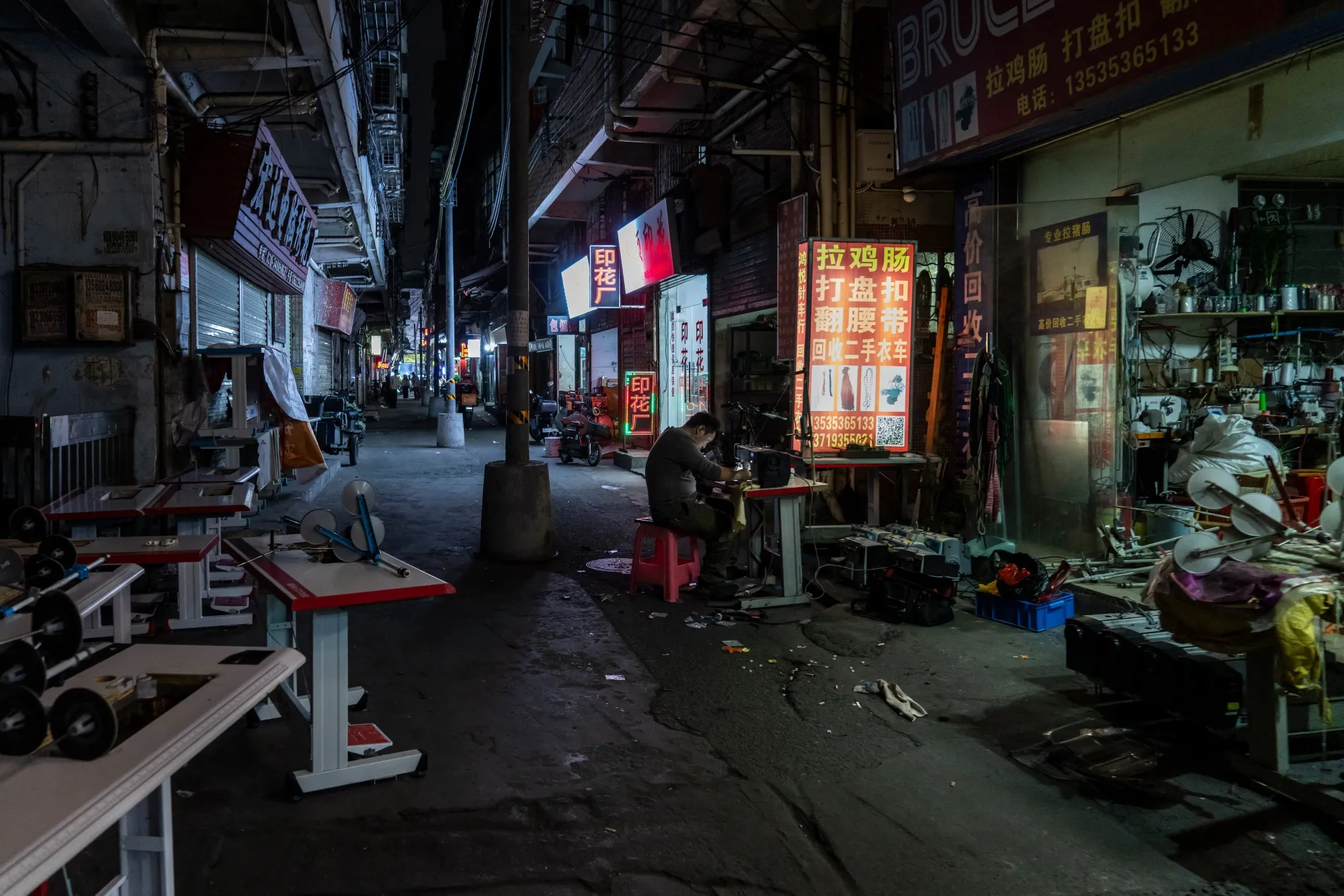
China’s sprawling Guangdong province has long been the main engine driving the nation’s manufacturing prowess. Photographer: Qilai Shen/Bloomberg
By Bloomberg News
Updated on
Along a stretch of shopfronts in downtown Guangzhou, dozens of middle-aged day laborers linger in the winter chill, waiting for agents from nearby factories in southern China to offer some work.
For Sheng, 55, the goal is simply to earn enough to eat and pay rent: His income more than halved to less than 100 yuan (around $14) per day over the past few years. “Some people can’t find work for months,” said Sheng, who asked to use only his surname. “People are here looking for jobs 24 hours a day.”
The group immediately swarmed one factory manager who pulled up on an electric scooter. She offered 20 yuan an hour to sew trousers — less than half the federal US minimum wage — and quickly found a few takers. “Last year was the worst since I joined the industry a decade ago,” said the manager, who asked to be identified by her surname Yuan. Her clothing company made a loss for the first time in 2025, and profit margins dropped to less than a single yuan per item.
President Xi Jinping’s increasingly powerful export machine stunned the world last year by generating a record $1.2 trillion trade surplus even after US counterpart Donald Trump raised American tariffs to the highest in nearly a century. Leaders from Europe to South America have warned that unstoppable Chinese exports threaten to decimate local industries.
Official data on Tuesday showed Chinese exports surged almost 22% from a year earlier in the first two months of 2026, an increase that was more than expected and resulted in a record trade surplus for the period.
Chinese Exports Moving Up the Value Chain
High-tech products lead growth; traditional labor-intensive sectors lag
Chinese exports of batteries
Passenger cars
Integrated circuits
Apparel
Toys
Furniture
Source: China's General Administration of Customs
Yet in China’s sprawling Guangdong province, long the main engine driving the nation’s manufacturing prowess, ordinary workers have seen a sharp decline in their living standards. Interviews with some two dozen workers and business owners painted a bleak picture of falling salaries and disappearing jobs.
For the ruling Communist Party, the disconnect between China’s strong exports and strained households is a warning after Xi devoted years to pivoting his economy toward high-end manufacturing, a mission reinforced at this month’s annual parliamentary meetings. Future technologies such as batteries, cars and chips — deemed essential for competing with the US — are taking a larger share of exports, but those products are less labor intensive.
Perhaps more alarming for global trade, the trend only appears set to get worse in the short term as an explosion of AI and robotics spawns so-called dark factories that require no human workers. As AI fears spread, Guangdong provides a cautionary tale of the bumpy path to what could be either a new era of abundance or the dystopian future outlined last month in the Citrini Research report that rocked global markets.
Day laborers looking for jobs in garment workshops and recruiters carrying samples of work mingle on the major thoroughfare in Datang, Guangzhou, in February.Photographer: Qilai Shen/Bloomberg
Day laborers looking for jobs.Photographer: Qilai Shen/Bloomberg
Some workers in Guangdong blamed the wreckage on US tariffs that peaked at 145% last year, along with Trump’s elimination of duty-free perks on small parcels. Others cited domestic price wars as driving wage decline, worsened by a rise in robots replacing human labor. Few expected things to improve anytime soon.
“These days, even the food in the factory canteen is made up mostly of vegetables with only a tiny bit of meat,” said Chen Cuilian, a 42-year-old mother-of-two at a factory in Guangzhou, who spends 12 hours a day behind a sewing machine, with only Sunday evenings off. Her salary plunged by 40% to around 6,000 yuan during the trade war.
Goldman Sach's China Wage Tracker Hovers at Record Low
The bank's measure of wage growth fell to the worst outside Covid in 2025 3Q
Covid
Source: Goldman Sachs Research
Employment data in China is politically sensitive, with the official jobless rate and income statistics often failing to capture the full picture. But even a recent central bank survey showed the problems with more than half those polled considering it “difficult” to get jobs in the third quarter of last year, a record high since data began in 2011. An alternative measure of China’s wage growth compiled by Goldman Sachs is hovering around the lowest level outside the pandemic in data going back to the beginning of the century.
Further masking the pain is gig work, which now accounts for about 40% of urban employment, leaving a large swathe of people without paid sick leave, medical insurance or holidays — benefits that underpin consumer spending.
If exports encounter headwinds, those protests “could erupt all at once on a larger scale,” said Xu, the Stanford scholar, adding that he sees the system getting “more and more fragile.”

Note: Each province and major city is shown on its own scale Source: Freedom House
Losing Streak
If Guangdong province was an independent country, it would be the world’s sixth largest exporter behind the Netherlands, having shipped some $880 billion in goods last year alone — more than any other Chinese region. Nowhere are the problems facing the nation’s legion of factories more apparent.
Long hailed as China’s largest provincial economy, Guangdong has now lagged the national growth rate for four straight years, an unprecedented streak. During a November visit, Xi indicated the slowdown was permissible, signaling top leaders don’t see a reversal of its fortunes anytime soon.
Part of what’s holding the province back is a half-decade-long crash in the housing market that once propped up factories and domestic demand. Property investment that accounted for 14% of Guangdong’s economy five years ago, is now contracting at a double-digit pace.
In Foshan — hometown of the failing real estate developer Country Garden Holdings Co. — the Cihai Ceramics Market shows the slowdown. Once one of the world’s biggest ceramics markets, spanning some 300,000 square meters and bustling with trucks and crowds of international buyers, today its streets are almost deserted, with weeds growing through shuttered windows.
Empty and abandoned businesses at the Cihai Ceramics Market in Foshan.Photographer: Qilai Shen/Bloomberg
One ceramic tile company owner, who asked not to be identified discussing the economic downturn, said his company’s sales had more than halved between 2023 and 2025, leading him to fire 180 workers — roughly four-fifths of his staff.
To survive, he pivoted to exports, selling to Southeast Asia and the US. But profit margins are so low it’s only enough to prevent workers from “starving,” he said. New factories in Vietnam — many invested in by peers using second-hand equipment imported from China — now undercut Chinese firms’ prices by almost half on lower-end products.
As a price war takes hold, the average value per ton of Chinese ceramic exports shriveled by more than 40% last year from 2022, industry data shows. Just surviving would be a blessing, he said.
‘Intelligent’ Manufacturing
As countries climb the value chain, generally the manufacturing sector’s productivity rises and its absolute size shrinks, leading to fewer people being directly employed in factories. Usually, incomes rise from the productivity boost, allowing services to boom and absorb workers. In China, however, services are struggling due to limp consumer spending.
Greater automation will likely lead to even tighter purse strings. Citigroup economists forecast almost a third of jobs in China could be impacted by AI. Ride-hailing platforms that once absorbed millions of workers displaced from manufacturing, for example, could soon be eliminated by self-driving cars. “The same group of workers would face a second wave of tech-driven displacement,” they wrote.
The Chinese government has long pushed for the use of industrial robots, detailing ambitious plans for “intelligent” modern manufacturing more than a decade ago. Over 2 million are now installed in China, exceeding the combined total of all other countries, meaning production lines are using a fraction of the workers once needed.
The smartphone assembly line at Oppo’s base in Dongguan.Photographer: Qilai Shen/Bloomberg
Machines at Oppo can now make a phone from scratch in 12 hours.Photographer: Qilai Shen/Bloomberg
Inside smartphone maker Oppo’s base in Dongguan, southern Guangdong, long rows of machines hummed as only a few humans quietly moved around. Machines here can now make a phone from scratch in 12 hours, down from three days a decade ago when humans were at the helm. To assemble the printed circuit board — a key component — only six workers are required, compared to 20 before automation kicked in.
“It’s difficult to make the kind of product needed today with human labor, because the precision level required is so much higher,” said Grus Shan, director of manufacturing at Oppo. “The smallest component is as thin as a thread of human hair.”
Xi will throw a spotlight on China’s technological advances when he hosts world leaders — including Trump — at the Asia-Pacific Economic Cooperation summit in Shenzhen this autumn. Home to national chip champion Huawei Technologies Co., the high-tech hub has defied Guangdong’s broader slowdown thanks to its output of drones, industrial robots and 3D printers, which all surged by around 40% in 2025.
‘Mind Numbing’
The rise of robots didn’t just reduce the need for workers, it also contributed to factories employing more short-term staff, according to one study by Peking University professor Zhang Dandan. During peak order season, as many as two-thirds of human hands in main industrial hubs like Guangdong are now temporary, she found. This is because factories only need workers to perform low-skill manual tasks that aren't yet automated during peak order seasons.
Zhu Hankun, 28, recently joined the gig economy. After quitting a “mind-numbing,” low-paying job checking the quality of smartphone screens, he decided to try delivering food in Shenzhen, becoming one among thousands of delivery men buzzing around the tech hub on bikes.
Long hailed as China’s largest provincial economy, Guangdong has now lagged the national growth rate for four straight years.Photographer: Qilai Shen/Bloomberg
“At the factory, I worked 12 hours every day and repeated the same action like a machine. When I was off work, all I could do was sleep. I felt like I was wilting,” said Zhu, during the first day on his new job. He hoped to earn more but was realistic, as his wage will be based on the number of orders he gets.
“The past two years the economy has not been good,” he said, picking up a milk tea from a shop for delivery. Echoing a common refrain across Guangdong, he added: “It’s really difficult to make money.”
Back at the labor market, 59-year-old Dai is packing up after an unsuccessful day job hunting. Reflecting on China’s ability to grow exports last year, Dai said he didn’t feel the benefit. “We are just workers,” he added. “We don’t get rich.”
-- John Liu, Yujing Liu, Colum Murphy, Jessica Sui, Linda Lew, Annabelle Droulers and Allen K Wan.