Why Keeping Up with Change Feels Harder Than Ever | Kayla Velnoskey, Ingrid Laman, Carolina Valencia
body
Summary.
Leading through change is more difficult than ever because of the convergence of four factors: 1) not only is there a large volume of change, but changes are stacked, one on top of the other; 2) not only are changes happening faster, they’re continuous, without a start or end date; 3) not only are changes larger in scale; they’re interdependent; and 4) not only is change unpredictable, they’re externally driven by technology, geopolitical trends, and more. Gartner calls this “ungovernable change,” and has found that instead of coaching employees through each needed change, the most successful leaders are routinizing change, or treating it as an everyday business process.
“Chaotic.” “Disruptive.” “Uncontrollable.” “Defeating.”
The words we hear leaders use to describe change today are troubling. While executives are accustomed to leading change in complex environments, we’re seeing even experienced leaders struggling. The typical approach of inspiring employees with an aspirational vision of the future is no longer working.
The reason is because change itself keeps changing in ways that cannot be fully controlled by leaders or their organizations. At Gartner we see this as the convergence of four factors:
- Not only is there a larger volume of change, but changes are stacked, with one happening on top of another.
- Not only are changes happening faster, they’re also continuous without a clear start or end date.
- Not only are changes larger in scale, they also have multiple interdependencies, such as one technology implementation failing to properly integrate with another.
- Not only are changes unpredictable, they’re externally driven, with impacts coming from all sides: technology, politics, economic uncertainty, societal trends, and more.
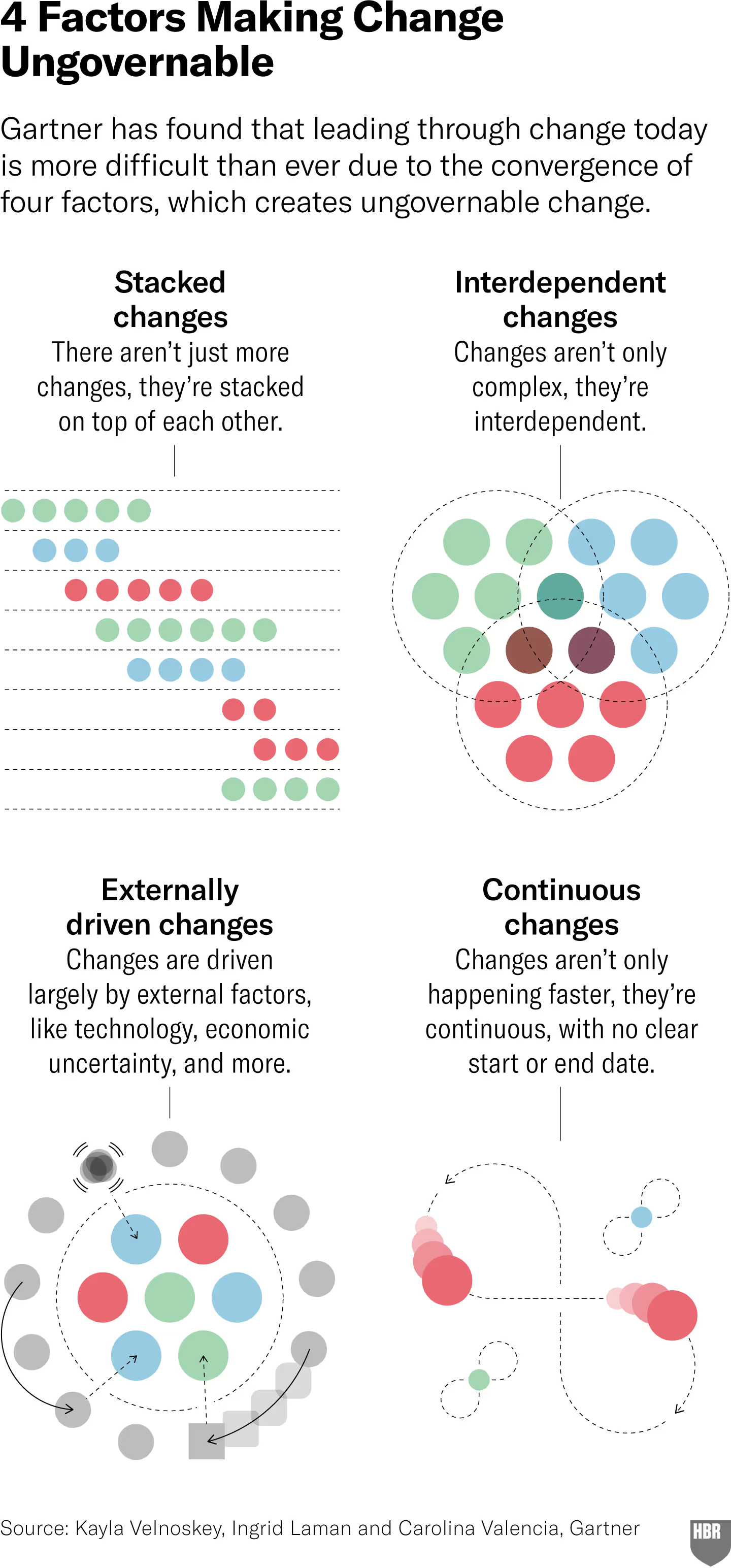
We call this “ungovernable change,” and in this environment, leaders are struggling to drive needed transformation. A March 2025 Gartner survey of more than 980 global leaders found that only 32% of mid- to senior-level leaders were able to implement their last change initiative on time while maintaining employee engagement and performance.
Leaders are managing ungovernable change at a time when their employees are increasingly skeptical of their efforts: 79% of the 2,900 global employees surveyed by Gartner in April 2025 don’t trust their organization’s ability to change effectively. The majority believe that their organization has made poor change decisions in the past and are unlikely to be successful in the future.
Amid this distrust, Gartner research found that the most successful leaders prepare employees to navigate ungovernable change by routinizing change—treating it as an everyday business process.[1] Leaders who routinize change acknowledge constant transformation is the norm. They embrace an ongoing responsibility to equip employees with well-practiced change skills that feel second nature and the right mindset they need to embrace ongoing change.
Successfully routinizing change means adopting the following three strategies:
Communicate that change is a journey, not a destination.
Traditionally, leaders have looked to inspire change by focusing on the desired outcome and the benefits it will bring. But employees who don’t trust the organization’s ability to change no longer believe that this vision will become reality.
Today’s successful change leaders acknowledge that transformation is a journey without a clear path—or even a fixed destination. Instead of promoting the benefits of changing, they create urgency by highlighting the risks of inaction. They reinforce the value of making progress by clarifying that consistent small wins on the change journey are the metric of success.
Finally, they share transparently but focus communications to maximize employees’ ability to absorb information. For example, at one U.S. bank, leaders are encouraged to use the following questions to guide their employee messaging:
- Why is the change occurring?
- Who is impacted by the change?
- What is the link to other changes?
- How could this change impact employees?
Leaders at the bank also carefully pace how they talk about change. If a team is not directly impacted at a given moment, that team’s leader will share stories about changes occurring across other parts of the business. This shows employees that they are a part of a continually transforming organization without overloading them with non-actionable information.
Enable change-ready employees, not change enthusiasm.
Leaders typically encourage change by building enthusiasm and providing support, such as tools and resources, for each initiative. However, treating change as a special occasion and building excitement for an individual event does not align with today’s reality.
Enabling employees to thrive in ungovernable change is all about helping them build the right mindset and practice change skills until they are second nature. This helps them become ready to embrace any change at all times.
Navigating change is an emotional journey. While historically leaders may have tried to help employees overcome discomfort by promising that benefits will outweigh costs, in the era of ungovernable change, employees need to become comfortable with discomfort. This requires leaders to help employees regulate their emotions.
A large pharmaceutical company wanted to help their employees understand the source of their negative responses to change. They developed a tool for leaders, built around existing frameworks, such as David Rock’s SCARF model(see[2].], to help them understand and respond to employee concerns about change. For example, a leader could use this tool to discover that an employee’s pushback on a certain process automation isn’t really about whether the new process is effective or not; the employee is actually worried that their expertise will no longer be valuable. Uncovering this allows the leader to provide reassurance, such as, “We will still count on your expertise to help us improve the new process.” The new process may still be uncomfortable for that employee. But when they understand why they feel uncomfortable, they’re more likely to be able to move forward with change despite their discomfort.[3]
Once employees are willing to move forward with change, they also need the skills to adapt. Leaders who routinize change build what we call “change reflexes.” These are core skills that are applicable to multiple change scenarios and have been practiced with enough repetition that they become intuitive.
Gartner research has identified six core change reflexes:
- Being open to new experiences
- Effectively managing time
- Understanding the context in which the business operates
- Using technology effectively
- Working well with anyone, regardless of prior experience
- Regulating emotions
The best time to practice and build these change reflexes is in the course of everyday work. For example, a financial services company helps leaders identify coaching opportunities—what they call “micro-moments of change”—tasks and activities that resemble employees’ experiences during significant changes. These micro-moments occur frequently enough for regular practice under less stressful conditions, creating the right conditions for building change reflexes. For example, a leader who sees their team struggling to effectively manage time might find a natural opportunity to ask employees how they would adjust a timeline to address new priorities.
Foresee multiple possible scenarios, not just the current change.
Change leaders know to expect the unexpected, but leaders who routinize change take this foresight one step further. They don’t just use their business acumen and visionary thinking to scenario plan; they empower employees to analyze and prepare for how likely future scenarios would impact the team.
To help leaders build their team’s foresight and business acumen, one financial services organization gives leaders a context-sensing exercise to use with their teams. Leaders first identify potential external triggers, such as artificial intelligence or regulation, that may cause a change for the organization. Next, they assign employees to ~learn~ research the trigger and teach the team about what they learn. As a group, the team discusses likely future scenarios and the skills they’ll need to respond. Over time, this helps employees more intuitively understand changes that may be coming and the skills they need to build to help them adopt a wide variety of future changes.
. . .
Normalizing ongoing change and building employees’ change reflexes means that when change changes—as is inevitable during this era of ungovernable change—employees will have a more intuitive understanding of what to do next. Rather than waiting for guidance when, say, a software implementation reveals the need for a new process, employees with change reflexes can independently adapt, building new workflows as the change evolves.
By investing in employees’ change reflexes, leaders can better prepare their organizations for a future of ungovernable change, seeing change not as chaotic, disruptive, uncontrollable or defeating, but rather as a core capability that can be mastered like any other.[4]
Building it into the job, not as an additional project to take on. ↩︎
[00 journal/2026-01-26 The Power of Metaphors When Introducing Change Initiatives - Tanvi Gautam|2026-01-26 The Power of Metaphors When Introducing Change Initiatives - Tanvi Gautam] ↩︎
Except when the worker is correct, that their expertise WIL BE less valuable. ↩︎
Note that employees don't agree. ↩︎