Leaders, It’s Time to Build Your Tolerance for Uncertainty | Simone Stolzoff
2026-01-20 Leaders, It’s Time to Build Your Tolerance for Uncertainty - Simone Stolzoff#^19c0d2
Summary.
In today’s volatile business environment, leaders must develop uncertainty tolerance as a core skill. Here are three ways to do so: Anchor yourself in clear values and enduring priorities to give yourself stability when everything else is in flux; embrace experimentation, building to learn rather than over-planning; and reframe murky conditions as an opportunity for growth, rather than a threat, so you are able to row through the fog.
/summary
body
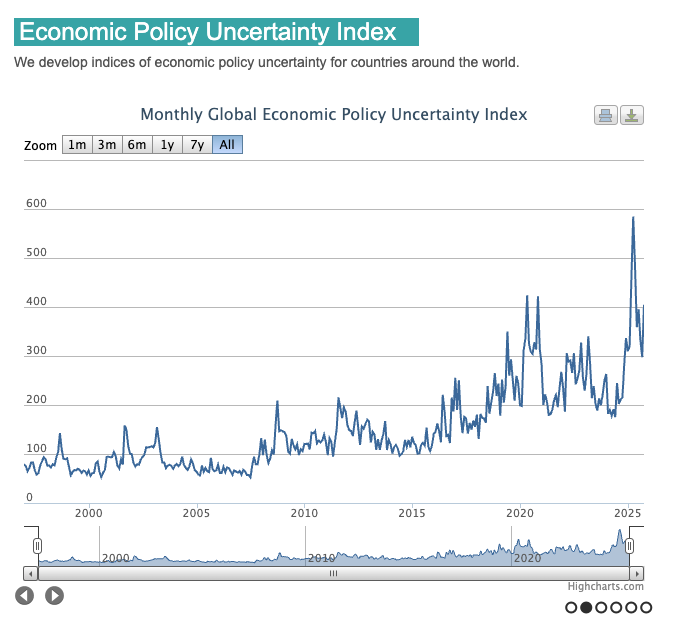
As we move into 2026, many leaders are fretting about the uncertain business environment. Given the transformational nature of AI, geopolitical instability, or economic disruption, it’s hard to plan for the future. According to an academic project that has tracked global economic policy uncertainty since the 1980s, the five highest measurements of uncertainty recorded since the study began have all come in the past five years. Mentions of uncertainty in Glassdoor reviews are up 80% year over year. And the word itself appeared in 87% of public earnings statements in early 2025.
It follows, then, that the ability to manage uncertainty—to tolerate it for long enough to discover possibilities waiting on the other side—is as important as ever. As OKCupid cofounder Sam Yagan put it, “The single biggest predictor of executive success is how you deal with ambiguity.”
For my new book on how to get better at dealing with the unknown, I talked to leading psychologists, economists, and philosophers about how to develop uncertainty tolerance. Here are three key principles.
Find Your Anchors
Certainty in some aspects of your life makes it easier to hold onto uncertainty in others. For a business leader, an anchor might be your company’s values or a commitment to serving a particular target customer. By clarifying the aspects of your business that will remain constant amidst all that is changing, you’ll be better equipped to navigate what lies ahead.
A telling example comes from Brian Chesky, cofounder and CEO of Airbnb. At the start of 2020, he was preparing to take the company public in what was predicted to be one of the largest tech IPOs ever, valued at over $30 billion. But, when the Covid-19 pandemic hit, the company lost 80% of its revenue, and the IPO had to be postponed.
Chesky knew this would be a period of unprecedented uncertainty for the company. So, one of the first things he did was create a list of four guiding principles for himself: Act fast, preserve cash, act with all stakeholders in mind, and play to win the next travel season.
In a crisis, “you make principle decisions, not business decisions,” he said, reflecting on what he learned. A business decision is “a decision predicting the best possible outcome. A principle decision is irrespective of the outcome.” These became Chesky’s anchors as he steered the company through 2020 to position it for success when the travel industry recovered. In December 2020, Airbnb went public, with a market capitalization of $86.5 billion after the first day of trading.
Build To Learn
When things feel uncertain, our first impulse is usually to plan. But especially in today’s fast-moving world, spending too much time planning can come at the expense of progress. At IDEO, where I worked as a design lead for four years, we used to have a saying: “Never come to a meeting without a prototype.” Low-fidelity experiments were our learning tools and kept us from doing too much talking before building and testing. Now, in the age of generative AI, this kind of work has never been easier.
A few years back, Danielle Feinberg, a visual effects supervisor at Pixar who I interviewed and saw speak on this panel, was feeling the uncertainty in her industry. Fewer people were going to movie theaters, budgets were being cut, and her team was being asked to do more with less. Amid the added pressure, her colleagues felt like they no longer had the space to innovate. But Feinberg had an idea for how to change that.
During the development of any film at Pixar, there are regular screening days with “the braintrust,” a group of top executives and creative leaders that leave the rest of the team in a holding pattern while they wait for feedback. Feinberg proposed treating those dead days as innovation days instead—an opportunity for people to work on whatever they wanted, even if it had no practical application, and then share what they made.
One team member had an idea for a technical hack that he had always wanted to try but “never had the time” for. He spent the day repurposing a piece of animation software, which eventually enabled the team to solve a problem in hours that had previously taken them weeks. Innovation day wasn’t designed to maximize productivity, but building led to learning, which led to progress.
Row Through The Fog
When we perceive uncertainty as a threat, blood flows away from the brain toward the body as we prepare to fight or flee. That’s why stressed-out leaders often double down on a fixed plan or shy away from their discomfort. But when we see uncertainty as an opportunity to learn, we enter what scientists call approach mode —our blood vessels dilate, sending more oxygen to the brain and allowing us to explore new ways of thinking.
Shaan Hathiramani, the founder of the startup Flockjay, a bootcamp to help people with nontraditional backgrounds get into tech sales, experienced this in 2021. While the company’s business was booming thanks to the shift to remote work and growing demand for salespeople, the team was also burning cash, beginning to burn out, and struggling with recruiting. Other leaders might have ignored these red flags, or worried about them so much that they ended up in a panic.
But Hathiramani leaned into the uncertainty of those mixed signals, thoughtfully considering whether to forge ahead into the boom or to recalibrate in light of emerging negative indicators. Following discussions with his team and board, he decided to change course, sticking to the same mission but shifting from running bootcamps to building software-based training solutions. Four years later, Flockjay has successfully transitioned to a B2B SaaS business.
“The uncertainty of the pivot could have been crippling,” he told me in an interview, “but the thing that made it bearable was falling in love with the problem as opposed to the solution…falling in love with the problem helped me keep going.”
His story reminds me of a metaphor I learned at IDEO. Being a leader is like sitting in a rowboat on a foggy lake. You can’t see far ahead or know precisely where you’ll end up, but you have two jobs: to maintain faith that you’ll eventually reach land and to keep rowing.
not just leaders. ↩︎